
LSA-1000
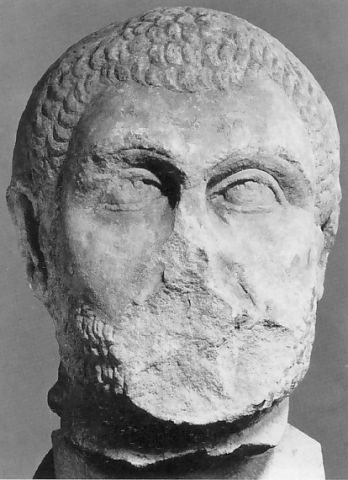
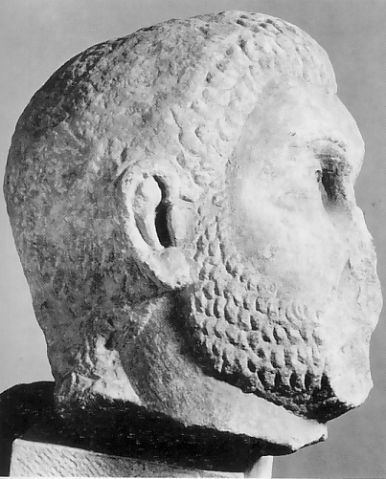
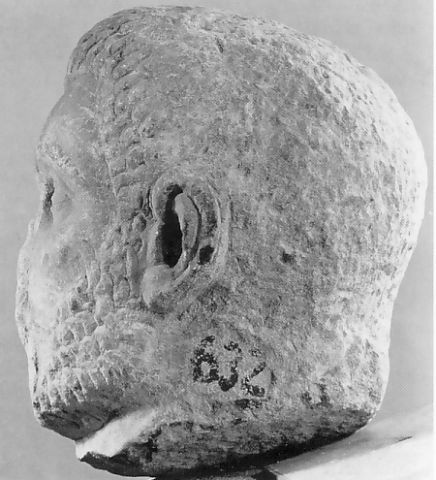
Portrait head of man with short-cropped hair and beard. From Durostorum (Moesia II). Earlier fourth century.
Record details
Photographs
Bibliography
- Alexandrescu Vianu, M. 'Portraits romains dans les collections de Bucarest', Jahrbuch des Deutschen Archäologischen Instituts, 110 (1995), 338-40, no. 35, fig. 35a-c
Discussion
DESCRIPTION (Object)
Marble portrait head of a male broken under chin, H 30 cm. Nose, mouth and chin are broken off, the left eye and eyebrow are chipped.
The hair is set off the flesh by a clear-cut line like a tight fitting cap. It is arranged in short lunular buckles separated from each opther by shallow chisel strokes; the beard is executed in the same technique. Both, hair and beard, have their buckles echeloned into regular rows.
The hair is executed only around the face; crown and back of the head are only roughly finished. This is the result of a late antique recut. In the back of the neck, there was a support ('Nackenbosse') now broken; it is still visible below the hairline in the right profile view.
The eyebrows are standing proud and are marked by short vertical chisel strokes. The iris is circumscribed by a thin incised line; the pupil is a dot standing proud at the upper lid, separated from the iris by a broad shallow chute.
The cheekbones are pronounced and on the left side the beginning of a marked naso-labial fold is still visible; otherwise the face is scarsely modelled.
PROVENANCE AND CURRENT LOCATION
The head is from Durostorum (modern Ostrov, Bulgaria). It was recorded in the National Museum of Antiquities in Bucarest, inv. no. MNA L 632, by Alexandru Vianu 1995 (on the history of this museum see Alexandru Vianu 1995, 278-9).
DESCRIPTION (Subject)
The portrayed is a mature man with dense hair that grows in a convex line into the brow. He is depicted with large open eyes and wears his hair and beard trimmed.
HONORAND AND DATE
The hairstyle, the large eyes and the eyes’ markings indicate a late antique date to the head. The bulky design and trimmed hair and beard, both set off the flesh, are characteristics of the portraiture already of the tetrarchic period. The scarse modelling and the convex hairline, together with the harmonized forms, however, point to a date in the later tetrarchic or Constantinian period.
The more than life-sized measurements of the head have been taken as an argument that it was imperial (Gramatopol 1985: Constantius Chlorus; Alexandrescu Vianu 1992: Licinius?). However, this is not cogent. As the portrait head of Dogmatius in Rome shows, recourses to tetrarchic forms were fashionable among imperial office holders of the Constantinian period (LSA 903, LSA 1266).
The head was dated to 260/80 by Bordenache 1958, followed by Covacef 1990. In our view, the typological and stylistic features indicate a date in the late tetrarchic or Constantinian period (earlier 4th century; see above).
Discussion references
- Bordenache, G., Correnti d'arte e riflessi d'ambiente su alcuni ritratti dell' Museo Nazionale di Antichità, Dacia. Revue d'archéologie et d'histoire ancienne. Nouvelle Série II, 1958, 267-80, 272-3
- Gramatopol, M., Portretul roman in România, București 1985, 177 no. 35 fig. 35
Cite: Last Statues of Antiquity, LSA-1000 (Ulrich Gehn).