
LSA-1001
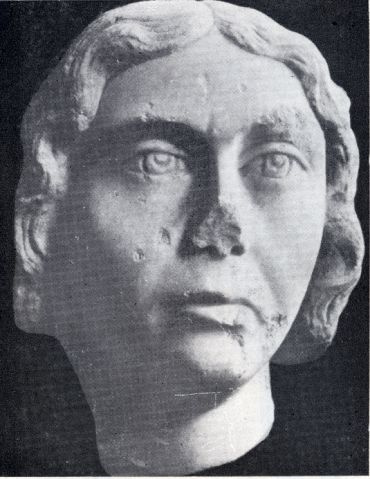
Portrait head of woman. Constantia (Tomis) (Scythia). Mid third to early fourth century.
Record details
Photographs
Bibliography
- Canarache, V. & A. Radulescu, Adamclisis Cetatea (Muzeul de Arheologie Constanța), Constanța 1968, p. 42
- Covacef, Z. 'Porträts aus dem 3. Jahrhundert u. Z. in Scythia Minor', Wissenschaftliche Zeitschrift der Humboldt-Universität zu Berlin. Reihe Gesellschaftswissenschaften, 31, Berlin 1982, 174-5, no. 3, fig. 27
Discussion
DESCRIPTION (Object)
Female portrait head of large-grained white marble, broken at neck; H (total) 27, H (head alone) 22 cm.
The tip of the nose and the braid at the top of the head are missing, and there are minor chips in the brow and cheeks.
The hair is parted over the centre of the brow and falls in long waves to both sdides, covering the ears. Its streaks are separated by long parallel chiselled lines.
PROVENANCE AND MOST RECENTLY RECORDED LOCATION
The head was found in the Necropolis at the junction of Cuza Vodă Street and Tomis Boulevard in Constanţa in 1959. It was recorded in Archaeological Museum Constanţa, inv. no. I 877, by Covacef 1982.
DESCRIPTION (Subject)
The portrayed is a woman of mature age as indicated by the thinning hair and the folds around her mouth. She is wearing her hair in a simple arrangement characteristic of female portraits of the 2nd quarter of the 3rd century (Fittschen-Zanker III no. 164 pl. 192. 193). The central braid covering only half of the crown supports a date in the earlier or mid 3rd century. The technique of sketching the hair by roughly grooved shallow lines likewise meets the practice of that period (Fittschen-Zanker III, 110).
Whereas the stylistic and typological features of our head point to a date in the mid 3rd century, the marking of the eyes points to the possibility of a later date, in the late 3rd or earlier 4th century. Exactly when this techique of marking the eyes came into practice in the black sea region is beyond saying; we can by no means exclude that this started already in the earlier 3rd century.
The portrait was dated to the mid 3rd century by Canarache. I tend to adhere to this date; I do, however, include the thoughts raised by the technical features of the eyes into our outer dates.
Discussion references
- Fittschen, Klaus and P. Zanker, Katalog der Porträts in den Capitolischen Museen und den anderen kommunalen Sammlungen der Stadt Rom, Band III , Mainz 1983, no. 164 pl. 192. 193
Cite: Last Statues of Antiquity, LSA-1001 (Ulrich Gehn).