
LSA-1002
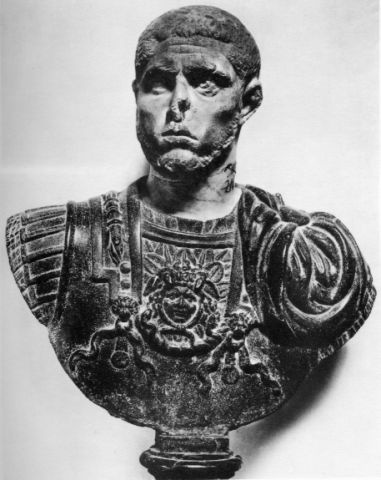
Porphyry bust for portrait. Tusculum. Late third to early fourth century.
Record details
Photographs
Bibliography
- Delbrueck, R., Antike Porphyrwerke. Studien zur spätantiken Kunstgeschichte, vol. 6, Berlin 1932, 82-4, pl. 30
- Gasparri, C. (ed.), Le sculture farnese, Naples 2009, 119-120, no. 95, pl. 106.1-4 (contemporary with head)
Discussion
DESCRIPTION (object)
Under life-sized bust. H. with head: 30 cm. Porphyry
The bust surface is polished. The marble head of about 250-280 A.D. is connected to the bust via a modern neck and probably does not belong to it.
PROVENANCE
Recorded in 1562 as found in Frascati (ancient Tusculum) with two over life-size, marble, cuirassed, headless statues (now also in the Farnese collection in Naples.) The 1644 record cites the bust as headless but the 1697 record notes the presence of a head. Thus the head was attached between those dates.
DESCRIPTION (subject)
The cuirassed bust is remarkably flat. The parts with the leather straps over the arms are separated in contour. Probably the bust, which has no body relief, is an abbreviation of the type of a Hellenistic leather- or linen cuirass.The cuirass has a rich decoration that goes back to the Hellenistic tradition. Epomides with thunderbolts terminate in lion heads which hold rings through which the leather straps binding the epomides to the cuirass are fastened. Between the epomides a head of Medusa is set on a background of scales. On the lower end of this ‚aegis’ snakes are wound around each other in a rope-like manner. On the left shoulder a paludamentum is gathered in a bunch and held with a round fibula.
The best parallel for the type and attributes of the bust is a cuirass from a grave-monument or tropaion from Kos, which probably belongs to the 1st.century B.C. ( see Laube 2006, 59. 237 nr.80 pl.25, 4-5)
HONORAND and DATE
The material and the symbolism of the decoration of the cuirass may point to an emperor. The date is not clear.
Discussion references
- Laube, I., Thorakophoroi, Rahden/ Westfalen 2006
Cite: Last Statues of Antiquity, LSA-1002 (Marianne Bergmann (with J. Lenaghan)).