
LSA-1003
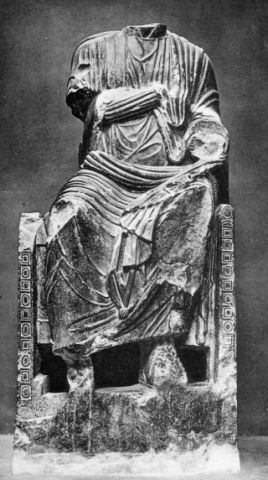
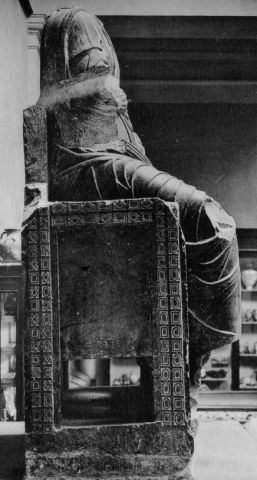
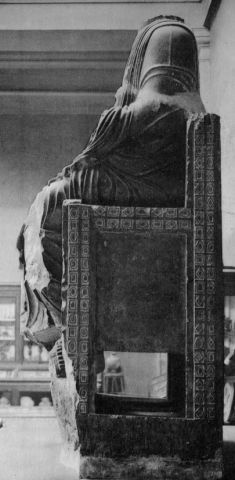
Colossal pophyry togate statue of Emperor seated on throne. Alexandria (Aegyptus). Late third or early fourth century.
Record details
Photographs
Bibliography
- Calza, R., Iconografia Romana Imperiale. Da Carausio a Giuliano (287-363 d. C.), Rome 1972, 110, no.16, pl.16,42
- Delbrueck, R., Antike Porphyrwerke. Studien zur spätantiken Kunstgeschichte, vol. 6, Berlin 1932, 96-8, pls. 40-41
- Ensoli, S. and E. La Rocca (eds.), Aurea Roma: dalla città pagana alla città cristiana, Roma 2000, 562 no. 218, compare nos. 216, 217, 219. (L. Faedo)
- Goette, H.R., Studien zu römischen Togadarstellungen, Mainz 1990, 47,77,155, no. 31, pl. 66.2
- L'Orange, H. P., Das spätantike Herrscherbild von Diokletian bis zu den Konstantin-Söhnen, 284-361 n. Chr. Das Römische Herrscherbild. III. Abteilung ; Bd. 4 , Berlin 1984, 67-9, 119, pl. 46 a-b
Discussion
DESCRIPTION object)
Togate statue seated on a throne. H: 266 cm (= 2 ½ life-size). Porphyry.
Broken and missing are: the head; the lower left arm; the right arm from above the elbow ( a lower part of it had been inserted, as the remains of a dowel hole show); the right knee and part of the throne beside it; the left knee and shin; the left forefoot; a part of the right foot; the front part of the high plinth. The statue is broken in two above the balteus which crosses the breast diagonally and wasmended there . Since the interim closure of the Greco-Roman Museum in 2005, the parts are again separated as the statue is lying on its back at Kom es Sukafa. The break caused the loss of the upper part of the back of the throne. All visible parts of the statue are well finished and polished.
PROVENANCE
Found in 1870 in the center of Alexandria, opposite the Attarin mosque and near the crossing of the ancient Via Canopica L 1 with R 6 (Tkazow 1993, 286 no.271 map A. D)
DESCRIPTION (subject)
The statue was 2 ½ times life-size. It shows the emperor seated on a rectangular throne with a high back and nearly no armrests. The profiles of the throne are adorned with representations of rows of gems set in metal: the frontal edges of the throne have one row, the lateral ones two rows. The portrayed sits with both upper arms lowered His left leg is bent and set back, the right one is more relaxed comes forward.The head was turned to its right. No remains of the hair have been preserved on the neck.
The statue is intended to wear an old-fashioned toga with elements of the first (the u-shaped umbo) and the second century (the balteus, which crosses the breast diagonally, Goette 1989). Both the toga and the shoes have further peculiarities, which need to be discussed elsewhere. As in the togatus in Berlin LSA-1004 the tunica copies the chiton of the main type of Sarapis (Hornbostel 1973, esp. pl.40)
HONORAND AND DATE
Earlier interpretations saw the statue as a representation of Christ. This was was refuted by Delbrueck on account of the toga. Because of the old-fashioned toga and the big impact of Diocletian’s repeated presence in Egypt (292/3? 296/7 siege of Alexandria and ensuing reorganisation, 302 , see LSA-874, LSA-1005), he saw in the statue a representation of Diocletian. L’Orange and others preferred the attribution to Constantine for stylistic reasons, which seem unfounded: The statue is part of a small group of sculptures which are closely linked by a style. This style is characterized by rope-like folds, which form also groups of parallels or spiderweb-like systems. The group consists in this statue, its replica from Hadrianopolis LSA-455, the togatus in Berlin LSA-1004, the cuirassed statue from Egypt in Turin LSA-1008, the groups of tetrarchs at Venice LSA-4, LSA-439 and in the Vatican LSA-480, LSA-481, the bust from Athribis in Cairo LSA-836 and the bust in the Vatican LSA-560 (without its head).
L’Orange adopted Delbrueck’s idea that the three under life-size porphyry statues LSA-1007, LSA-1008, LSA-1009 formed an ancient group of the three sons of Constantine erected at Alexandria in the thirties of the 4th century and proposed to combine with them the enthroned emperor under discussion here as a representation of Constantine. His argument for a later Constantinian date for this statue was its stylistic difference from the porphyry togati found on the Forum Romanum ( believed by H.Kähler to have belonged to the tetrarchic column monument in the Forum--Kähler 1964, 11 pl.12.13) and the colossal seated porphyry togatus at Caesarea LSA-1026 , which L’Orange and others dated to the tetrarchic period as well.
In the meantime, the togati from the Forum Romanum have been firmly dated to the second century (Goette 1990, 48 pl.18, 1.6.7), though possibly reused in the tetrarchic column monument, and the the excavator M.Avi-Yonah‘s belief that the togatus at Caesarea is a product of the second century is widely accepted (see LSA-1026). For these reasons and because of the evident differences in size and partly in style between the four statues combined by L’Orange, his theory is now rejected.
Because this seated statue is an important piece of statuary that has connections to secure representations of the tetrarchs and because of the impact of Diocletian’ presence in Egypt, it is most probable that the statue represents this emperor. The toga is thought to show the emperor as consul, though the consuls are normally represented in this period with the toga trabeata. In response to the argument that one finds jewelled thrones for emperors on coins only from the time of Constantine onwards, one should cite the tetrarchic court scenes from Luxor with similar elements (Deckers 1979).
FURTHER COMMENT
The above mentioned group of sculptures forms the core of the production of tetrarchic images in porphyry by Egyptian workshops. These workshops were located in the country of the porphyry quarries and used their material for a central production of the new porphyry images in the decentralized tetrarchic empire (Mayer 2002) – and their rather local style was no hindrance.
Discussion references
- Deckers, J., Die Wandmalerei im Kaiserkultraum von Luxor, Jahrbuch des Deutschen Archäologischen Institus 94, 1979, 600-652
- Kähler, H., Das Fünfsäulendenkmal für die Tetrarchen auf dem Forum Romanum, Köln 1964
- Mayer, E., Rom ist dort, wo der Kaiser ist, Mainz 2002
- Tkazow, B., The topography of ancient Alexandria (An archaeological map), Warszawa 1993, 286 no. 271 map A, D
Cite: Last Statues of Antiquity, LSA-1003 (Marianne Bergmann).