
LSA-1004
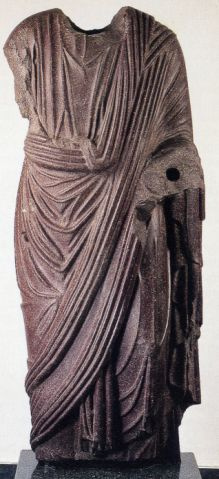
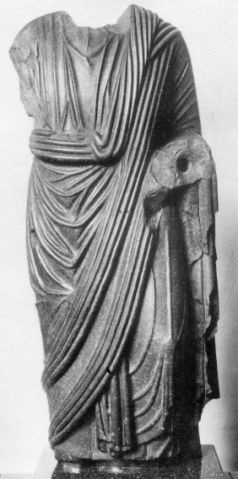
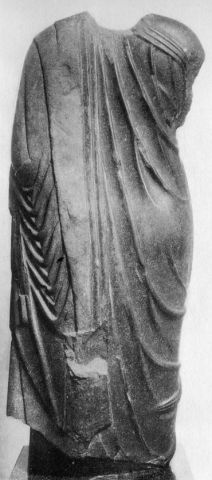
Porphyry statue of emperor wearing toga. From Constantinople? Late third century.
Record details
Photographs
Bibliography
- Calza, R., Iconografia Romana Imperiale. Da Carausio a Giuliano (287-363 d. C.), Rome 1972, 110, no. 15, pl. 15, 41
- Delbrueck, R., Antike Porphyrwerke. Studien zur spätantiken Kunstgeschichte, vol. 6, Berlin 1932, 99-100, pls. 42-3
- Ensoli, S. and E. La Rocca (eds.), Aurea Roma: dalla città pagana alla città cristiana, Roma 2000, 562 no. 219 (L. Faedo)
- L'Orange, H. P., Das spätantike Herrscherbild von Diokletian bis zu den Konstantin-Söhnen, 284-361 n. Chr. Das Römische Herrscherbild. III. Abteilung ; Bd. 4 , Berlin 1984, 69,120, pl. 47 c
Discussion
DESCRIPTION (object)
Porphyry statue of a man wearing a toga. H: 140 cm.
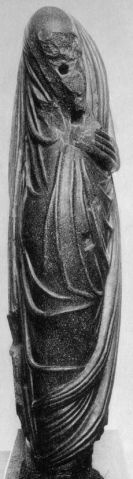
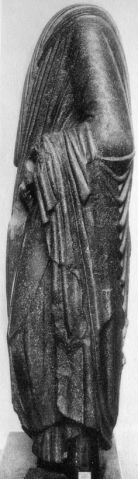
Missing are the head and the arms, which were worked separately, and the lower part of the statue. There is a shallow hole with a big dowel hole for the insertion of the head. A small rectangular hole on the right upper thigh with a dowel hole probably served to insert a patch because of a flaw in the material. In pursuit of metal dowels and lead plunderers of later centuries caused heavy damage to the areas around most of the dowels. The surface is polished on the front, the back is summarily worked and not polished. A support at the lower back has broken away and be reattached.
PROVENANCE
From Venice. Until 1854 in Sanssouci.
DESCRIPTION (subject)
Statue of an emperor wearing a toga in the type of the first to second century AD. The direction of the dowel holes for the arms shows that the lower left arm came forward, whereas the lower right arm extended diagonally to the right. A dowel hole in the right upper arm probably served to connect the statue with something beside it (another figure of a group or a victory crowning two emperors etc.).
DATE AND HONORAND
The statue clearly represents the same style of the colossal seated togatus in Alexandria LSA-1003, its replica LSA-455 and the bust from Athribis LSA-836 as well as the two groups in Venice LSA-4, LSA-439, and the Vatican LSA-840, LSA-841. It is characterized by rope-like folds, which form also groups of parallels or spiderweb-like systems. As in the statue LSA-1003, its tunic copies the main type of Sarapis (Hornbostel 1973, esp. pl. 40).
The date of the togatus depends on the date of the colossal statues in Alexandria and Istanbul from Hadrianopolis (see discussions at LSA-1003 and LSA-455) and on the material of the inserted head and arms. Before the Tetrarchic period marble heads and limbs used to be inserted into porphyry portrait statues, which were in any case seldom produced. Only with the new emphasis on the monarchic quality of the emperors in the Tetrarchy were images completely made of ‚purple’. If the head and limbs had been inserted in marble, one might suspect that the statue is a forerunner to the tetrarchic sculptures. In this case however the insertion of head and arms may have simply been caused by the small proportions of the available porphyry block. The statue is very flat ( greatest depth:41 cm) and the front face of the block can be perceived in the flat surfaces of the folds of the umbo in the middle of the front. Thus the inserted head and arms may well have been made in porphyry, and the statue should represent one of the Tetrarchs. For the use of the old-fashioned type of toga in the tetrarchic period, see Kähler 1964,42.
Discussion references
- Hornbostel, W.
, Sarapis. Studien zur Überlieferungsgeschichte, den Erscheinungsformen und Wandlungen der Gestalt eines Gottes. (Etudes préliminaires aux religions orientales dans l’Empire romain, v. 32), Leiden 1973 - Kähler, H., Das Fünfsäulendenkmal für die Tetrarchen auf dem Forum Romanum, Köln 1964
Cite: Last Statues of Antiquity, LSA-1004 (Marianne Bergmann).