
LSA-1006
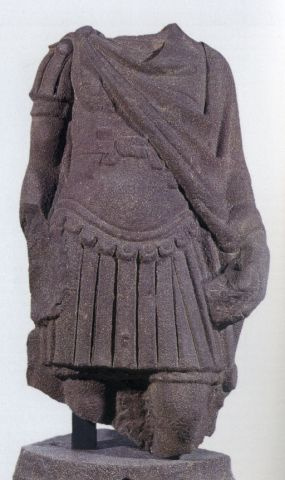
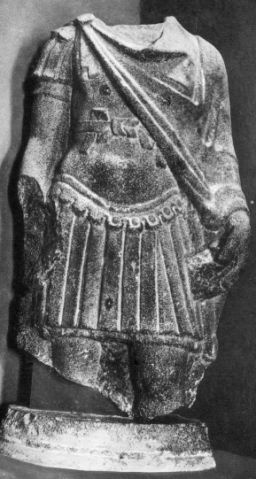
Unfinished porphyry statue in armour with cylindrical base. Rome or environs. Late third to fourth century.
Record details
Photographs
Bibliography
- Calza, R., Iconografia Romana Imperiale. Da Carausio a Giuliano (287-363 d. C.), Rome 1972, 208, no.126, pl. 68.234
- Delbrueck, R., Antike Porphyrwerke. Studien zur spätantiken Kunstgeschichte, vol. 6, Berlin 1932, 101-3, pl. 44
- Donati, A. and G. Gentili, Costantino il Grande. La civiltà antica al bivio tra Occidente e Oriente, Milan 2005, 284, no.122 (G.Spinola)
- L'Orange, H. P., Das spätantike Herrscherbild von Diokletian bis zu den Konstantin-Söhnen, 284-361 n. Chr. Das Römische Herrscherbild. III. Abteilung ; Bd. 4 , Berlin 1984, 126
- Stemmer, K., Untersuchungen zur Typologie, Chronologie und Ikonographie der Panzerstatuen, Berlin 1978, 177, no. 43
Discussion
DESCRIPTION (object)
Under life-size statue missing head. H: 111, W: 63, D: 29 cm. Porphyry.
The head was to be inserted into a shallow roughened hole with a massive dowel hole in the middle. The legs are broken above one and below the other knee. The right hand and a large strut in front of it are broken off.
The statue is unfinished. Between the right arm and the body and between the left hand and the body the material has not been cut away. This is true also on between and outside the legs. There seem to be two measuring points on the breast and chlamys and one on the middle leather strip of the cuirass.
PROVENANCE
Mentioned in 1550 by Aldroandi in the Palazzo Farnese in Rome. It is said to come from Frascati or from the Campus Martius. The sculptor Carlo Albacini bought it in 1804 and exhibited in the Museo Chiaramonti. Between 1820 and 1822 the restorer Michele Ilari put the statue on the round porphyry base.
DESCRIPTION(subject)
The emperor is depicted as standing on his right leg, the left leg is slightly advancing. His arms are lowered beside the body, the left hand grips an unknown object. He wears a short tunica with short sleeves, a muscle cuirass, and a chlamys, which is closed on his right shoulder and hangs diagonally over his body and his left arm. The cuirass has two rows (one very short and one longer) of leather straps on the upper arm, a single row of pteryges forms the lower border of the cuirass, and single row of leather straps covers the upper thighs. At the waist is a belt with the standard large knot. A sword in a scabbard with a rounded end hangs along the left left from below the chlamys. The fibula is round, and on the pteryges the sculptor had begun to put in representations of gems (?).
DATE/INTERPRETATION
This is one of the known types of a cuirassed statue, comparable to a statue of Septimius Severus from Alexandria in the British Museum (McCann 1968, 127 nr.1 pl.22). Because the arms are made in porphyry it is imagined that the head was also made in this material. One can use the typological detail to place the statue earlier than the Tetrarchic period because of its conventional iconography. Equally one can argue that the technical detail (head and limbs were made in porphyry) should place it in the Tetrarchic period (see the discussion under LSA-1004) with the acknowledgement that different models were used at the same time.
Discussion references
- Mac Cann, A. M., The portraits of Septimius Severus (A.D.193-211). Memoirs of the American Academy in Rome 30, Rome 1968
Cite: Last Statues of Antiquity, LSA-1006 (Marianne Bergmann).