
LSA-1007
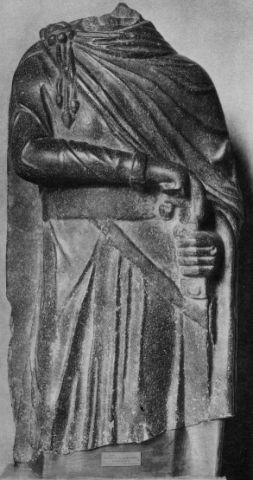
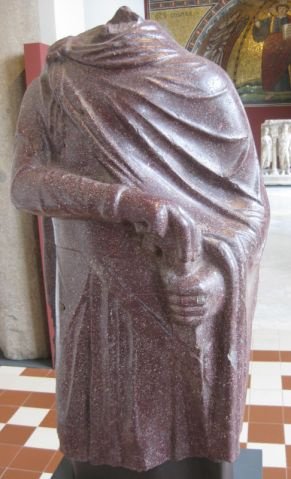
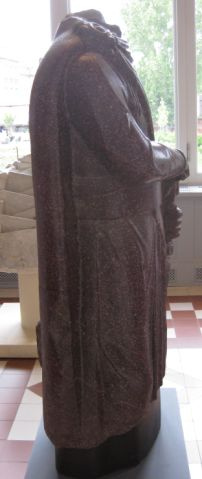
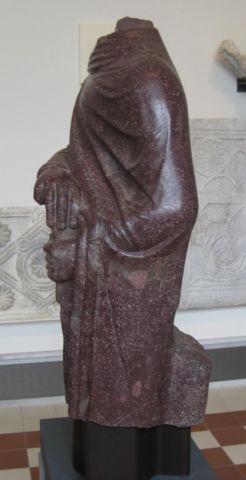
Under life-size pophyry portrait statue in chlamys. From Alexandria (Aegyptus). Fourth century.
Record details
Photographs
Bibliography
- Delbrueck, R., Antike Porphyrwerke. Studien zur spätantiken Kunstgeschichte, vol. 6, Berlin 1932, 104-6, pl. 47, fig. 37
- Tkaczow, B., The topography of ancient Alexandria (An archaeological map), Warsaw 1993, 287, no. 273 Map A.D
Discussion
DESCRIPTION (object)
Under life-size statue. H. 94 cm. Reconstructed total H: c. 130 cm (Delbrueck),
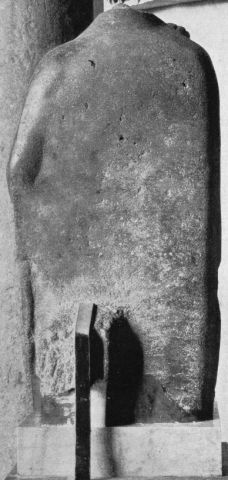
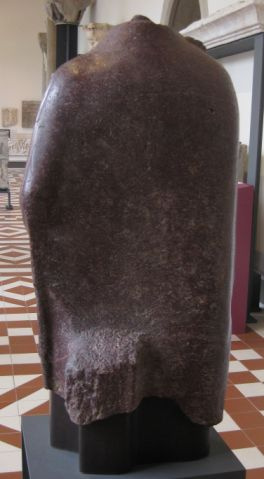
The statue is broken at the neck and below the knees; the head and legs are missing. The right hand is chipped. The work on the front is detailed. In contrast the back is without representational detail; only the shoulders and the left upper arm with elbow are modelled. The shape of block, which was used, can still to be recognized in the protruding and slab-like form of the chlamys on the right side of the statue. The surface of the front is polished, that of the back is smoothed.
PROVENANCE
Excavated 1909 in the garden of the then German consulate at Alexandria, at the street L 1 and between R 5 and R 4 (Tkaczow 1993, 287 no. 273 Map A.D)
DESCRIPTION (subject)
The represented person has his weight on his left leg, the right leg is bent. In the left hand he holds a sword; his right hand rests on the sword’s hilt. He wears a long sleeved tunica and a chlamys held by a big fibula on the right shoulder. The fibula has an oval gem at its centre, three round pearls or gems on opposite sides, and three long pendilia with drop-like ends. The chlamys has a broad belt. A sword belt emerges below this and crosses the body diagonally from roughly the right waist to the left thigh. The sword is held diagonally to the back and disappears under the chlamys. Its hilt is not detailed, but below the left hand it has a protruding field adorned with an oval gem.
The strange bend in the pendilia and the rough form of their ends are caused by a flaw in the stone material, which can still be seen in the surrounding zone and elsewhere on the statue. The flaw forced the sculptors to re-carve this part as well as the furrow between the body and the right upper arm. In general the awkward upper part of the statue -- the right arm and hand protruding and the left side of the torso receding in an unnatural way-- may have been caused by flaws in the material.
DATE/ INTERPRETATION
The statue corresponds in typology to the chlamys statues now in Ravenna and Paris, LSA-1010, and LSA-1185 and to the hand in London, LSA-1011.The rather rope-like folds of the chlamys reflect the tradition of the Egyptian workshops. But in general its style tends to be influenced by models with a more classical style, where the drapery shows differences between between broad and narrow folds and seems to hang at a distance from the body. This classicising style is typical for Constantinople from some time probably in the second half of the fourth century on. The statue represents the shift from Egyptian workshops working for the decentralized empire of the tetrarchs in a local style to the an orientation of these workshops around the style of the new capital Constantinople. It is probably to be dated to the second half of the 4th century A.D. (see discussion at LSA-1010). For older ideas of grouping and dating the statue, see LSA-1003. Z. Kiss proposed that the feet of the statue have been found at Alexandria, LSA-2561.
Discussion references
- Calza, R., Iconografia Romana Imperiale. Da Carausio a Giuliano (287-363 d. C.), Rome 1972, 296-8, no. 208, pl. 103, 370a (if one accepts Delbrueck, then perhaps Crispus)
- de Nuccio, M and L. Ungaro (eds.), I marmi colorati della Roma imperiale, Venice 2002, 329-330, no. 28 (A. Effenberg)
- Kiss, Z., Études sur le portrait impérial romain en Egypte, Warsaw 1984, 102, fig. 260
- L'Orange, H. P., Das spätantike Herrscherbild von Diokletian bis zu den Konstantin-Söhnen, 284-361 n. Chr. Das Römische Herrscherbild. III. Abteilung ; Bd. 4 , Berlin 1984, 67-8, 129-30, pl. 46c (Constantinian family group)
Cite: Last Statues of Antiquity, LSA-1007 (Marianne Bergmann).