
LSA-1008
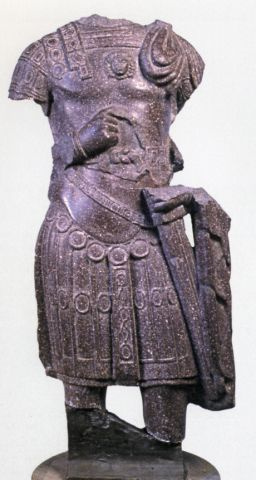
Under life-size pophryry portrait statue in armour. From Egypt. Fourth century.
Record details
Photographs
Bibliography
- Delbrueck, R., Antike Porphyrwerke. Studien zur spätantiken Kunstgeschichte, vol. 6, Berlin 1932, 106-108, pl. 48, fig. 38
- Mercando, L. 'Sculture greco-romane provenienti dell'Egitto nel Museo di Antichità di Torino+, Alessandria e il mondo ellenistico-romano : 1. centenario del Museo greco-romano : Alessandria, 23-27 novembre 1992 : atti del 2. Congresso internazionale italo-egiziano, Rome 1995, 365, no. 9, pl. 64.4
Discussion
DESCRIPTION (object)
Underlife-size statue. H: 87, W: 47, D: 27 cm. Reconstructed total H: ca, 130 cm (Delbrueck).Porphyry.
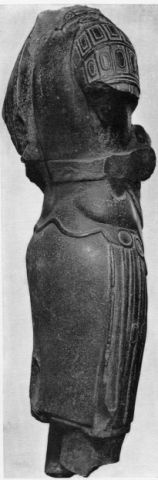
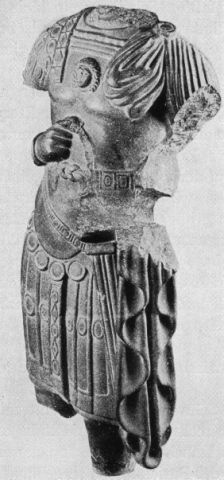
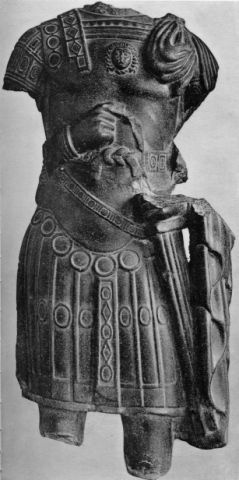
Broken and missing are the head; the right arm with exception of area adjacent to the wrist and the hand which adhere to the body; most of the left arm and hand; the sword hilt; and the legs from the upper thighs down. The statue has been broken in two at the waist. Broad pegs on both sides of the waist connected the missing pieces of the arms with the body. On the back are also the remains of two rectangular struts.
The front of the body is worked in detail. The back is well worked and polished, but without much representational detail.
PROVENANCE
Bought after 1821 from the Drovetti Collection, which was assembled in Egypt
DESCRIPTION (subject)
The statue stands with its weight over its right leg. It wears a a long-sleeved but short tunica, a muscle cuirass and a paludamentum, gathered in a bunch at the left shoulder. From there it seems to have been slung around the left arm, from which it hangs down freely with undulating and symmetric seams. The cuirass is heavily adorned with gems represented as set in metal: on the shoulder straps, between the straps and the border of the cuirass, two stiff rows on the upper arm, on the belt (although its middle is closed with the usual Herakles-knot). A simpler decoration, probably also metal and gems, decorates the sword’s strap, which crosses the belly diagonally. The pteryges have changed to round discs, which presumably contain gems and hang from the lower edge of the muscle cuirass.On the back a wavy contour line characterizes this zone of the cuirass. More gems are to be found in the middle of each of the leather straps of the skirt; the middle strap is completely decorated.
With the left hand the statue grips the hilt of a sword, which hangs diagonally down. The right hand holds a strap,which has to do with the sword. On the breast of the cuirass there is a simplified Medusa head.
DATE/INTERPRETATION
The model for the body of the statue is a more classizising one than those of the Tetrarchs in the groups in the Vatican and Venice (LSA-840, LSA-841 and LSA-4, LSA-439). But the style of execution, that is the structure of the folds of the paludamentum like ropes or bundles of ropes and the conversion of the pteryges into set gems is similar to those groups in the Vatican and in Venice and to seated togati from Hadrianopolis and Alexandria (LSA-455 and LSA-1003) and the bust from Athribis (LSA-836). The exaggerated use of gems on the cuirass seems to represent an advanced stage of the development of imperial ornatus in comparison to the tetrachs in the Vatican (LSA-840, LSA-841), but there is still the old fashioned round fibula. Dates between the advanced Tetrarchic and the uncertain period before the Egyptian porphyry workshops converted to the style of Constantinople are possible. Former ideas, which attributed this statue together with LSA-1007a nd LSA-1009 to a group representing the sons of Constantine at Alexandria and even to combine it with the seated togatus LSA-1003 have been abandoned.
Discussion references
- Calza, R., Iconografia Romana Imperiale. Da Carausio a Giuliano (287-363 d. C.), Rome 1972, 332-3, no. 238, pl. 116,424-5 (unconvinced by Delbrueck)
- Donati, A. and G. Gentili, Costantino il Grande. La civiltà antica al bivio tra Occidente e Oriente, Milan 2005, 283-4, no. 121 (G. Pantó)
- L'Orange, H. P., Das spätantike Herrscherbild von Diokletian bis zu den Konstantin-Söhnen, 284-361 n. Chr. Das Römische Herrscherbild. III. Abteilung ; Bd. 4 , Berlin 1984, 67-8, 138-9, pl.47 (Constantinian family group)
Cite: Last Statues of Antiquity, LSA-1008 (Marianne Bergmann).