
LSA-1009
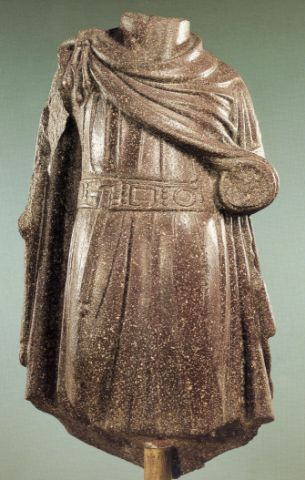
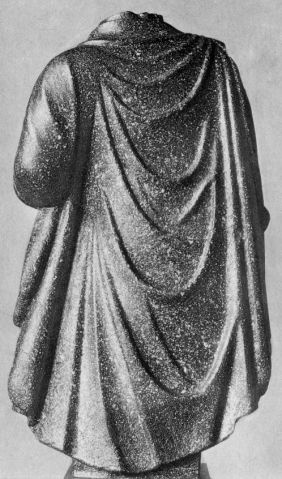
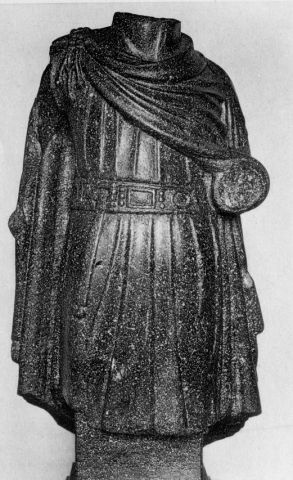
Under life-size porphyry statue of Emperor in chlamys and tunica. From Alexandria (Aegyptus). Fourth century.
Record details
Photographs
Bibliography
- Delbrueck, R., Antike Porphyrwerke. Studien zur spätantiken Kunstgeschichte, vol. 6, Berlin 1932, 108-110, pl. 49, fig. 39
- Tkaczow, B., The topography of ancient Alexandria (An archaeological map), Warsaw 1993, 201, no. 38, map A.D
Discussion
DESCRIPTION (object)
Under life-size statue. H. 39 cm. Reconstructed total H: c. 70 cm. Porphyry.
The head, the right arm, the lower part of the left arm, and the legs beneath the chlamys and tunic are broken and missing.The statue is worked in detail and polished on all sides.
PROVENANCE
Given to the Egyptian Collection of the Kunsthistorisches Museum in 1851 by von Laurin, the Austrian General Consul at Alexandria. Bought there or found during his excavations in the garden of his villa which lay in the centre of ancient Alexandria, at the street R 5 and between L 1 and L 2 (cp.Tkazow 1993, 201 nr.38, map A . D). Later it passed to the collection of Maximilian of Mexico to Miramare and returned in 1891 to Kunsthistorisches Museum.
DESCRIPTION (subject)
The emperor, whose head was turned to his right, wears a tunica and a chlamys. The tunica covers the knees and has a jewelled belt. The belt is studded alternately with oval and rectangular gems and vertical rows of knobs or pearls. Its end, a long leather band with a round terminal, hangs down from the clasp which is located to the proper right of centre.
The chlamys is fastened on the right shoulder by a fibula and falls diagonally in direction of the left arm. The large fibula has an oval centre, three round gems and/or pearls on two sides, and long pendilia with three ends in the form of droplike pearls.
HONORAND/DATE
The identity of the honorand depends on the date of the statue.
The statue still has some connections to the works of the Tetarchic period in Egypt. These are the rope-like structure of the folds in the tunica and the organisation of the folds in the chlamys, which resemble typologically that of the bust of Sol in the wreath of the emperor from Romuliana LSA-845and that in the bust in the Vatican LSA-560. On the other hand the harmonious classical proportions of the body and softer parts of the drapery show all the elements of late-antique classicism and elegance, which must be a reception of the new style of Contantinople. It is best known from around the Theodosian period.
Compared to the statue from Alexandria in Berlin LSA-1007, the statue in Vienna seems nearer to the works of the tetrachic period. For the former idea to combine this statue with others to a group at Alexandria, seethe discussion at LSA-1003.
Discussion references
- Calza, R., Iconografia Romana Imperiale. Da Carausio a Giuliano (287-363 d. C.), Rome 1972, 298, no. 209, pl.103. 370 b
- Ensoli, S. and E. La Rocca (eds.), Aurea Roma: dalla città pagana alla città cristiana, Roma 2000, 562-3, no. 217 (L. Faedo: ca. 310-350)
- Kiss, Z., Études sur le portrait impérial romain en Egypte, Warsaw 1984, 102, fig. 260
- L'Orange, H. P., Das spätantike Herrscherbild von Diokletian bis zu den Konstantin-Söhnen, 284-361 n. Chr. Das Römische Herrscherbild. III. Abteilung ; Bd. 4 , Berlin 1984, 68, 139, pl. 47b (Constantinian family group)
- Tkaczow, B., The topography of ancient Alexandria (An archaeological map), Warsaw 1993, 287 no. 272
Cite: Last Statues of Antiquity, LSA-1009 (Marianne Bergmann).