
LSA-101
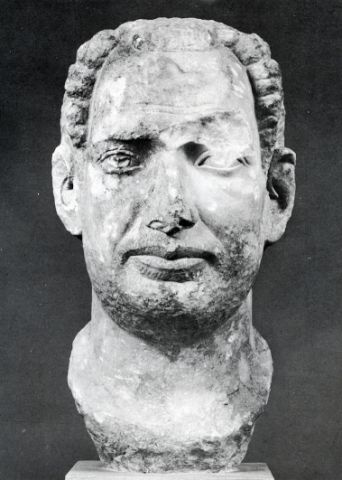
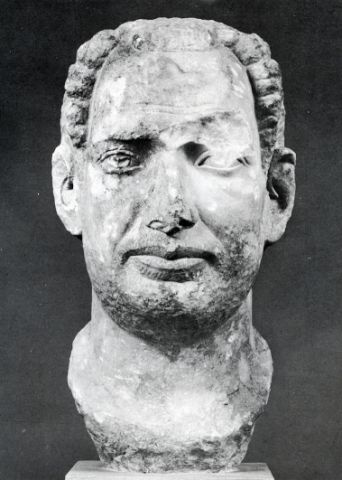
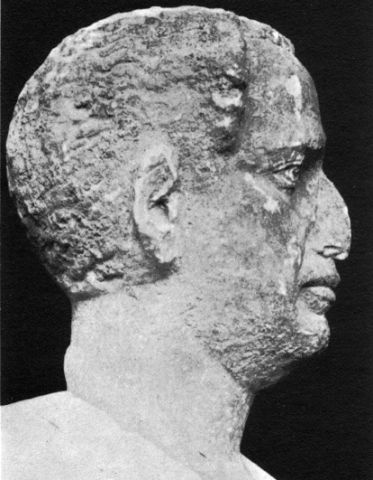
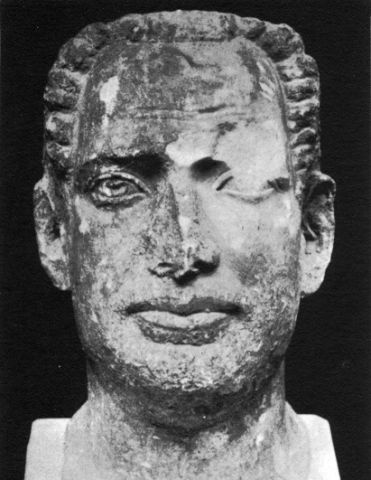
Portrait head of man with short beard. From Piraeus (Athens). Late fourth to fifth century.
Record details
Photographs
Bibliography
- L'Orange, H. P., Studien zur Geschichte des spätantiken Porträts, Oslo 1933, pp. 88-92, 150 Cat. no. 125 figs. 235, 237
Discussion
DESCRIPTION (Object)
Over life-sized male portrait head worked for insertion. Marble, H 37 cm, W 20 cm. The head with neck is fully preserved in a generally good state. The left eyebrow with root of the nose, centre of left upper lid and eyeball, and tip of the nose are broken; chips are scattered over the face. The surface is not polished, the flesh is finished with a rasp.
The conically shaped trunk for the insertion indicates a high imperial date for the original production of the head which in its present state is possibly the result of a late antique re-work.
The hair is short, brushed forward and bagging into a moderate 'wreath' around the face. Around the forehead, the hairwreath is arranged into single strands separated by a deeply chiselled line and subdivided by a shallow line. At the back, the hair is only roughly indicated with a point. The hairline is defined against the flesh by a chiselled line.
The beard is picked in with a point, in irregular strokes on chin and cheeks, in short parallel vertical strokes on moustache and below the lower lip.
The forehead is furrowed by two horizontal sinuous wrinkles. Deep naso-labial folds run from the nostrils to the corners of the mouth. The mouth is protruding, the lips are edged by a sharp line and separated from each other by a chiselled line. The filtrum is pronounced, the lower lip sharply delineated against the chin.
The eyebrows are flat, sharply lined at the outer side and with dense hair indicated by short vertical chisel strokes at the inner ankle. The upper lid is separated from the orbital by a drilled line. Both lids are fleshy; at the inner side they surround the large caruncle as an uninterrupted bend (better visible at the left eye, the right one is chipped there) while at the outer side the upper lid is overlapping. The nose is markedly aquiline.
PROVENANCE
From Piraeus.
LOCATION
Athens, National Archaeological Museum, storerooms, inv. no. 3339.
DESCRIPTION (Subject)
Portrait head of a mature man with aquiline nose, full lips, and double chin. The hair is a short, compact mass brushed forward and forming a small wreath around the face. The wreath is fuller at the temples than above the forehead. The forehead is high, the hairline slightly receding over the temples. The fleshy, sensuous lips give the impression of a slight smile.
Hairstyle and stubble beard label an imperial office holder rather than a local man or an intellectual (Smith 1999); nothing specific, however, is known about the honorand.
DATE
L'Orange 1933 saw the modest wreath-hairstyle of our head in the tradition of coiffure types of around 400 and the early 5th century (L'Orange 1933, 89). The hairstyle is represented for examples by portraits of office-holders on the obelisk base in Constantinople, datable 390/2, by contemporary senatorial sarcofagi of the early theodosian period, or by the fine chlamydatus bust in Thessalonica (LSA-90). Stylistically, however, L'Orange saw our head advanced towards a more abstract, more linear, more ornamental 'byzantine' form. He dated the head to the 2nd half of the 5th century, by comparisone to diptychs of that period (L'Orange 1933, 88-92).
Rhomiopoulou 1985, 91 dated to the 4th century.
The wreath-hairstyle provides a terminus post quem in the late 4th century for our head. The plastic values with the few but marked caesuras dislodge our head from the portraiture of the late 4th/ beginning 5th century with its subtle modellings. The stubble beard is a typological feature reappearing on heads conventionally dated to the 2nd quarter/ mid 5th century, like the so-called 'Elder Magistrate' (LSA-169) and 'Younger Magistrate' (LSA-170), both from Aphrodisias. These considerations lead, in our view, to a date towards the middle of the 5th century.
Our outer dates account for the late 5th-century date as proposed by L'Orange.
Discussion references
- Datsoule-Satvride, A., Romaika Portraita sto Ethniko Archaiologiko Mouseio tes Athenas, Athens 1985, pp. 90-1 pl. 135
Cite: Last Statues of Antiquity, LSA-101 (Ulrich Gehn).