
LSA-1010
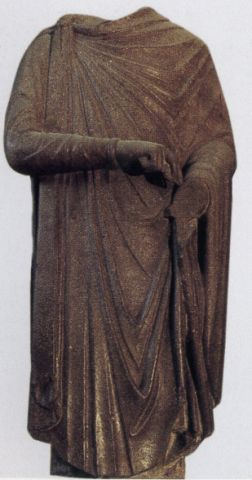
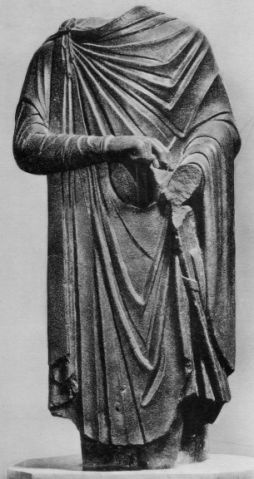
Over life-size porphyry statue of Emperor in tunica and chlamys. Ravenna or Forum Cornelii (Flaminia et Picenum). Mid fourth to fifth century.
Record details
Photographs
Bibliography
- Bartoccini, R. 'La statua di porfido del Museo Arcivescovile in Ravenna', Felix Ravenna 40, Faenza 1932, 5-31
- Delbrueck, R., Antike Porphyrwerke. Studien zur spätantiken Kunstgeschichte, vol. 6, Berlin 1932, 111-14, pls. 50-51
Discussion
DESCRIPTION(object)
Over life-size statue. H: 140 cm, Reconstructed total H: c.220 cm. Porphyry.
The head was inserted and is missing. The place for insertion is shallow with a roughened surface and a dowel-hole. As the hands are made of porphyry, the head was probably also made of porphyry.
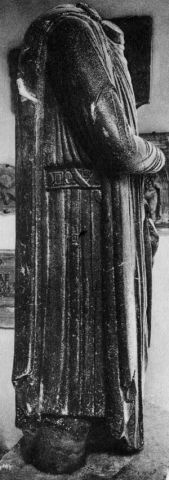
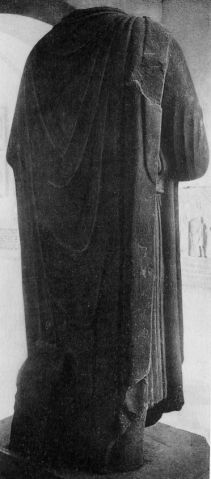
Also missing are the left hand, part of the sword, and the lower part of the legs. The back of the statue is sculpted, though with less detail than the front and the sides. The surface is polished on all sides.
PROVENANCE
The statue was first recorded in the garden of the Palazzo Arcivescovile at Ravenna in the 17th c., and is now in the Museo Arcivescovile. In 1869, however, its right hand was found in the river Santerno near Forum Cornelii (Imola) on the Via Aemilia. The early presence of the torso in Ravenna, and the fact that an imperial porphyry statue would suit an imperial residence, both point to Ravenna as its place of origin; the discovery of one of its hands near Imola, however, is much more easily explained if it came from Forum Cornelii. (We are grateful to Andrea Augenti for discussing this issue with us.)
DESCRIPTION (subject)
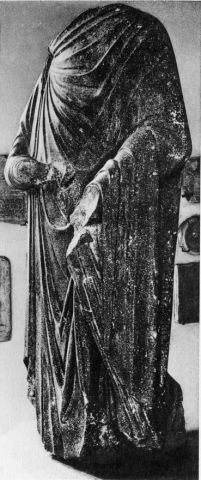
The statue shows a man wearing a tunica and chlamys and holding a sword. He stands on his left leg, his right leg is slightly bent and set backwards. The tunica has long sleeves and ends below the knees; the chlamys is longer. On his right side, a belt which girds the tunica and is studded with gems, is visible. With his left arm, he holds the scabbard of a sword in a diagonal position. His right hand rests on the sword’s hilt.The sword strap is wound around the scabbard. It is also wound around the jewelled belt; this is visible in the right profile view. There its end with metal ornaments hangs down vertically.
The chlamys is held by a fibula on the right shoulder. The fibula has a large central oval gem, around which on each side are three jewels or one set jewel and two pearls. Pendilia, with three ends adorned by oval pearls and small knobs at their terminations, hang from the fibula.
DATE/INTERPRETATION
The statue is devoid of the rope-like style of drapery typical for the Egyptian workshops of the tetrarchy. It is clearly related to the so-called Theodosian classicism, whenever this begins and ends. Compared to the fragments of the replica in the Louvre (LSA-1185), the style is more angular and rigid. Because Delbrueck was convinced, that most of the work in the porphyry quarries ended in the middle of the 4th century, he dated all post-tetrarchic statues (with the exception of LSA-1185) not later than this. The statue at Ravenna seemed to him the latest of the chlamys-statues. As a statue in the hinterland of Ravenna would not make sense before Ravenna became an imperial residence in 404, he thought that the statue was re-used.
In the meantime it has become evident that the work at the quarries ended in the middle of the fifth century and that there were enormous masses of material already extracted to be used or re-used after the closure of the quarries (Peacock-Maxfield 2007, 426-427). The statue is now generally dated after 404. Kollwitz compared it to the so-called younger magistrate from Aphrodisias LSA-170. However there is discussion about its arrival at/or in the region of Ravenna (Malgouyres 2003, 65).
The gesture of emperors dressed in chlamydes, who put their hands on their swords’ hilts (which occurs here, LSA-1185, LSA-1007, and LSA-1011) has been interpreted as one of pushing a sword back into its scabbard and thus conveying the idea of peace. But the hands are resting rather lightly on the hilts, with the three middle fingers parallel and lightly bent and the small finger completely bent. The probably convey the idea of a calm preparedness.
Discussion references
- Donati, A. and G. Gentili, Costantino il Grande. La civiltà antica al bivio tra Occidente e Oriente, Milan 2005, 282-3, no. 119 (M-G. Maioli)
- Kollwitz, J., Oströmische Plastik der theodosianischen Zeit, Berlin 1941, 99, pl. 19.1
- Lavizzari Pedrazzini, M.P. (ed.), Milano capitale dell’Impero romano, 286-402 d.C, Milan 1990, 229, no. 3g.2a (R. Farioli Campanati)
- Malgouyres, P. & C. Blanc-Riehl, Porphyre. La pierre pourpre des Ptolémées aux Bonaparte, Paris 2003, 64-5, fig. 25
- Peacock, D and V. Maxfield, The Roman Imperial Quarries. Survey and Excavation at Mons Porphyrites 1994-1998. 2.The Excavations, London 2007
Cite: Last Statues of Antiquity, LSA-1010 (Marianne Bergmann).