
LSA-1012
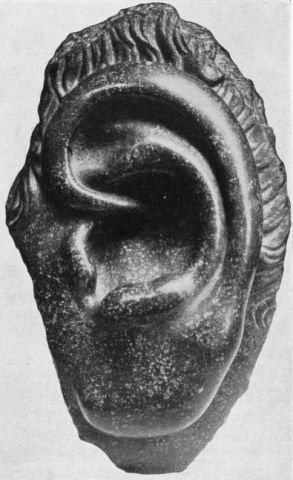
Ear and contiguous hair broken from colossal porphyry portrait of Emperor. Unknown provenance. Earlier fourth century.
Record details
Photographs
Bibliography
- Delbrueck, R., Antike Porphyrwerke. Studien zur spätantiken Kunstgeschichte, vol. 6, Berlin 1932, 116, fig. 47
Discussion
DESCRIPTION (object)
Colossal left ear and the contiguous hair, worked separately for insertion. H: ca. 17 cm. Total H: (of the statue): c. 420 cm. Porphyry.
Excellent quality, surface polished.
PROVENANCE
Unknown but formerly in a private collection in Rome.
DESCRIPTION (Subject)
Touching the top and back of the ear are short locks of hair which turn in a natural, irregular manner. Styled hair around an ear indicates that the portrait represented a mortal. The scale, however, is colossal, and the material porphyry.Thus, the fragment came from a portrait of an emperor.
DATE
Delbrueck compared the small and slightly wavy strands of hair with the haistyle of the colossal bronze head of Constantine in Rome, LSA-562. This seems still the best comparison.
Cite: Last Statues of Antiquity, LSA-1012 (Marianne Bergmann).