
LSA-102
Base for statue of Archon Hegias, son of Timocrates. Athens (Achaea). Fourth century
Record details
Photographs
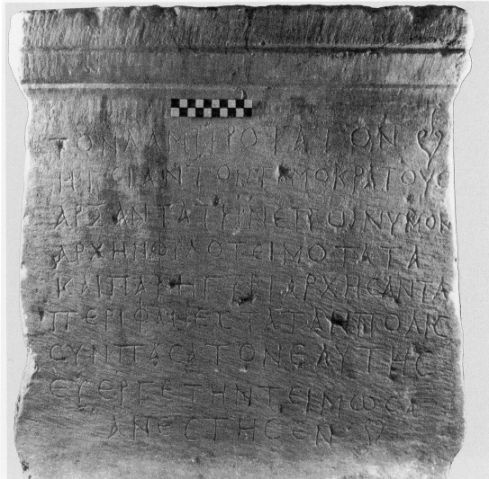
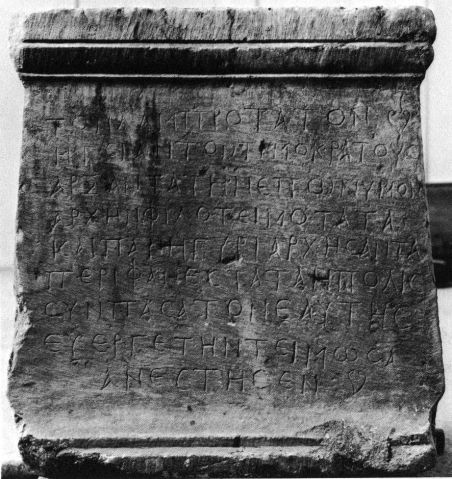
Inscription
τὸν λαμπρότατον (ivy leaf) / ῾Ηγείαν, τὸν Τιμοκράτους, / (3) ἄρξαντα τὴν ἐπώνυμον / ἀρχὴν φιλοτειμότατα, / καὶ πανηγυριαρχήσαντα / (6) περιφανέστατα, ἡ πόλις / σύνπασα τὸν ἑαυτῆς / ἐυεργέτην τειμῶσα / (9) ἀνέστησεν (ivy leaf)
Inscription translation
With veneration the entire city set [this] up [to] her benefactor, Hegias, of clarissimus rank, son of Timocrates, who very generously held the office of eponymous archon and very conspicuously held the office of Panegyriarch.
Textual evidence
τὸν λαμπρότατον (ivory leaf)/ ῾Ηγείαν τὸν Τιμοκράτους/
ἄρξαντα τὴν ἐπώνυμον / ἀρχὴν φιλοτειμότατα/ καὶ πανηγυριαρχήσαντα/ περιφανέστατα ἡ πόλις/ σύνπασα τὸν ἑαυτῆς/ ἐυεργέτην τειμῶσα/ ἀνέστησεν (ivy leaf)
Translation
With veneration the entire city set [this] up to her benefactor, Hegias, man of clarissimus rank, son of Timocrates, who very generously held the office of eponymous archon and very conspicuously held the office of president of the Panegyris-festival.
Bibliography
- Inscriptiones Graecae, II/III 3692
- Inscriptiones Graecae, II/III(2) 13273
Discussion
INSCRIPTION
In nine lines:
τὸν λαμπρότατον (ivy leaf) / ῾Ηγείαν, τὸν Τιμοκράτους, / (3) ἄρξαντα τὴν ἐπώνυμον / ἀρχὴν φιλοτειμότατα, / καὶ πανηγυριαρχήσαντα / (6) περιφανέστατα, ἡ πόλις / σύνπασα τὸν ἑαυτῆς / ἐυεργέτην τειμῶσα / (9) ἀνέστησεν (ivy leaf)
'With veneration the entire city set [this] up [to] her benefactor, Hegias, of clarissimus rank, son of Timocrates, who very generously held the office of eponymous archon and very conspicuously held the office of Panegyriarch.'
Letter height 1.5-3.6 cm.
DESCRIPTION (from Sironen 1997 and the published photo)
Rectangular base of white marble with mouldings at bottom and top, used for three dedications at different times: H 61, W 59, D 67 cm. The first use was for Marcus Ulpius Flavius Tisamenus before the middle of the third century (IG II/III 3701) and is associated with the imprints of the feet of a statue on the top. The second use (with the inscription set on the original left side) was for our dedication to Hegias. The third use (on the original right side) was for the sophist Plutarchus in the late fourth or early fifth century (LSA-134). The back is unworked.
PROVENANCE AND LOCATION
Found in 1848 in a wall of the church of Agia Kandili in the Plaka. The church which is now destroyed was located at the eastern slope of the Acropolis in the region of today's Agia Aikaterini Square. In this area recently the Old Agora of Athens and the Prytaneion have been located (Schmalz 2006). The base is today in the Epigraphic Museum, inv. no. 10512.
HONORAND AND DATE
This incription cannot be dated with confidence. Sironen 1994, 27 attributed it to the first half of the fourth century, on the basis of its letter forms and because it is certainly later than the first dedication to Marcus Ulpius Flavius Tisamenus in the earlier 3rd century, and earlier than the dedication to Plutarchus of the late fourth or early fifth century (LSA-134; see above, 'Description').
The honorand is not known from other inscriptions (Traill 1999). As Sironen (1994, 27-8) argues, he must have been a member of the wealthy local class who spent their money generously on the public good, and took charge of the religious priesthoods and celebrations. He was of senatorial rank (λαμπρότατον, line 1), and held the office of eponymous archon (lines 3-4) and of Panegyriarch; the latter's duty was to feed the visitors who came to Eleusis every fourth year to celebrate the mysteries (Geagan 1967, 136).
FURTHER DISCUSSION
Unusual - but not unparalleled - for late antique honorific inscriptions, the text is in prose.
Discussion references
- Geagan, D. J., The Athenian Constitution after Sulla (Hesperia supplement XII), Princeton 1967
- Schmalz, G. C. R., The Athenian Prytaneion Discovered?, Hesperia 75, 2006, 33-81
- Sironen, E., The late Roman and early Byzantine inscriptions of Athens and Attica, Dissertation - University of Helsinki 1997, 65-6 nr. 11
- Sironen, E. , 'Life and administration of late Roman Attica in the light of public inscriptions'
P. Castrén, Post-Herulian Athens : aspects of life and culture in Athens, A.D. 267-529 , Helsiniki 1994, 15-62, 26-8 no. 11 - Traill, J. S., Persons of Ancient Athens, Vol. 8: Z- to Eoe- (zeta, eta), Toronto 1999, 132 no. 480350
Cite: Last Statues of Antiquity, LSA-102 (Ulrich Gehn).