
LSA-1026
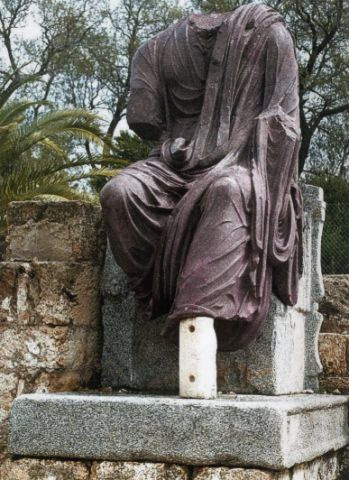
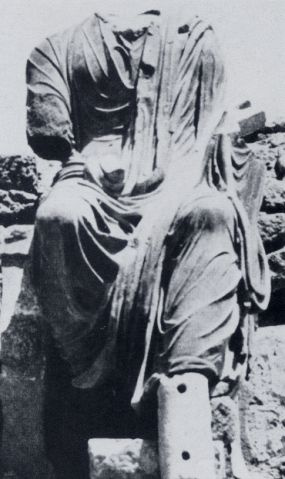
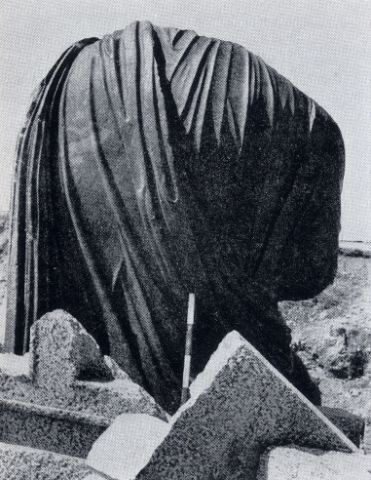
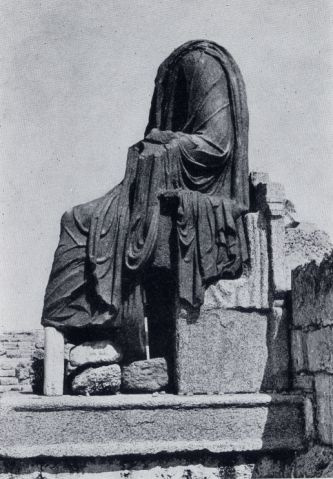
Colossal porphyry seated statue of high-imperial emperor on granite throne. Caesarea Maritima (Palaestina I). Sixth century.
Record details
Photographs
Bibliography
- Avi-Yonah, M. 'The Caesarea Porphyry Statue', Israel Exploration Journal 20, Jerusalem 1970, 203-208, pls. 44a-b, 46a-b
- de Nuccio, M and L. Ungaro (eds.), I marmi colorati della Roma imperiale, Venice 2002, 483, no. 204 (Y. Porath)
- Lehmann, C. M. and K. G. Holum, The Greek and Latin inscriptions of Caesarea Maritima, Boston 2000, 16, 82-4, no. 59, fig. 6 and pl. 44
- Yievin, S. 'Excavations at Caesarea Maritima', Archaeology 8, New York 1955, 122-7, figs. 1-12
Discussion
DESCRIPTION (object)
Seated togatus on throne with plinth. H: 245, W: 112 cm (reconstructed total 320 cm). H (throne): 209, W (throne): 138, D(throne): 76cm. Togatus: Porphyry. Throne: granite.
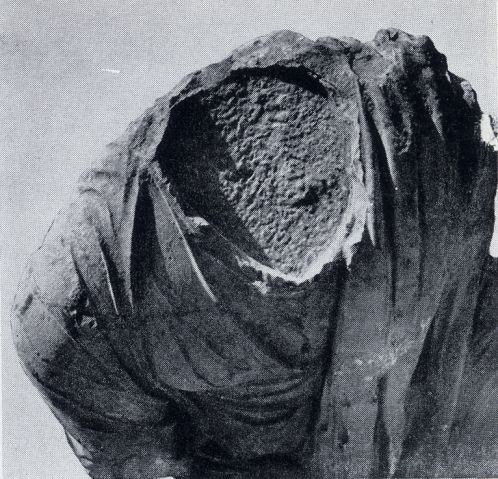
Body nearly completely preserved. The head, arms with hands, and the legs –in as much as can now be observed—were inserted and are now missing. At the head there is a shallow cavity, and there is a hole at the left wrist.
A fragment of a white column beneath the broken left leg is an ancient repair. Two small holes in a fold over the chest were probably for an ornament. The front proper left edge of the throne has been cut back to suit the statue.
PROVENANCE
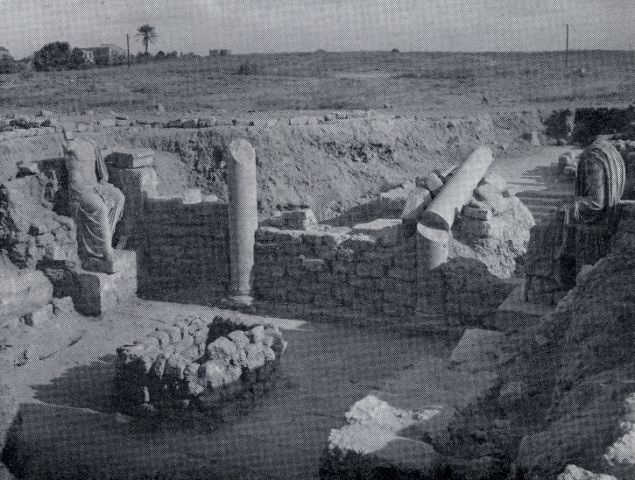
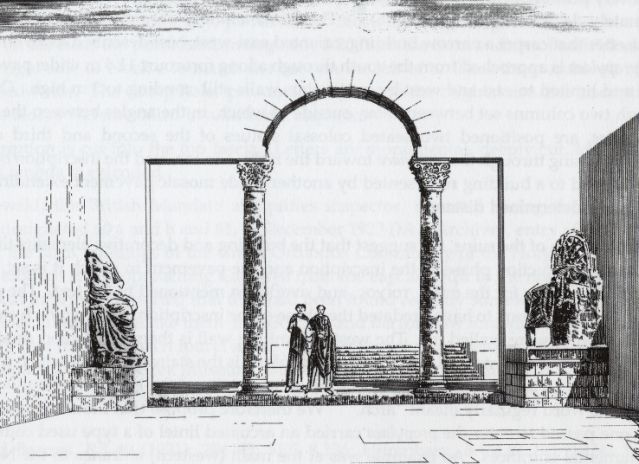
Found in the fields east of the crusader wall of Caesarea in 1951 by IDAM. Here a paved grey-marble forecourt, the ‚Byzantine esplanade‘ is oriented north-south and defined by walls on the east and west sides (still standing 3 m high). It ends on the north side in a stylobate with two columns set between antae.
The statue was found on the northeast side before the columns; it sat on a throne and base of grey granite. On the northwest another seated statue of a half-draped man was found facing it. This latter statue was made in marble and had been adapted for its new setting.
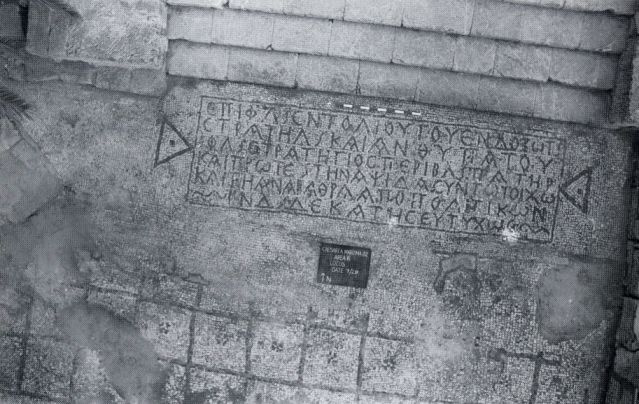
To the north of this forecourt is an east-west space (propylaea) from which ten steps, exactly north of the columns in antae, depart. In front of the steps on the mosaic floor was a sixth century building inscription.
DESCRIPTION
The statue shows a man wearing a toga with balteus, umbo at the right hip, and sinus near the right shin. This is the standard toga of the imperial period. The figure sits with its left leg extended, and both arms bent at the elbows but lowered.
It sits on a grey granite throne which rests upon a large rectangular granite plinth. The proper right arm of the throne is decorated with a sphinx.
DATE
Because of its material the statue has sometimes been dated to the tetrarchic period (see L’Orange) . Its style shows a slight tendency to the typical rope-like folds, which one finds in Egyptian local sculptures of the Tetrarchic period. But otherwise its type and style are so ‚classical’, that the Hadrianic date proposed by the excavators and the majority of the recent literature seems to be justified.
CONTEXT
Whatever its original date the statue and its pendant have clearly been re-set in the late-antique period. They may possibly be associated with the building work commemorated in front of the flight of ten steps due north of this forecourt.
There an inscription on the mosaic floor reads in Greek ‚Under Flavios Entolios, of gloriosissimate grade, general and proconsul, Flavius Strategios, of spectabilate grade, father and first man, (built) the arch together with the wall and the staircase from city funds, in the tenth indiction, with good fortune. ‘ (translation C. M. Lehmann). The governor is unknown but must have been in office between 546 (when Justinian made the post proconsular ) and 640 (Muslim conquest). The rank of gloriosissimus should be the date later in the sixth century because Justinian assigned to this post of proconsular governor only the rank of spectabilis.
Discussion references
- Calza, R., Iconografia Romana Imperiale. Da Carausio a Giuliano (287-363 d. C.), Rome 1972, 106, no. 12, pl. 13.33-4
- L'Orange, H. P., Das spätantike Herrscherbild von Diokletian bis zu den Konstantin-Söhnen, 284-361 n. Chr. Das Römische Herrscherbild. III. Abteilung ; Bd. 4 , Berlin 1984, 11, 22, 95, pl. 13d
Cite: Last Statues of Antiquity, LSA-1026 (Marianne Bergmann with J. Lenaghan).