
LSA-1027
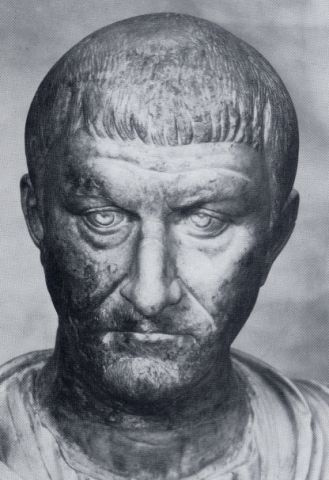
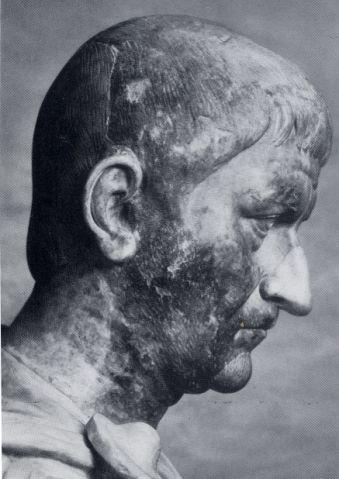
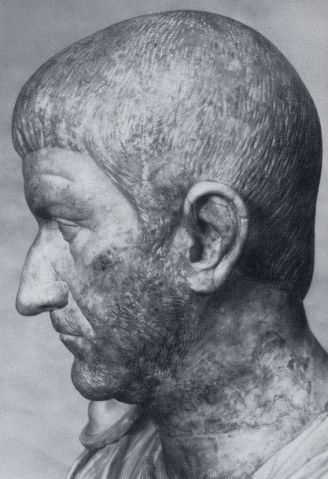
Portrait head of Tetrarch (Diocletian or Maximian?) in Milan-Munich type. From Italy. Late third century.
Record details
Photographs
Bibliography
- Mansuelli, G. A. , Galleria degli Uffizi : le sculture, II, Rome 1961, 119-120, no. 153, fig. 153 (Maximinus Thrax?)
Discussion
DESCRIPTION (Object)
Over life-size head. H (of bust): 57, H (of head): 23 cm. Italian marble.
The head appears to be attached to the bust by means of a cylindrical marble spacer at the base of the neck. The bust foot, also modern, has a tabula which is inscribed MAXIMINUS. The back of the head, the right ear, the outer edge of the left ear, the nose, and the chin are also modern restorations.
The hair is engraved in long strands with a fine flat chisel; a light beard is also engraved with a fine chisel. The irises are semi-circular, and the pupils appear to be drilled. The eyes, however, are difficult to make out in the published photographs.
PROVENANCE
The head was formerly in the Gaddi collection, and it was recorded there in 1702. The Gaddi were a Florentine family. It arrived in the Uffizi in 1778.
DESCRIPTION (Subject)
The portrait shows a mature man with a distinctive physiognomy who turns to his right. He has short, straight hair that falls forward. The locks of the fringe are separated by small areas of exposed brow. The locks over the centre of the brow turn inwards and converge over the inner corner of the left eye. The locks also part over the outer corner of the right eye. Immediately to the outside of this part is an exposed area of brow that moves upwards well into the hair.T he beard and moustache are light and slightly wavy.
The face is long and triangular. The brow is broad and has a heavy crease across it. The eyes are small and have curving wrinkles beneath the lower lids which echo the form of the lower lids. The nose was once (as it is in the restoration) hooked. The naso-labial folds are deep and long. The mouth is broad, tightly closed, and thin-lipped. The chin is receding, and there is loose skin (‘double chin’) beneath it. In addition, the neck has two rolls of flesh.
DATE AND HONORAND
This portrait is known in four other versions which follow the same type (Milan-Munich type). The other versions are varied but clearly depend on one model. These are LSA-1028 supposedly from Egypt but possibly not ancient, LSA-1029 from Utica, LSA-1030 now in Munich, and LSA-1031 possibly from Milan.
Although the portrait type has been associated with Maximinus Thrax, recent scholarship has argued convincingly that it is stylistically and conceptually better placed in the Tetrarchic period; compare the Tetrarchic portraits in Ostia (LSA-848, LSA-1055) or the type associated with Maxentius (see LSA-895, LSA-897).
Because of the number of examples of the type (four or five) and the fact that one of the examples (LSA-1029) wears a corona civica, the type must have represented an emperor. Scholars are divided as to its identity; both Maximian and Diocletian have been proposed.
Discussion references
- Calza, R., Iconografia Romana Imperiale. Da Carausio a Giuliano (287-363 d. C.), Rome 1972, 123-124, no. 32 (Maximian)
- Demandt, A. and J. Engemann, (eds.), Konstantin der Grosse, Mainz 2007
, no. I.7.3 (A. Romualdi: overview of research to date) - L'Orange, H. P., Das spätantike Herrscherbild von Diokletian bis zu den Konstantin-Söhnen, 284-361 n. Chr. Das Römische Herrscherbild. III. Abteilung ; Bd. 4 , Berlin 1984, 17, 95-6, pl. 10a-c (Diocletian)
Cite: Last Statues of Antiquity, LSA-1027 (J. Lenaghan).