
LSA-1028
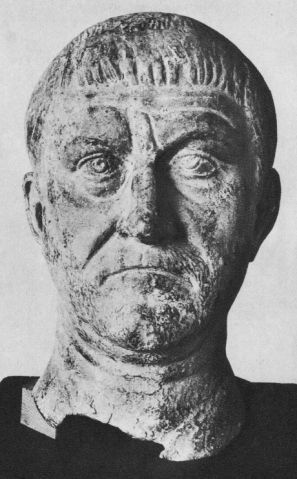
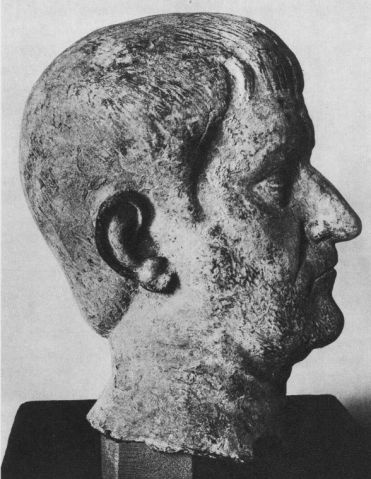
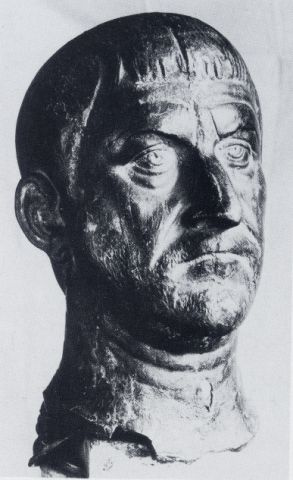
Bronze portrait of Tetrarch (Diocletian or Maximinian?) in Milan-Munich type, possibly modern. From Crocodilopolis (Augustamnica, after 400 Arcadia). Late third century.
Record details
Photographs
Bibliography
- Graindor, P., Bustes et statues-portraits d'Égypte romaine, Cairo 1937, 64-5, no. 20, pl. 19 (Maximinus Thrax)
Discussion
DESCRIPTION (Object)
Over life-size head, worked separately. H: 34 cm. Bronze.
The head appears to have been worked separately. There is a missing area in the bottom edge of the neck at the front right. There is a round, horizontal hole in the neck which has been filled.The hair is engraved The irises are semi-circular, and the pupils are round holes.
PROVENANCE
The head was in the possession of the art dealer Bircher in Cairo from 1914 and certainly until 1936 when Graindor published as being there. It was said to be from Crocodilopolis. Its current location is unknown.
DESCRIPTION (Subject)
The portrait shows a mature man with a distinctive physiognomy. He has short, straight hair that falls forward. The locks of the fringe are separated by small areas of exposed brow. The locks over the centre of the brow come slightly forward and mainly turn inwards. The locks part over the middle of the left eye and over the outer corner of the right eye. Immediately to the outside of this part is an exposed area of brow that moves upwards well into the hair. The beard and moustache are light.
The face is long, triangular, and marked by signs of age. The brow is broad and has a heavy crease across it and two vertical lines above the root of the nose. The eyebrows flare, and the eyes are small with curving wrinkles beneath the lower lids which echo the form of the lower lids. The nose is hooked. The naso-labial folds are deep and long. The mouth is broad, tightly closed, thin-lipped, and downturned. The chin is small, and there is loose skin (‘double chin’) beneath it. In addition, the neck has two rolls of flesh.
AUTHENTICITY
In the documents of G. Kaschnitz-Weinberg there is another picture of a bronze head which is almost identical to this; it is labelled ‘private collection Europe’. The date of the label, however, is unclear. Either the Kaschnitz-Weinberg shows the same head in an earlier, ‘pre-art market’, state of conservation or the photograph shows another head altogether. Given the perimeter of the neck line and the hole in the neck, it would seem to me that these are two different head.
Thus, K. Parlasca argues that both bronze heads, both now lost, were Renaissance bronzes made after the marble head in the Gaddi collection in Florence, LSA-1027. This sort of reproduction was common in Florence.
In 1984 L’Orange however believes that the photographs show only ONE bronze head. He also believes that the provenance of Fayum is valid. Thus, he points out that there are differences between the Florence head and the bronze under discussion here; for example, in the mouth and hair over the brow.
Whereas Parlasca’s argument is compelling, until the bronze heads can be located or further pictures become available, I withhold judgement.
DATE AND HONORAND
If this portrait is ancient, it is one of five versions which follow the same type (Milan-Munich type). The other versions are varied but clearly depend on one model. These are LSA-1027 from Italy, LSA-1029 from Utica, LSA-1030 now in Munich, and LSA-1031 possibly from Milan.
Because of the number of examples of the type (four or five) and the fact that one of the examples (LSA-1029) wears a corona civica, the type must have represented an emperor. Scholars are divided as to its identity; both Maximian and Diocletian have been proposed. A previous identification as Maximinus Thrax can be disregarded on both technical and iconographic grounds.
Discussion references
- L'Orange, H. P., Das spätantike Herrscherbild von Diokletian bis zu den Konstantin-Söhnen, 284-361 n. Chr. Das Römische Herrscherbild. III. Abteilung ; Bd. 4 , Berlin 1984, 17-19, 96-7, pl. 10d (argues for authenticity)
- Parlasca, K. '‘Zwei falsche Bronzeporträts', Archäologischer Anzeiger, Berlin 1969, 203-207, figs. 2-3 (modern forgery)
Cite: Last Statues of Antiquity, LSA-1028 (J. Lenaghan).