
LSA-103
Base for statue of Rufius Festus, governor of Achaea. Athens (Achaea), Acropolis. Mid to late fourth century
Record details
Photographs
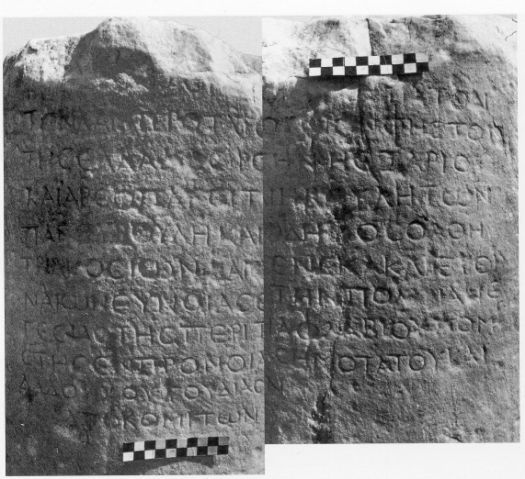
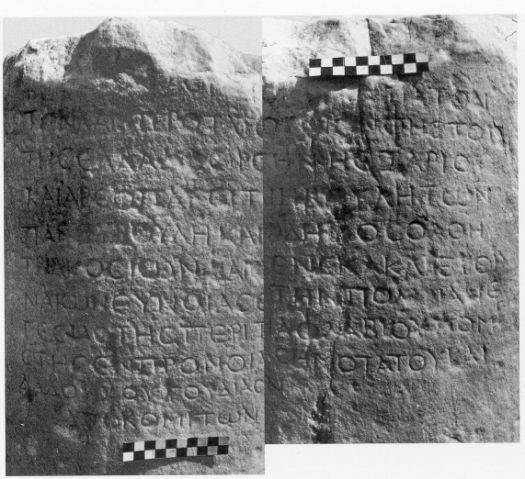
Inscription
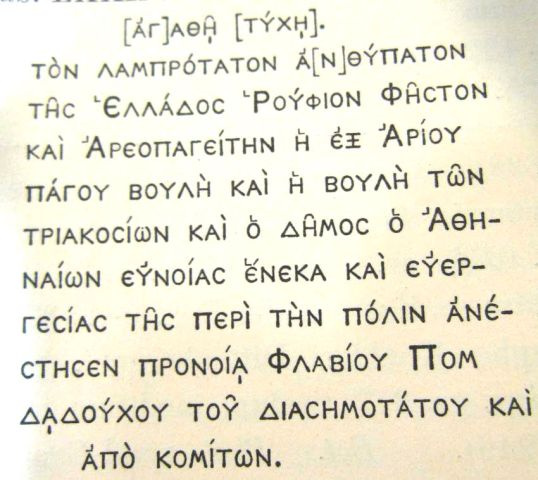
[Ἀ]γ̣αθ̣ῆ̣[ι τύχηι]. // τὸν λαμπρότατον̣̣̣ ἀ̣ν̣θ̣ύπα̣τον /(3) τῆς Ἑλλάδο̣ς Ῥούφιον Φῆστον / καὶ Ἀρεοπαγε̣ίτην, ἡ ἐξ Ἀρίου/πάγο̣υ βο̣υλὴ τῶν / (6) τριακοσίων καὶ ὁ̣ δῆμ̣ος ὁ Ἀθη/ναίων, εὐνοίας κ<α>ὶ εὐερ/γεσίας τῆς περὶ τὴν πόλιν ἀνέ/στησεν, προνοίᾳ Φλαβίου Πομ(πηίου?) / (10) Δᾳδούχου, τοῦ διασημοτάτου καὶ / ἀ̣πὸ κομίτων.
Inscription translation
To good Fortune. The council of the Areopagus and the council of the 300 members and the people of Athens set [this] up [to] the man of clarissimus rank, governor (anthupatos) of Achaea and member of the council of the Areopagus, Rufius Festus, for his favour and beneficence towards the city. The torchbearer (dadouchos) Flavius Pompeianus, of perfectissimus rank and former comes (apo comiton), took charge.
Bibliography
- Inscriptiones Graecae, II/III 4222
- Inscriptiones Graecae, II/III(2) 13274
Discussion
INSCRIPTION
In eleven lines:
[Ἀ]γ̣αθ̣ῆ̣[ι τύχηι]. // τὸν λαμπρότατον̣̣̣ ἀ̣ν̣θ̣ύπα̣τον /(3) τῆς Ἑλλάδο̣ς Ῥούφιον Φῆστον / καὶ Ἀρεοπαγε̣ίτην, ἡ ἐξ Ἀρίου/πάγο̣υ βο̣υλὴ τῶν / (6) τριακοσίων καὶ ὁ̣ δῆμ̣ος ὁ Ἀθη/ναίων, εὐνοίας κ<α>ὶ εὐερ/γεσίας τῆς περὶ τὴν πόλιν ἀνέ/στησεν, προνοίᾳ Φλαβίου Πομ(πηίου?) / (10) Δᾳδούχου, τοῦ διασημοτάτου καὶ / ἀ̣πὸ κομίτων.
'To good Fortune. The council of the Areopagus and the council of the 300 members and the people of Athens set [this] up [to] the man of clarissimus rank, governor (anthupatos) of Achaea and member of the council of the Areopagus, Rufius Festus, for his favour and beneficence towards the city. The torchbearer (dadouchos) Flavius Pompeianus, of perfectissimus rank and former comes (apo comiton), took charge.'
Letter height 1-2 cm.
DESCRIPTION (from Sironen 1997 and the published photo)
Re-used cylindrical statue base of white marble (Pentelic, according to Sironen 1997, 66), part of top edge broken: H 87, W 50, D 50 cm. A first-use inscription from the early third century, for L. Egnatius Victor Lollianus, (IG II/III 4217) is cut on the opposite side. On the top there is a round cavity, 4 cm deep, for the insertion of the plinth of a marble statue.
PROVENANCE AND CURRENT LOCATION
The base was found on the Acropolis, but, according to Sironen 1997, information about the exact find-spot is ambiguous: either the colonnade of the Parthenon, or between the Propylea and Erechtheion (Sironen 1997, 66). The base is today preserved on the Acropolis, between the Erechtheion and Propylea (National Museum inv. no. MA 13247).
HONORAND, AWARDER, AND DATE
The identity of the honorand is debated. Groag 1946 argued for a son of the poet Rufius Festus Avienus, and suggested a terminus post quem of 372 for his governorship of Achaea; he has been followed in this by Sironen 1994 and 1997, and in IG II/III(2). However, Matthews and PLRE have attributed our inscription to the poet himself, who was active in the mid to late fourth century and who is known to have held two governorships (Matthews 1967; PLRE I, 336-7 Festus 12). Rufius Festus, besides being proconsul, was a member of the council of the Areopagus in Athens; this is attested also for the proconsul Claudius Illyrius in the late 3rd century (LSA-93, LSA-94; Sironen 1994, 29 with n. 73).
The dedication is awarded by three civic bodies, the council of the Areopagus, the council, and the people of Athens (lines 4-6). This is 'the official address of the polis of the Athenians during the Roman period' (Geagan 1967, 32 and appendix pp. 139-42); the council has been reduced, however, to 300 members (from 600, respectively 500 after reform by Hadrian, and 750 in the later 3rd century, Geagan 1967, 74) by the 4th century (LSA-96).
Pompeianus, the man responsible for erecting the statue on the orders of the city, was a dadouch (priestly torchbearer) at the shrine of Eleusis, an office held by aristocratic families of Athens. It is a characteristic of the 4th-century inscriptions of Athens that aristocrats were proudly listing their traditional priestly titles.
Discussion references
- Geagan, D. J., The Athenian Constitution after Sulla (Hesperia supplement XII), Princeton 1967
- Groag, E., Die Reichsbeamten von Achaia in spätrömischer Zeit, Budapest 1946, 49-51
- Jones, A. H. M. et al., The Prosopography of the Later Roman Empire. Vol. I 260-395, Cambridge et al. 1971 (1975), 336-7
- Matthews, J. Continuity in a Roman Family: the Rufii Festi of Volsinii, Historia 16, 1967, 484-509
- Sironen, E., The late Roman and early Byzantine inscriptions of Athens and Attica, Dissertation - University of Helsinki 1997, 66-9 no. 12
- Sironen, E. , 'Life and administration of late Roman Attica in the light of public inscriptions'
P. Castrén, Post-Herulian Athens : aspects of life and culture in Athens, A.D. 267-529 , Helsiniki 1994, 15-62, 29 no. 13
Cite: Last Statues of Antiquity, LSA-103 (Ulrich Gehn).