
LSA-1030
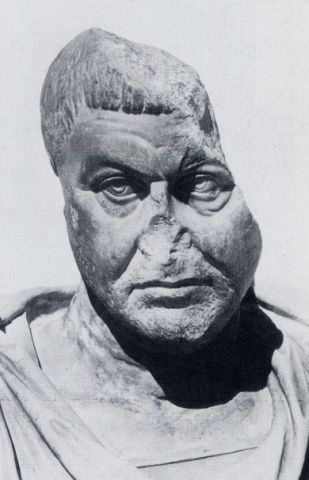
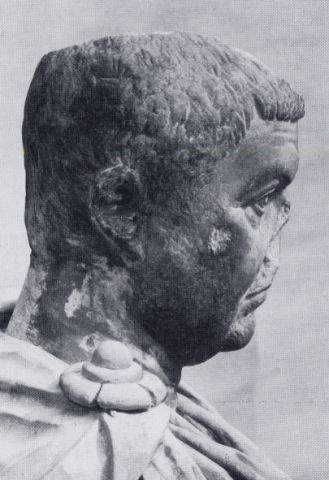
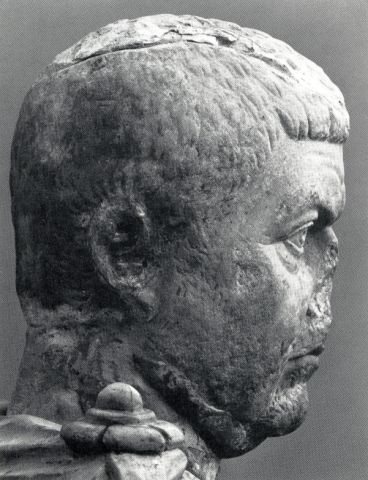
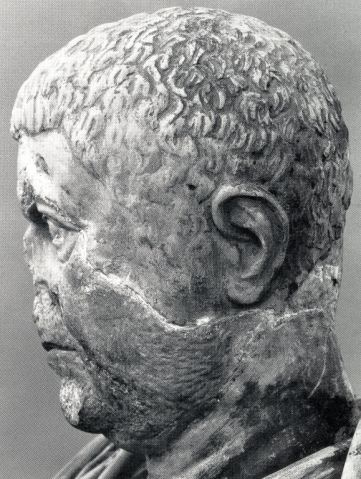
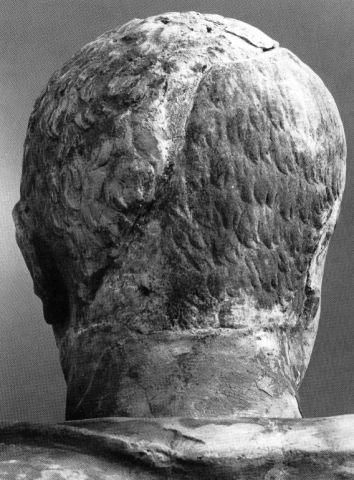
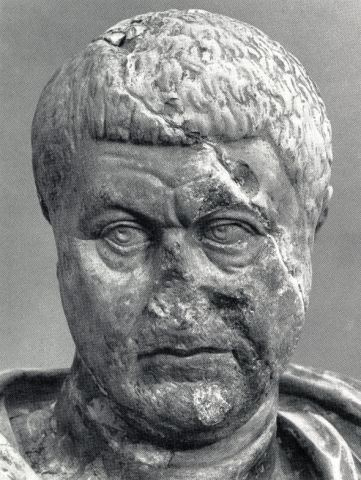
Portrait of Tetrarch (Diocletian or Maximian?) in Milan-Munich type. Unknown provenance. Late third century.
Record details
Photographs
Bibliography
- Weski, E. and H. Frosien-Leinz (eds.), Das Antiquarium der Münchner Residenz : Katalog der Skulpturen, Munich 1987, 261-2, no. 148 (doubts pertinence to type)
Discussion
DESCRIPTION (Object)
Over life-size head. H: 28.5 cm, H (of face): 19, W (of face): 16.5 cm. Large-grained marble.
The head is heavily restored and has been attached to a neck and bust in the modern period. The lower break runs from the top of the front of the neck into the hair on the nape at back. Missing is an area on the back left and the nose. A large diagonal slice which includes the left temple , left side of the head, ear, and some of the cheek is modern restoration.
The hair is rendered in short over-lapping locks. Over the left eye, vertical cuts of a chisel have been added to the brow hair. The facial hair is indicated with short curving strokes of a chisel. The irises are greater than semi-circular and are finely engraved. The pupils are crescent shaped.
PROVENANCE
According to L’Orange this portrait is from Egypt. Acording to Weski and Frosien-Leinz , the marble and technique suggest an eastern origin. It seems to me that the head has been expertly restored by restorers who knew LSA-1027 (see below). This further suggests that it had been in Italy.
DESCRIPTION (Subject)
The portrait shows a mature man with a distinctive physiognomy. He has short, straight hair that is brushed forward and cut high over the brow. The locks of the fringe are short, have three vertical slashes cut into the extant right side, a triangular parting over the outer corner of the right eye. T he beard and moustache are light and slightly wavy.
The face is full but ends in a small chin. The brow is broad and has heavy irregular creases across it and short vertical lines of contraction stemming from the root of the nose. The eyes are small but set under raised eyebrows and accentuated by deep parallel wrinkles below them. The naso-labial folds are deep, slightly curving, and long. The mouth is broad, thin-lipped, and downturned. The receding chin has a loose roll of flesh (double chin) below it.
TYPE AND DATE
This portrait should be considered with a group of four other portraits. The group presents problems of authenticity, identity, and typology. The other portraits are LSA-1027 from Italy , LSA-1028 supposedly from Egypt but possibly not ancient, LSA-1029 from Utica, and LSA-1031 probably from Milan.
The well-known head in Florence LSA-1027 has been perhaps justifiably considered the model for the bronze head, LSA-1028. It has less securely been considered a source for the head in Milan, LSA-1031. Certainly the restorers of the head under discussion, now in Munich, must have been familiar with the Florence head because the restoration of the neck follows that head.
Nonetheless, Florence, Milan, Munich, and Utica present enough similarities to be considered based on the same model. They are probably all re-cut from earlier portraits in the Tetrarchic period. Thus, the strict formal adherence to a type that characterized high-imperial production is no longer to be expected. In this case, the portrait shares the detail of the part over the outer corner of the right eye with the Florence head and with the Milan head the deep slashes in the brow hair. With both of those examples, it shares the creases on the brow, the lined orbitals, and the double chin.
IDENTITY
The type has been periodically associated with Maximinus Thrax (235-238). Of all the extant examples, this head in Munich comes closest to the square solidity of the facial structure of Maximinus Thrax. However, the technical details of the better preserved examples of the type make the Tetrarchic date most probable.
Scholars currently now identify the type as either Maximian or Diocletian. The Maximian argument is mainly based on the find locations of Milan and Africa. L’Orange, however, argues that the sheer number and widespread diffusion of the portrait better suits Diocletian.
Discussion references
- L'Orange, H. P., Das spätantike Herrscherbild von Diokletian bis zu den Konstantin-Söhnen, 284-361 n. Chr. Das Römische Herrscherbild. III. Abteilung ; Bd. 4 , Berlin 1984, 17-20, 98, pl. 11c-d
Cite: Last Statues of Antiquity, LSA-1030 (J. Lenaghan).