
LSA-1032
Base for statue of Constantinian emperor, probably Constantine II. Thasos (Insulae). 317-337
Record details
Photographs
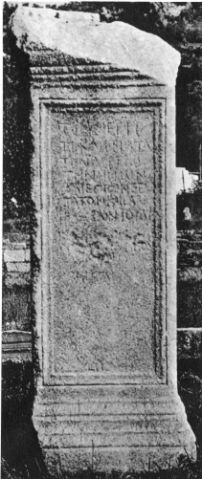
Inscription
Τὸν μέγισ- / τον καὶ θειότα- / τον δεσπό- /(4) την ἡμῶν / καὶ ἐπιφανέσ-/τατον Καίσαρα / Φλάβιον Ἰουλι- /(8) --- / --Ν̣..Ι Κ ̣̣ΟΝ / ----ΟΝ / ἡ πόλις.
Inscription translation
The city (set this up to) our most powerful and divine Lord and most noble Caesar Flavius Iuli ....
Bibliography
- Dunant, C. & J. Pouilloux, Recherches sur l'Histoire et les cultes de Thasos. II. De 196 avant J.-C. jusqu'à la fin de l'Antiquité (Études Thasiennes V), Paris 1958, 190-2 no. 360
Discussion
INSCRIPTION
In eleven lines:
Τὸν μέγισ- / τον καὶ θειότα/τον δεσπό/την ἡμῶν /(5) καὶ ἐπιφανέσ/τατον Καίσαρα / Φλάβιον Ἰουλι- / --- / --Ν̣..Ι Κ ̣̣ΟΝ /(10) ----ΟΝ / ἡ πόλις
'The city (set this up to) our most powerful and divine Lord and most noble Caesar Flavius Iuli ....'
The inscription is dedicated to an emperor of the Constantinian dynasty whose name is partly erased (see below, 'Honorand, Awarder, and Date').
Letter height 4.5 cm.
DESCRIPTION (from Dunant & Pouilloux and the published photo)
Tall base of Thasian marble, moulded at top and bottom. H 182 cm, W 55 cm, D 55 cm. Top moulding on front side broken diagonally from left corner pitch to beginning of moulding at right corner, and at lower left corner. The epigraphic field is framed.
PROVENANCE/ LOCATION
The base was discovered 1951 in the medieval fort on the Agora of Thasos. Now in the Thasos Museum, inv. no. 976
HONORAND AND DATE
The honorand is an emperor; the attribute 'epiphanestatos’ (line 5) makes sure that he is a Caesar, not an Augustus. Of his name Φλάβιον Ἰουλι- -Flavius Iuli.. has survived (line 7), which assigns him to the Constantinian dynasty. The extant letters can be extended to the names of Constantine’s sons Flavius Iulius Crispus (Caesar 317-26), or Flavius Iulius Constantius (Constantius II, Caesar 324-37), or Flavius Iulius Constans (Caesar 333-7). Constantine’s fourth son, Constantine II (Caesar 317-37) is usually called Flavius Claudius Constantinus, but on some coins also Flavius Iulius Constantinus. The name of Constantine’s nephew Flavius Iulius Dalmatius (Caesar 335-7) is possible, but less likely. Julian, full name Flavius Claudius Julianus, is unlikely because the nomen Claudius would have been omitted.
Of Constantine’s sons, the name of Constantine II has often been erased after his defeat by his brother Constans and his death in 340. This can explain the erasure of the imperial name (lines 7-8); in our view the inscription goes most likely to Constantine II, despite the fact that the unusual nomen Iulius is selected for him.
The inscription was set up by the city of Thasos.
Cite: Last Statues of Antiquity, LSA-1032 (Ulrich Gehn).