
LSA-1033
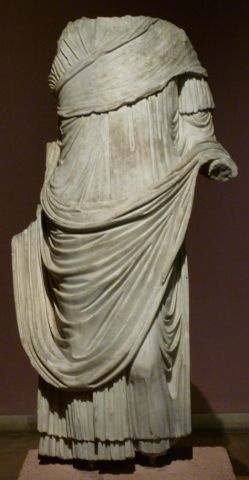
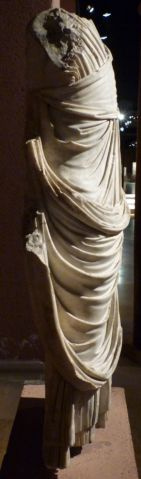
Body of portrait statue of man in toga. Constantinople. Late fourth to earlier fifth century.
Record details
Photographs
Bibliography
- Fıratlı, N., La sculpture byzantine figurée au Musée archéologique d'Istanbul, Paris 1990, 12, no. 14, pl. 8
- Gehn, U., Ehrenstatuen in der Spätantike. Chlamydati und Togati, Wiesbaden 2012, 351-2 cat. no. O 3 pl. 2
- Kollwitz, J., Oströmische Plastik der theodosianischen Zeit, Berlin 1941, 84-5, no. 4, pls. 21-2
Discussion
DESCRIPTION (Object)
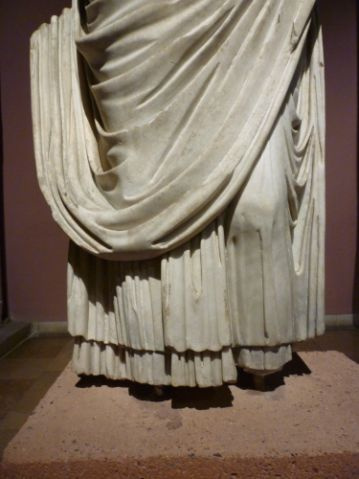
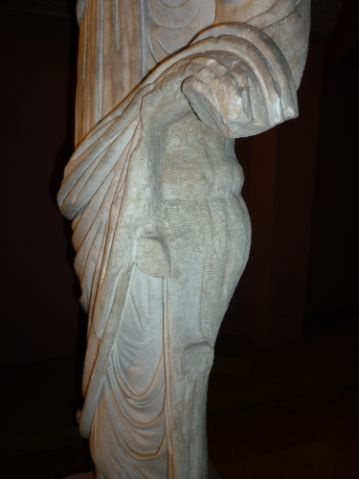
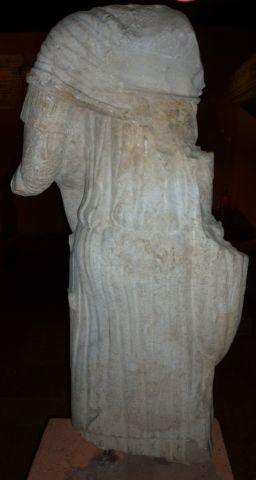
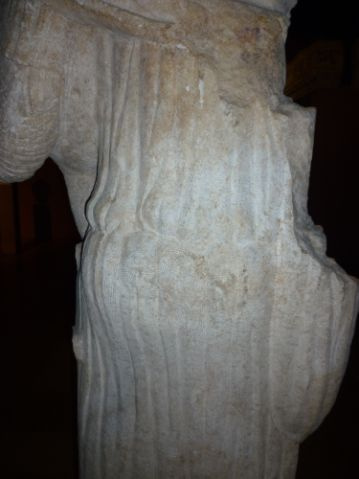
Life-size marble statue H, 122, W (at left arm) 54, D 26 cm. The right arm together with a large part of the garment and of the back at the right side, left wrist and hand, and the feet are missing. The head was worked separately and is also missing. The hollowed hole at the neck is preserved.
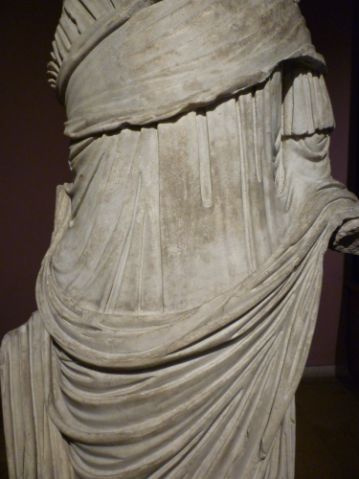
The folds of the garments are detailed, with plastic values. The body under the garment is visible and determines the fall of the folds.
PROVENANCE AND CURRENT LOCATION
The statue was found in Istanbul, near Tahtakale Hamam, at the Golden Horn (Müller-Wiener 1977, 331). The only major public space in the wider area, the strategion, was situated some hundred meters west of this location. It is well possible therefore, that our statue is from a senatorial or domestic context, rather than imperial.
The statue is now in the Archaeological Museum, Istanbul, inv. no. 4417; it entered the museum collection in 1939.
DESCRIPTION (Subject)
The statue stands over its right leg; the left knee is bent and becomes apparent under the heavy garment. The left arm is bent in the elbow and was stretched out towards the front. The right arm is lost; however, the vertical folds at the right shoulder indicate that it was possibly raised in a gesture similar to that of the so called Consules in Rome (LSA-1068, LSA-1069). No attribute is preserved (on this issue see Gehn 2012, 141-2).
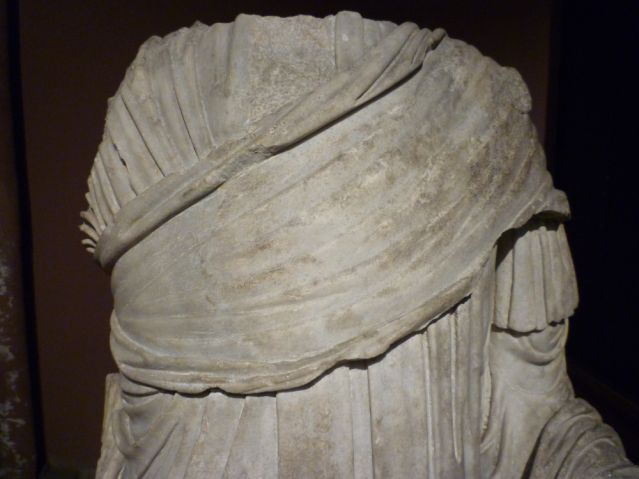
The portrayed wears two undergarments, an ankle-length tunic with long sleeves (tunica manicata) visible at the lower seam and at the left arm, and an upper tunic (colobium) which is only slightly shorter. The colobium is held by a belt, as is visible at the back and at the open left side; the belt is covered by a pad of garment.
One layer of the late antique toga crosses the breast from the right armpit to the left shoulder (the balteus), a second layer is extended in front of the lower body in the form of a broad sinus; since the belt is not visible at the front side, the layer of garment spread out here between balteus and sinus must also belong to the toga. The tip of the garment is hanging over the left forearm.
Different from most other statues in the late antique toga, the lorum is not visible below the seam of the sinus; the only parallel in this respect is the statue of a Theodosian emperor in Aphrodisias, LSA-165 (for similar display see also the late antique toga statues in Rome, LSA-1068, LSA-1069). However, the broad vertical stripe at the front side is probably the imprint of the lorum which is worn above the colobium, but under the cloak. Almost uniquely among the late antique type toga statues is the broad vertical stripe below the neck (the lorum?); the only parallel known to me is the Athenian statue LSA-143.
The late antique toga identifies the portrayed as a man of senatorial rank, or perhaps as an emperor. The find spot far from the imperial palace and the central places of imperial representation along the Mese probably speaks in favour of a non-imperial honorand (see above, 'Provenance and Current Location').
DATE
The arrangement of the late antique toga with the balteus spreading out at the left shoulder is displayed by the togati on the reliefs of the obelisk base in Constantinople (dated 390/2). This feature is missing, however, at the imperial statues from Aphrodisias, LSA-163 and LSA-165, dated 388/92 (see also the ‘togate with inkpot’, likewise in Aphrodisias, LSA-154). All later representations of the late antique toga follow the typological alterations introduced by the obelisk reliefs (Gehn 2012, 137-40). Another typological feature, the visibility of the seams of both tunics, is likewise not displayed by the early Aphrodosian monuments, but shared by all later statues (Gehn l. c. 140). I therefore assume that our statue dates somewhat later than the imperial statues from Aphrodisias, in the late 4th or early 5th century. A date in the earlier 5th century is suggested by the spread out sinus, while later statues show this piece of the garment reduced to a broad scarf-like coil (e. g. LSA-147, LSA-198; cf. Gehn 2012, 138-9).
A date in the late 4th/ early 5th century is supported by the stylistic values of the statue, the classicizing relation between garment and underlying body, and the plastic values of the modelings (Gehn 2012, 147-50).
Cite: Last Statues of Antiquity, LSA-1033 (Ulrich Gehn).