
LSA-1034
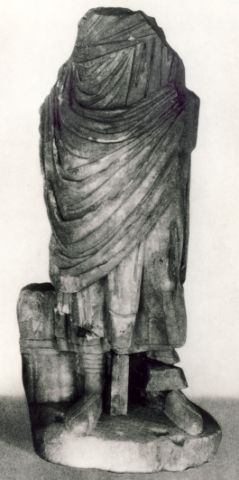
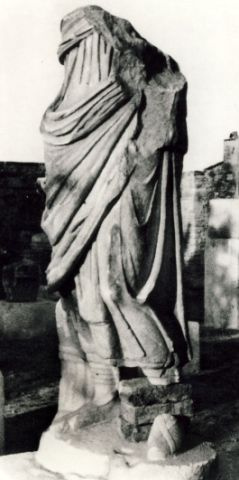
Over life-size togate portrait statue (preserved from chest to plinth). From Ephesus. Late fourth century to early fifth century.
Record details
Photographs
Bibliography
- Kollwitz, J., Oströmische Plastik der theodosianischen Zeit, Berlin 1941, 85-6, 99 ff., no. 6, pl. 20.1-2
Discussion
DESCRIPTION (Object)
Over life-size statue. H: 155 cm. Medium-grained white marble.
The statue is now preserved in three parts. Lower part of the body is preserved from chest to the lower end of the garment. Right foot and left foot with plinth separately preserved. Plinth broken in middle (break not visible in Kollwitz photograph). In the break surface at right shin is a square cutting, very likely for repair (for patching with torso). Arms not preserved. Back of the statue heavily damaged.
Deep folds are drilled. Back of statue flat and with tooth chiselled surface. Clamp cutting on the top of the plinth on hte inside of the left foot.
PROVENANCE
Found during excavations of the Celsus library, in 1905(?).
DESCRIPTION (Subject)
Figure stands with weight over the right leg. A bundle of upright scrolls supports the statue on the outside of the right leg. It wears the senatorial calcei with straps crossing over the foot, wrapping around the leg above the ankle, and their ends falling around the ankles.
The statue wears a late antique toga over two tunics: a long-sleeved (the tunica manicata ), and, over it a slightly shorter colobium . The toga's lower edge, the sinus, hangs along the right side of the body until the knee. The long-sleeved under-tunic is visible at the shins. The colobium appears at the right chest and below the lower curve of the sinus.
CONTEXT
The find location at the Celsus library is not necessarily its primary context.
DATE
The type of the toga is like the one of Arcadius (LSA-163) and consequently suggests a date in the period of Theodosius I or slightly later. Both Kollwitz and Oberleitner dated the torso around 400 on the basis of a stylistic comparison to Arcadius (LSA-163), the 'Elder Magistrate' (LSA-169), and the 'Younger Magistrate' (LSA-170) from Aphrodisias.
Discussion references
- Oberleitner, W. 'Fragment eines spätantiken Porträtkopfes aus Ephesos', Jahreshefte des Österreichischen archäologischen Instituts in Wien 44, Vienna 1959, 96-7
Cite: Last Statues of Antiquity, LSA-1034 (J. Auinger).