
LSA-1036
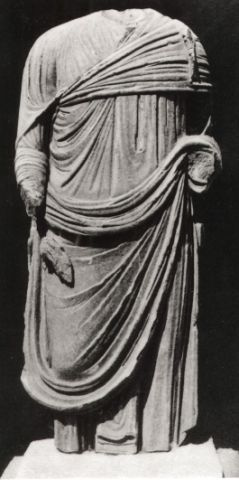
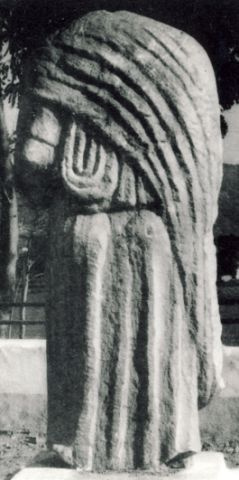
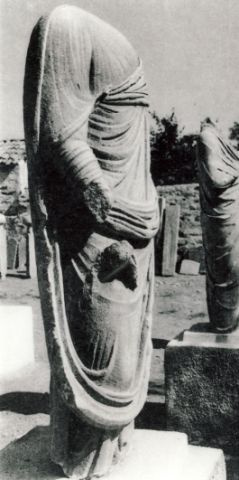
Togate portrait statue holding sceptre. From Ephesus. Late fourth century to early fifth century.
Record details
Photographs
Bibliography
- Kollwitz, J., Oströmische Plastik der theodosianischen Zeit, Berlin 1941, 87, 107 ff, no. 8, pls. 27, 28.1-2, Beilage 14
Discussion
DESCRIPTION (Object)
Over-life size statue. H: 156 cm (torso), H: 52 cm (Plinth with left leg area). Medium-sized white marble.
The statue is preserved in three pieces: torso from neck to lower edge of toga, ankles of left leg with scroll bundle and plinth with left foot. Plinth broken in middle, right foot with plinth is missing. Head separately worked (cutting in neck of torso with dowel-hole), not preserved. Square cutting in the bottom between the legs, this cutting corresponds on a cutting on the top of the plinth, very likely for repair
Torso found in good state of preservation (now washed). Right arm preserved to wrist, left arm up to elbow. Various folds are chipped off, edge of rear part of sinus broken off. On right thigh rest of mappa. On left shoulder broken end of scepter.
Deep fold are drilled, back of statue flat and with tooth chiselled surface.
PROVENANCE
Found during excavations on marble street before 1908, built into one of the late walls.
DESCRIPTION (Subject)
Figure stands with weight over the left leg. The right arm is held down along the side of the body with the forearm lightly projecting, once holding the mappa. The left forearm is projecting, once holding a scepter. A bundle uppright scrolls supports the statue of the left leg. He wears the senatorial calcei with the crossed straps directly over the foot and their ends falling near the ankles.
The statue wears a late antique toga over two tunics: a long-sleeved (the tunica manicata ), and, over it a slightly shorter colobium . The toga's lower edge, the sinus, hangs along the right side of the body until the knee and is then draped over the left arm. The long-sleeved under-tunic is visible on the right arm and at the shins. The colobium appears at the right chest and below the lower curve ot the sinus.
DATE
The form of the toga compares well to the figures on the base of Theodosius in Istanbul. It should be therefore late fourth century. Kollwitz dated stylistically the torso from Ephesos in the middle of the fifth century, later than the togatus found near the Laleli Camii (LSA-1040). Also on stylistic grounds, Oberleitner dated the togatus at the end of the fifth century. These dates illustrate the difficulties in stylistic dating.
Discussion references
- Auinger, J. 'Zum Umgang mit Statuen hoher Würdenträger in spätantiker und nachantiker Zeit entlang der Kurenstrasse in Ephesos', Vienna 2009, 37, fig. 22
- Oberleitner, W. 'Fragment eines spätantiken Porträtkopfes aus Ephesos', Jahreshefte des Österreichischen archäologischen Instituts in Wien 44, Vienna 1959, 88. 97
Cite: Last Statues of Antiquity, LSA-1036 (J. Auinger).