
LSA-1038
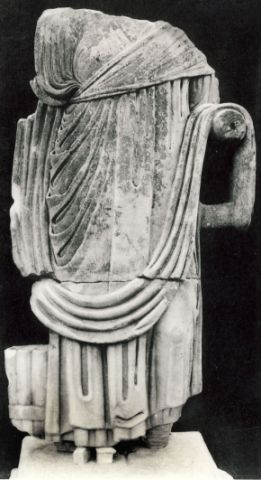
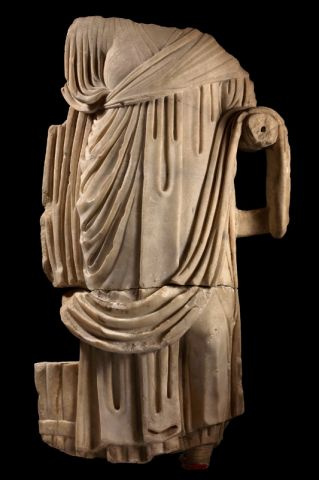
Togate portrait statue (preserved from chest to lower legs). From Ephesus. Fifth century.
Record details
Photographs
Bibliography
- Kollwitz, J., Oströmische Plastik der theodosianischen Zeit, Berlin 1941, 87-8, no. 10, pl. 31.1, Beiblatt 14
Discussion
DESCRIPTION (Object)
Life-size statue. H 135 cm. Greyish coarse-grained marble.
The statue is preserved in two parts. Upper part of the body is preserved from chest to the region above the knees (horizontal break). Lower part until the end of the garment. Beside the right leg is the upper part of a scroll-bundle. Right arm not preserved, left arm preserved up to wrist.
Various folds are chipped off, espacielly some parts of the external edge of the sinus are broken off. Deep folds are drilled. Back of statue flat and with tooth chiselled surface. The left hand was separately worked, fixed with a dowel.
PROVENANCE
Found during excavations on marble street before 1908, built into one of the late walls.
DESCRIPTION (Subject)
Figure stands with weight over the right leg. Because of the colobium<i/>- folds on the right side of the chest, the right arm was raised up, once holding the mappa. The left forearm is projecting, once holding a scepter. A bundle uppright scrolls supports the statue of the right leg.
The statue wears a late antique toga over two tunics: a long-sleeved (the tunica manicata ), and, over it a slightly shorter colobium . The toga's lower edge, the sinus, hangs along the right side of the body until the knee and is then draped over the left arm. The long-sleeved under-tunic is visible at the shins. The colobium appears at the right chest and below the lower curve ot the sinus.
DATE
Stylistic and technical details link him closely with Pytheas from Aphrodisias (LSA-147). Maybe they are from the same workshop. It should be therefore maybe late fifth century.
Kollwitz dated stylistically the torso from Ephesos around 430-40, also on stylistic grounds, Oberleitner dated the togatus 520-30. These dates illustrate the difficulties in stylistic dating.
Discussion references
- Auinger, J. 'Zum Umgang mit Statuen hoher Würdenträger in spätantiker und nachantiker Zeit entlang der Kurenstrasse in Ephesos', Vienna 2009, 37, fig. 22
- Oberleitner, W. 'Fragment eines spätantiken Porträtkopfes aus Ephesos', Jahreshefte des Österreichischen Archäologischen Instituts in Wien 44, Vienna 1959, 88. 97
Cite: Last Statues of Antiquity, LSA-1038 (J. Auinger).