
LSA-1039
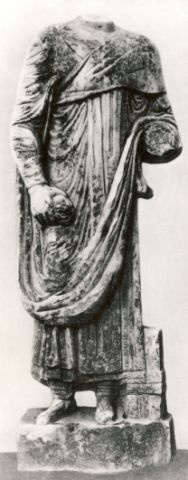
Headless togate portrait statue with mappa. From Ephesus. Fifth century.
Record details
Photographs
Bibliography
- Kollwitz, J., Oströmische Plastik der theodosianischen Zeit, Berlin 1941, 88. 112, no. 11, pl. 32.2
Discussion
DESCRIPTION (Object)
Over-life size statue. H: 190 cm. Medium-sized grey marble.
The statue is preserved in two pieces: torso from neck to the ankles, and plinth with feet and scroll-bundle, horizontal break. Head separately worked (flat cutting for neck, with clamb-hole in front, maybe dowel-hole in the middle), not preserved. Left arm preserved up to elbow. On left shoulder broken end of sceptre.
Surface weathered. Back of statue flat.
PROVENANCE
Found on the Embolos, between library and octagon, in 1904.
DESCRIPTION (Subject)
Figure stands with weight over the left leg. The right arm is held down along the side of the body with the forearm lightly projecting, holding the mappa. The left forearm is projecting, once holding a sceptre. A bundle uppright scrolls supports the statue of the left leg. He wears the senatorial calcei with the crossed straps directly over the foot and their ends falling near the ankles.
The statue wears a late antique toga over two tunics: a long-sleeved (the tunica manicata ), and, over it a slightly shorter colobium . The toga's lower edge, the sinus, hangs along the right side of the body until the knee and is then draped over the left arm. The long-sleeved under-tunic is visible on the right arm and at the shins. The colobium appears at the right chest and below the lower curve ot the sinus.
DATE
Kollwitz and Oberleitner decided to put this torso at the end of their theoretically stylistic sequence of late antique togate statues (Kollwitz: around 500, Oberleitner: shortly after the middle of the sixth century).
Discussion references
- Auinger, J. 'Zum Umgang mit Statuen hoher Würdenträger in spätantiker und nachantiker Zeit entlang der Kurenstrasse in Ephesos', Vienna 2009, 36, figs. 19-20
- Oberleitner, W. 'Fragment eines spätantiken Porträtkopfes aus Ephesos', Jahreshefte des Österreichischen Archäologischen Instituts in Wien 44, Vienna 1959, 97
Cite: Last Statues of Antiquity, LSA-1039 (J. Auinger).