
LSA-1040
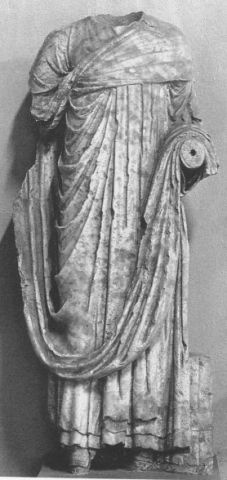
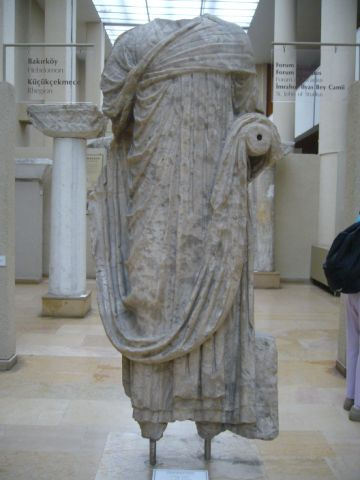
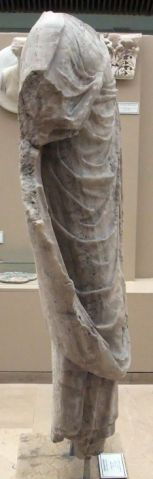
Portrait statue of man in toga missing head for insertion. Constantinople. Fifth century.
Record details
Photographs
Bibliography
- Fıratlı, N., La sculpture byzantine figurée au Musée archéologique d'Istanbul, Paris 1990, 12-13, no. 15, pl. 8
- Gehn, U., Ehrenstatuen in der Spätantike. Chlamydati und Togati, Wiesbaden 2012, 353-5 cat. no. O 5
- Kollwitz, J., Oströmische Plastik der theodosianischen Zeit, Berlin 1941, 85, no. 5, pl. 26
Discussion
DESCRIPTION (Object)
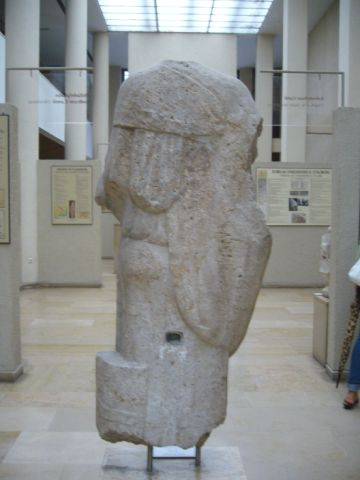
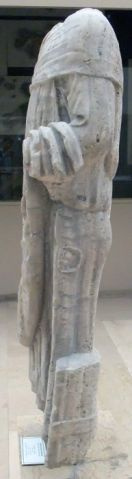
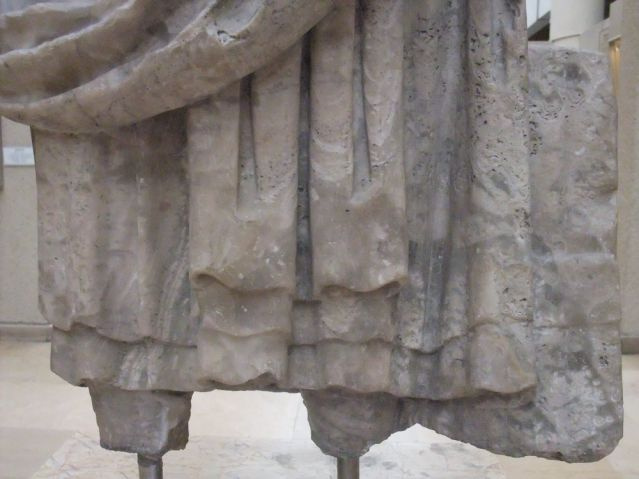
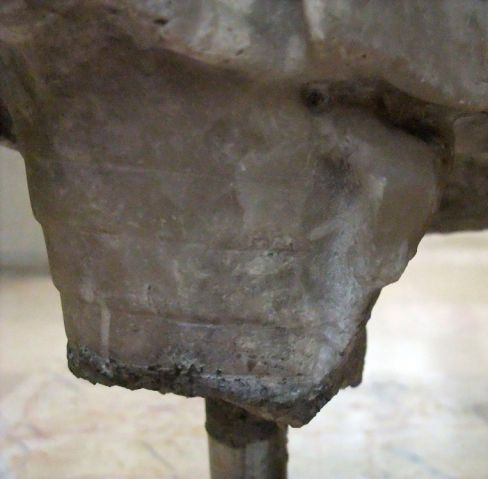
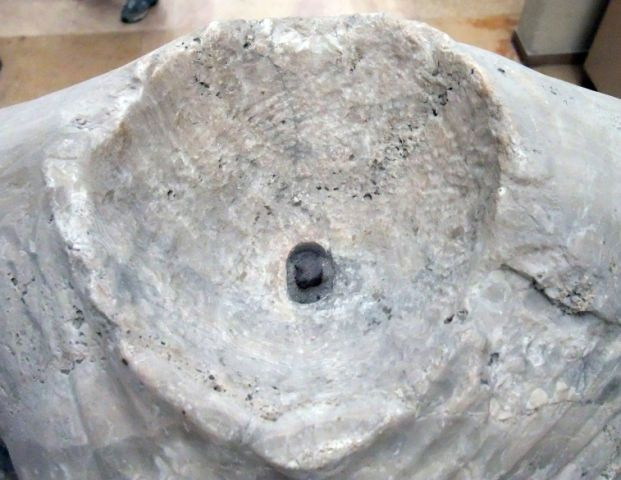
The material is an alabaster-like transparent marble; H 129, W 60, D 14.5 cm. The head was worked for insertion and is today missing. The carving of the neck has traces of a claw chisel; at its bottom there is a dowel hole with a dowel. The feet are broken above the ankles; the right elbow and forearm are broken with a portion of the edge of the toga at the right side. The left forearm was worked separately and attached with a round dowel; it is now missing. There are some chips on the surface, in particular on the folds of the sinus. At the back side, there is a rectangular hole in the lower part of the statue; this was possibly to fix the statue. At the left waist there is a large rectangular chip.
The statue is worked detailed on the front and lateral faces; the back is only worked summarily. The vertical folds of the garment are flat, the bent folds at the right side with sharp ridges. The folds are arranges schematically; the underlying body has little influence on the build-up of the statue.
PROVENANCE AND CURRENT LOCATION
The statue was found in the area of the Laleli Camii and entered the museum in 1896. It is now in the Istanbul Archaeological Museum, inv. no. 769.
DESCRIPTION (Subject)
The statue stands over its left leg, the right knee is slightly bent. The left arm was bent and stretched forward; the lost right arm was lowered and probably also bent in the elbow.
The statue is clad in the late antique toga costume consisting of two tunics, the lorum, the cloak (toga) and strapped boots. The upper tunic is slightly shorter than the lower one. It is girded, as is visible in the back and at the open left side; the belt is covered by a puff. The lorum is plastically distinguished at the front between the legs; it disappears under the cloak and shadows at the left side of the body. In the back it is looping from the left shoulder. The extant bits of the shins show the horizontal laces (corrigiae) of the strapped senatorial boots. The toga covers the largest part of the front of the statue. The layer on the breast (balteus) is tightly wrapped and folded out on the left shoulder; in the back the two layers are also distinguished. The edge of the toga (sinus) is framing the lower body as a sash-like bulge; the tip of the garment is laid over the left forearm. At the left leg a scroll bundle is standing; it is held by a broad, flat band. Attributes are lost with the two hands; it is possible that the statue was once equipped with mappa and scipio, the standard attributes of the late antique toga statues, in a gesture similar to the statue of Flavius Palmatus in Aphrodisias (LSA-198) or to a statue in Izmir (LSA-1038).
The portrayed was a man of senatorial rank, perhaps a high ranking imperial office holder, or even an emperor.
DATE
The schematic rendering of the folds and the stiff posture of the statue suggest a date in the later 5th century. This style is shared by a series of statues (LSA-147, LSA-198, LSA-697, LSA-698, LSA-707, LSA-1035, LSA-1038, LSA-1039, LSA-1095, LSA-1096), among them two statues which can be approximately dated to the late 5th century (LSA-147 = Gehn 2012, 446-51 cat no. O 32; LSA-198 =Gehn 2012, 437-46 cat. no. O 31; see also Gehn 2012, 155-8). This suggests a date in the later 5th century for our statue.
Cite: Last Statues of Antiquity, LSA-1040 (Ulrich Gehn).