
LSA-1041
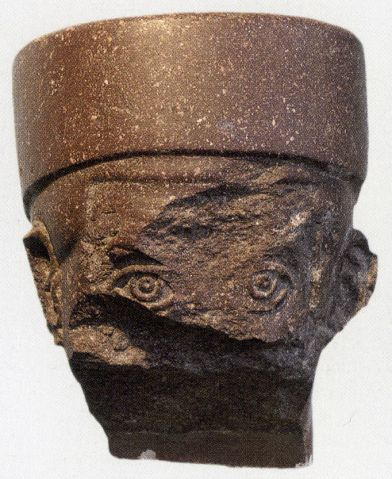
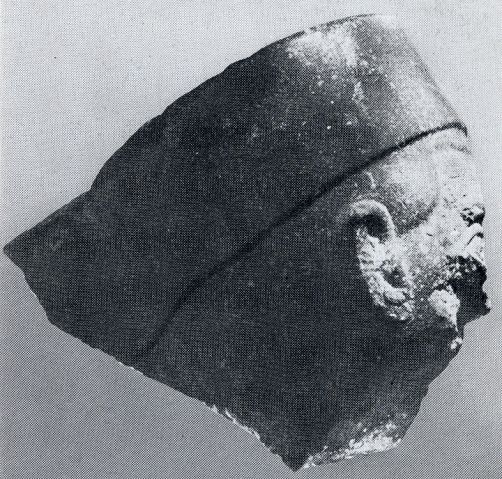
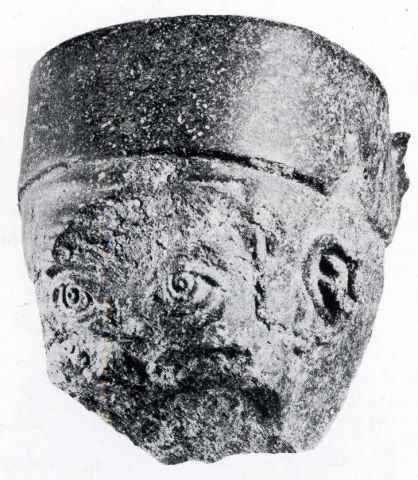
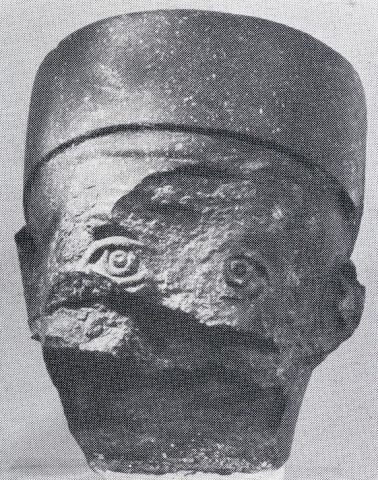
Upper part of porphyry head of Tetrarch in military cap. Naissus (Dacia Mediterranea). Late third to early fourth century.
Record details
Photographs
Bibliography
- Bergmann, M., Studien zum römischen Porträt des 3. Jahrhunderts n. Chr., Bonn 1977, 165, 176 pl. 51.1.2
- Jevtovic, J. (ed.), Antički portret u Jugoslaviji : Narodni muzej, Beograd, Muzeji Makedonije, Skopje, Arheološki muzej, Zagreb, Arheološki muzej, Split, Narodni muzej, Ljubljana , Belgrade 1987, 232, no. 220
- L'Orange, H. P., Das spätantike Herrscherbild von Diokletian bis zu den Konstantin-Söhnen, 284-361 n. Chr. Das Römische Herrscherbild. III. Abteilung ; Bd. 4 , Berlin 1984, 10, 99
Discussion
DESCRIPTION (object)
Upper part of a head. H:17, W: 15 cm. Porphyry.
The front is heavily damaged. A peg on its back connected the head with the column behind it. The surface is polished.
PROVENANCE
Found 1954 in the Osmanic fortress of Nis/ Naissus
DESCRIPTION (Subject)
The emperor was part of a group which was a smaller replica of the groups at Venice (LSA-4, LSA-439). The position of a peg on the back, which connects the head with the column shows, that the head is turned to its left and that the emperor was, thus, the one on the proper right in a group of two.
He wears a pilleus pannonicus. As in the Venice groups (LSA-4, LSA-439), the texture of the hair and that of the pilleus is not rendered by incisions. Just enough left of the right cheek is extant to ensure that no beard was incised. There are no holes in the pilleus.
INTERPRETATION
As part of a smaller replica of the Tetrarchs’ groups in Venice, this fragment contributes two important arguments to the discussion.1. Being part of a figure that stood on the right of a group (seen from the group) and having no beard, it shows, that, these groups were not conceived as combining an older, bearded emperor/Augustus on the right with a younger, beardless emperor/Caesar on the left. As the head in Gamsigrad (LSA-845) it has to be reconstructed with the structure of hair, beard and the surface of the pilleus indicated by paint, and of course also the eyeballs.
2. There are no holes in the pilleus.This confirms, that the holes in the pillei of the emperors in the groups at Venice have been inserted on the occasion of a second use of the group, most probably in Constantinople, when diadems with gems were attched to them.
Discussion references
- Antike Porträts aus Jugoslawien. Exhibition catalogue Frankfurt 1988, Frankfurt 1988, 188-9 no. 220 (J. Rankov)
- Demandt, A. and J. Engemann, (eds.), Konstantin der Grosse, Mainz 2007
, no. 1.4.7 (S. Drča) - Donati, A. and G. Gentili, Costantino il Grande. La civiltà antica al bivio tra Occidente e Oriente, Milan 2005, 285, no. 124
- Laubscher, H.-P., 'Beobachtungen zu tetrarchischen Kaiserbildern aus Porphyr', Jahrbuch des Deutschen Archäologischen Instituts 114, 207-252, (1999), 239
- Srejović, D. , Dva kasnoantička portreta iz Srbije. Two late-antique portraits from Serbia., Živa antika 9, 1959, 253-264 fig.2.3, 253-64, figs. 2-3
- Stutzinger, D. (ed.), Spätantike und frühes Christentum. Ausstellung im Liebieghaus, Museum alter Plastik, Frankfurt am Main. 16. Dezember bis 11. März 1984, Frankfurt a.M. (1983), no. 28
Cite: Last Statues of Antiquity, LSA-1041 (Marianne Bergmann).