
LSA-1042
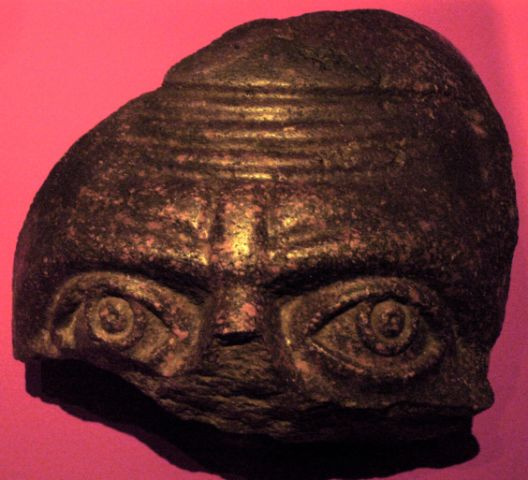
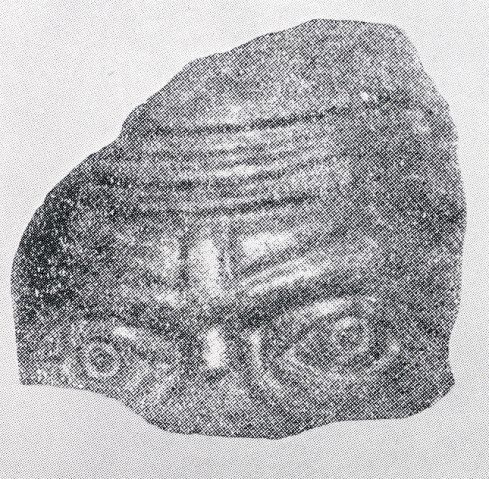
Fragment of porphyry portrait head of Tetrarch. From Transdierna (Dacia Ripensis). Late third to early fourth century.
Record details
Photographs
Bibliography
- Antike Porträts aus Jugoslawien. Exhibition catalogue Frankfurt 1988, Frankfurt 1988, 189, no. 221 (D.Srejovic)
- Srejović, D. , Dva kasnoantička portreta iz Srbije. Two late-antique portraits from Serbia., Živa antika, 9, Skopje 1959, 259-64, fig.1
Discussion
DESCRIPTION (Object)
Fragment of life-size head. H: 13, W: 17 cm. Porphyry.
The hair as a mass rises off the flesh, but its surface is smooth. The rings of the irises are in high relief and polished; the lower-lying surface of the eyeballs is roughened. This technique is comparable to that seen on the head from Romuliana (LSA-845).
PROVENANCE
From Transdierna/Tekija,opposite of amcient Dierna on the southern bank of the Donau at the entrance to the Iron Gate.
DESCRIPTION (Subject)
The fragment preserves the eyes, the forehead and part of the front hair. The iconography is similar to that of the other life-size and over life-size portraits in porphyry from the tetrarchic period. But the fragment from Tekija has the most tense expression of all of them, with more and deeper lines across the forehead. The smooth surface of the hair indicates a portrait where hair and beard were added in paint (see discussion at LSA-845). The technique of the eyes indicates that they were also painted.
DATE
No specific identification of the emperor nor a date more precise than Tetrarchic are possible.
Discussion references
- Bergmann, M., Studien zum römischen Porträt des 3. Jahrhunderts n. Chr., Bonn 1977, pl. 48.6
- Demandt, A. and J. Engemann, (eds.), Konstantin der Grosse, Mainz 2007
, no. I.4.6 (D. Ratković) - L'Orange, H. P., Das spätantike Herrscherbild von Diokletian bis zu den Konstantin-Söhnen, 284-361 n. Chr. Das Römische Herrscherbild. III. Abteilung ; Bd. 4 , Berlin 1984, 99
Cite: Last Statues of Antiquity, LSA-1042 (Marianne Bergmann).