
LSA-1043
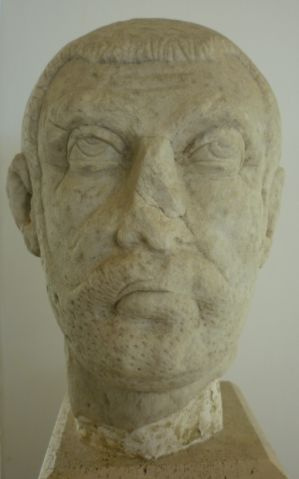
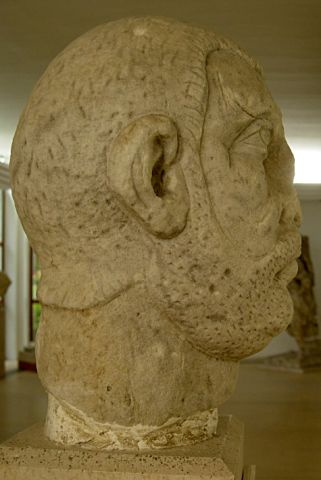
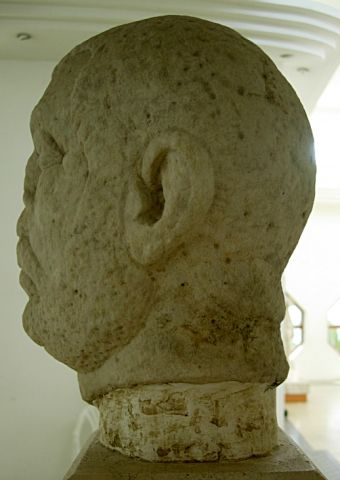
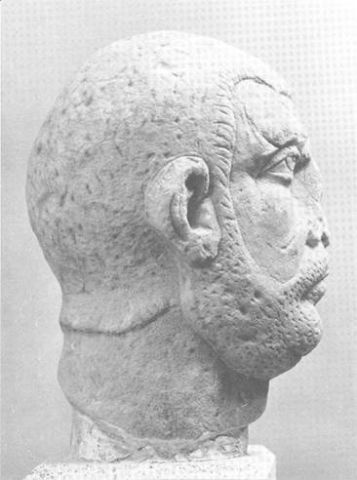
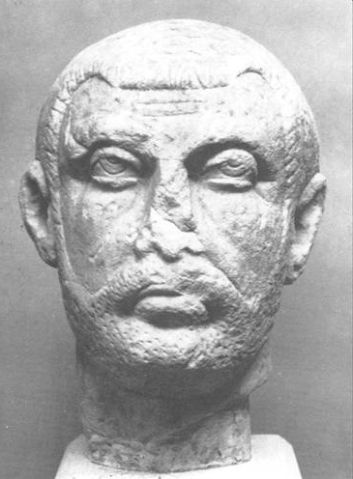
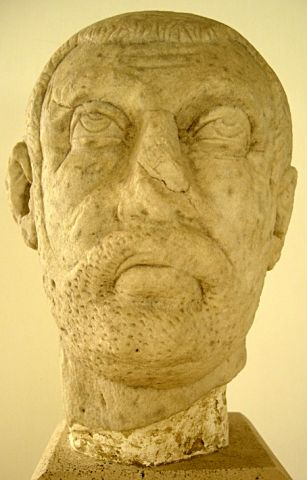
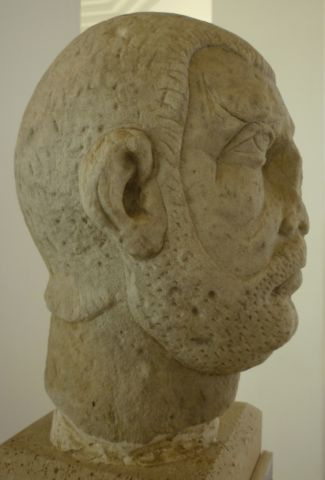
Re-cut portrait head of man with short-cropped hair and beard, Tetrarch? Speluncae. Late third to early fourth century.
Record details
Photographs
Bibliography
- Cassieri, N., La grotta di Tiberio e il Museo archeologico nazionale, Sperlonga, Rome 2000, 75-6, fig. 38 (again no mention of find location)
- Iacopi, G., L'antro di Tiberio a Sperlonga, Rome 1963, 145-6, figs. 142-3 (Tetrarchic, no mention of find location)
Discussion
DESCRIPTION (Object)
Life-size head. H: 25 cm. Marble.
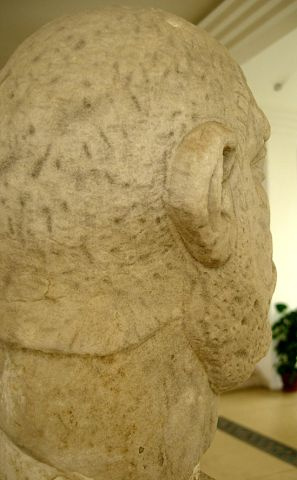
The head is broken through the neck. More of the right side of the right side of the neck is preserved. The nose is mainly missing. The surface is very worn. The ears are too large for the face and have a thick shell (most visible from behind). The head has been re-cut from an earlier portrait.
The hair of the fringe is rendered with curving strokes of a thick flat chisel. Behind the fringe it is cursorily rendered with shorter strokes. The beard, separated from the face by continuous line, is rendered with the taps of the point of a chisel. The eyes are marked by two parallel, U-shaped, engraved lines that indicate the iris and the edge of the pupil. Engraved lines also denote two short creases across the brow and creases at the corners of the eyes.
PROVENANCE:
From Sperlonga.
DESCRIPTION:
The head shows a mature man whose hair is brushed forward and whose beard and moustache are stubbly. The hair sits as a short unified cap; it perimeter over the brow is defined by the same continuous line that defines the inner edge of the beard. The fringe recedes significantly over both corners of the brow.
The face is intended to be aged. The brow has two short creases across the forehead. The heavy-lidded eyes have wrinkles at the outer corners; the cheeks have creases from the inner corners of the eyes down to the beard; there is loose skin beneath the chin. The mouth has full lips which turn downwards.
DATE AND HONORAND
The brushed-forward fashion, short stubble beard, and intensely rendered eyes place this head in the later third or early fourth century. L’Orange identified it as Diocletian. It seems to me likely to be one of the Tetrarchs since another Tetrarchic head, now in Oslo, (LSA-850) is so similar in size, manufacture, and representation that it probably comes from the same find location. Thus it suggests a group of at least two similar individuals.
Discussion references
- L'Orange, H. P., Das spätantike Herrscherbild von Diokletian bis zu den Konstantin-Söhnen, 284-361 n. Chr. Das Römische Herrscherbild. III. Abteilung ; Bd. 4 , Berlin 1984, 102, pl. 8a-b
Cite: Last Statues of Antiquity, LSA-1043 (J. Lenaghan).