
LSA-1045
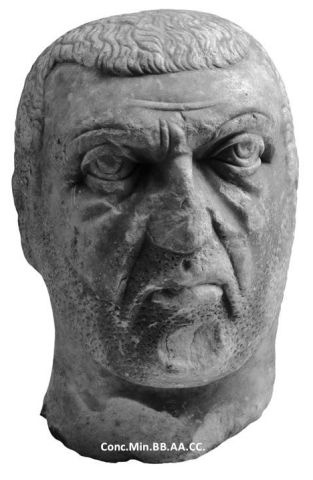
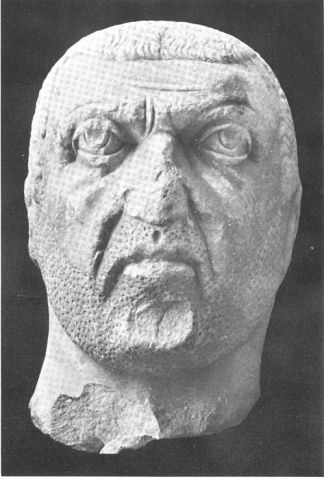
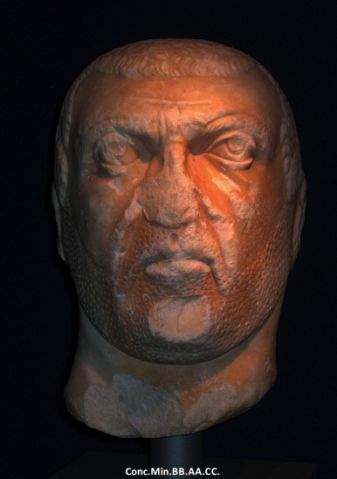
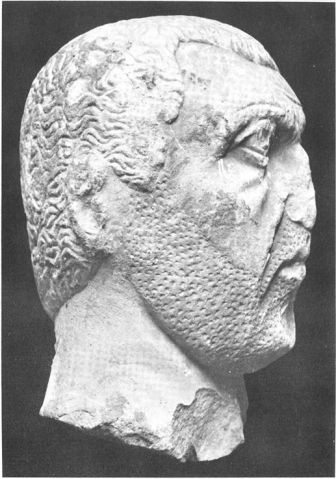
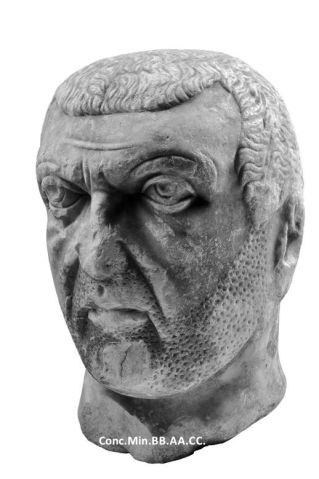
Re-cut portait head of man with short-cropped hair and beard, Tetrarch? From Alba Fucens. Late third to early fourth century.
Record details
Photographs
Bibliography
- Campanelli, A. (ed.), Poco Grano Molto Frutti. 50 Anni di archeologia ad Alba Fucens, Sulmona 2006, 207, no. 12
- De Ruyt, F., Alba Fucens. III, Sculptures d'Alba Fucens (pierre, marbre, bronze), Bruxelles 1982, 39-41, no. 17, pl. X.
Discussion
DESCRIPTION (Object)
Over lIfe-size head. H: 29, W: 18, D: 18 cm. White marble.
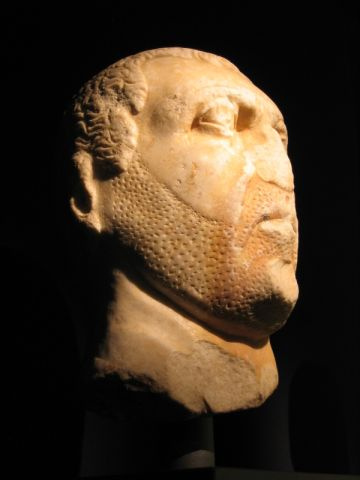
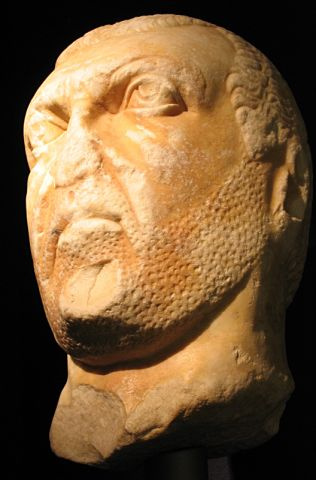
The head is broken through the base of the neck. There are breaks around the neckline and significant chips at the end of the nose, in the chin, and in the rims of the ears.
The hair is rendered with a flat chisel. The beard and moustache are indicated by regularly repeating drill points. The irises are defined by a deep semi-circular line of the flat chisel, and the pupils by a large hole made of two drill points. Creases on the forehead and especially the arch of the eyebrow are indicated by deep lines of the flat chisel.
The portrait has been re-cut from an earlier portrait. This is most evident in the unusual proportions of the face, the location of the ears, the additional lines at the eyebrows, and in the stippling of the beard and moustache.
PROVENANCE
The head was found in a tomba a cassa (a slab-lined tomb) near the north terrace outside the city walls. This is probably a secondary context.
DESCRIPTION (Subject)
The head is a striking portrait of an older man whose physiognomy exudes toughness and sobriety. This is in part a desired effect and in part the result of the adaptation of an extant portrait.
The hair is rendered as a uniform mass which recedes symmetrically at both temples. The individual locks are short, wavy, and combed forward. The stubble beard and moustache are regular. The beard is firmly within an area that is marked by a strong line on the cheek and the line at the juncture of neck and cheek.
The unnaturally low and sloping brow is emphatically creased; there are two horizontal furrows and three vertical creases. The eyebrows are deep flaring lines. The eyes are unduly large with defined irises and pupils. The skin beneath them sags with heavy folds. The naso-labial folds are also dramatic, deep, long and straight, and echoed by lines descending from the corners of the mouth. The mouth is small, and the chin long. Moreover, both mouth and chin are set back from the plane of the rest of the face.
DATE
The portrait wears the fashion style (short hair and beard) of the military emperors of the third century and the Tetrarchs. The exaggerated and forceful physiognomy, that emphasizes the eyes, is typical of Tetrarchic works (see for example, the Cairo bust LSA-836 and the ‘Milan-Munich’ type, LSA-1027, LSA-1028, LSA-1030). Moreover, the technical rendering of the beard, stippling with a small point within a defined band, also finds closest parallels in portraits of the Tetrarchic period (see for example, again the Cairo bust LSA-836 and ‘Vienna-Izmir’ type, LSA-325, LSA-373, and LSA-687). It is especially common in Italian portraits (for example, LSA-811, LSA-850, LSA-854 and LSA-1116.)
HONORAND
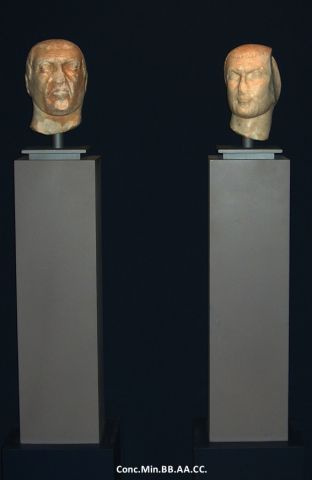
A portrait head, found in Sperlonga, shows possibly the same man, LSA-1043. Moreover, a portrait of a similar style and rendering, possibly of a slightly younger man, LSA-1046, was also found at Alba Fucens and suggests that this head belongs to a group. Thus, it is plausible that this head represents one of the Tetrarchs.
Discussion references
- L'Orange, H. P., Das spätantike Herrscherbild von Diokletian bis zu den Konstantin-Söhnen, 284-361 n. Chr. Das Römische Herrscherbild. III. Abteilung ; Bd. 4 , Berlin 1984, 104, pl. 8c-d
Cite: Last Statues of Antiquity, LSA-1045 (J. Lenaghan).