
LSA-1046
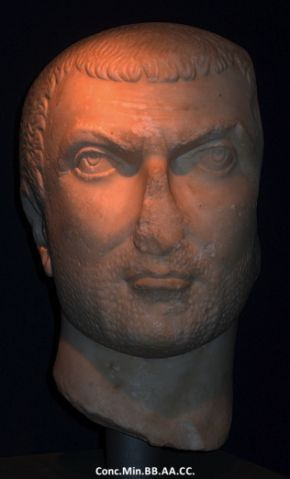
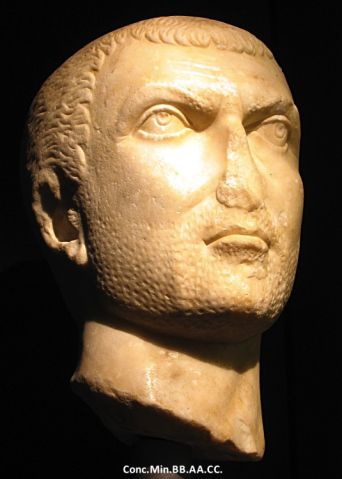
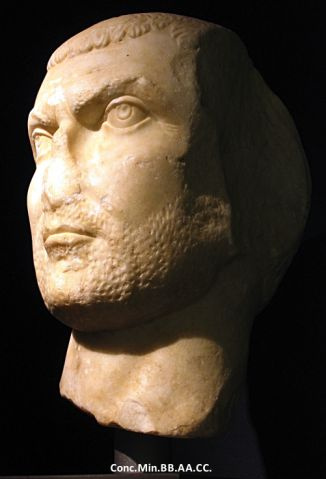
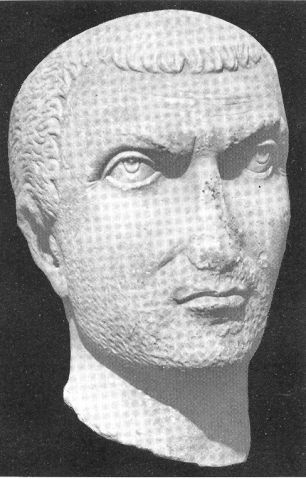
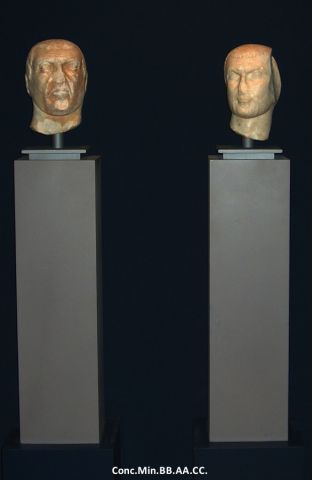
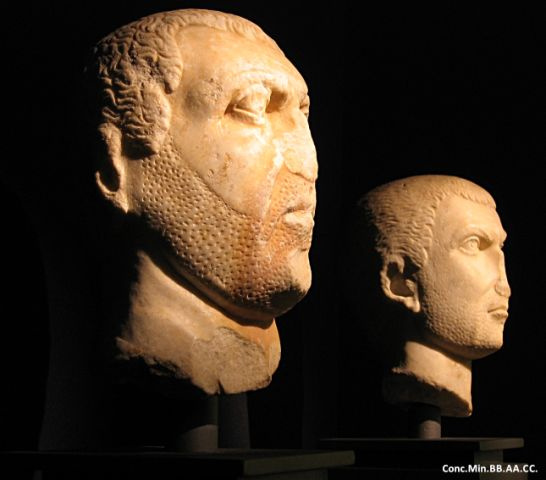
Portait of man with short-cropped hair and beard, younger Tetrarch? Alba Fucens (Valeria). Late third to early fourth century.
Record details
Photographs
Bibliography
- Campanelli, A. (ed.), Poco Grano Molto Frutti. 50 Anni di archeologia ad Alba Fucens, Sulmona 2006, 205-207, no. 11
- De Ruyt, F., Alba Fucens. III, Sculptures d'Alba Fucens (pierre, marbre, bronze), Bruxelles 1982, 35-8, no. 15, pl. 9 (Constantius I?)
Discussion
DESCRIPTION (Object)
Over life-size head. H: 32, W: 18, D: 23 cm. White marble.
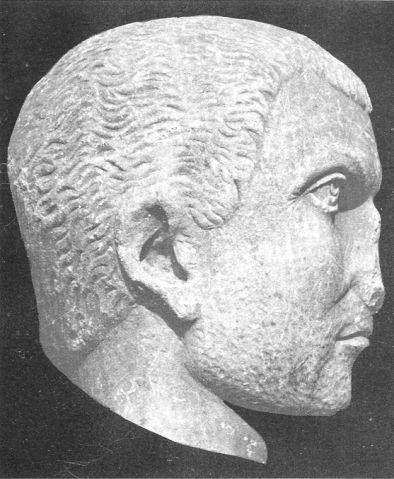
The head is broken diagonally at the base of the neck. The back left side of the head is missing, as is the nose and rim of the right ear.
The hair is rendered on a uniformly raised surface with a flat chisel. It does not appear to be fully worked at the back. The beard, moustache, and eyebrows are indicated by regularly repeating points of a drill. The irises are defined by small semi-circular engraved arcs (made with a flat chisel). They do not touch the lower eyelids, and the pupils by a large hole made of two contiguous drill points which form a crescent shape.
The portrait has been re-cut from an earlier head. This is evident in the uniform shape of the hair and the position of the right ear with respect to the hair.
PROVENANCE
The head was found in 1952 in a well in front of the first taberna at the corner of the decumanus maximus (via del Milario) and the cardo (via dell’Elefante). It was near the surface, not at the bottom.
DESCRIPTION (Subject)
The head shows a mature man with receding hair, a stubble beard, and forcefully raised eyebrows. The hair, which is brushed forward, ends in short bending locks on the brow. At both temples there are parts in the hair at the points of greatest recession. The central portion of the fringe comes slightly forward. Most of the locks here turn inwards, and there are three interruptions in the hairline. One is a triangular part over the nose; then there are two smaller parts over the left eye. The stubble beard and moustache cover the cheeks and upper lip fully.
The brow is low, sloping, and creased; there are two horizontal furrows and vertical creases rising from the root of the nose. The eyebrows flare emphatically over the outer corners of the eyes. The eyes are wide-set and large with small crow’s feet wrinkles at the outer corners. The nose indents notably at the root and was probably once hooked. The naso-labial folds are straight and deep but seem as if they are unnatural additions to the face. The mouth is small from side to side, full-lipped, and slightly down-turned. The chin is regular and without definition.
DATE
The portrait wears the fashion style (short hair and beard) of the military emperors of the third century and the Tetrarchs. The exaggerated and forceful physiognomy, that emphasizes the eyes, is typical of Tetrarchic works (see for example, the Cairo bust LSA-836 ). Moreover, the technical rendering of the beard, stippling with a small point, also finds closest parallels in portraits of the Tetrarchic period (see for example, again the Cairo bust LSA-836 and ‘Vienna-Izmir’ type, LSA-325, LSA-373, and LSA-687). It is especially common in Italian portraits (for example, LSA-811, LSA-850, LSA-854 and LSA-1116.)
Honorand
Another portrait of similar style and rendering, LSA-1045, was also found at Alba Fucens. The portrait under discussion here shows a slightly younger man than the other which has connections with portraits identified as Diocletian (see LSA-1043). It seems possible that the two portraits from Alba Fucens represent an older and younger Tetrarch. Constantius I or Maximinus Daia have been suggested as potential identifications.
Discussion references
- L'Orange, H. P., Das spätantike Herrscherbild von Diokletian bis zu den Konstantin-Söhnen, 284-361 n. Chr. Das Römische Herrscherbild. III. Abteilung ; Bd. 4 , Berlin 1984, 112-3 (private portrait)
- Stutzinger, D. (ed.), Spätantike und frühes Christentum. Ausstellung im Liebieghaus, Museum alter Plastik, Frankfurt am Main. 16. Dezember bis 11. März 1984, Frankfurt a.M. (1983), 416-17, no. 34 (Tetrarch, second Tetrarchy)
- Visscher, F. de et al.,'Les Fouilles d'Alba Fucens (Italie Centrale) de 1951 a 1953', L'Antiquité Classique 24, Louvain 1955, 117-119, no. 3, pls. 47-8 (Constantius I?)
Cite: Last Statues of Antiquity, LSA-1046 (J. Lenaghan).