
LSA-1050
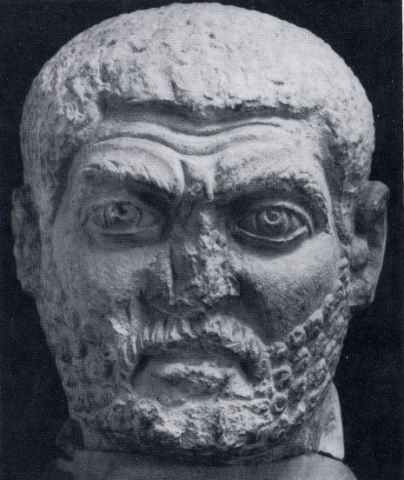
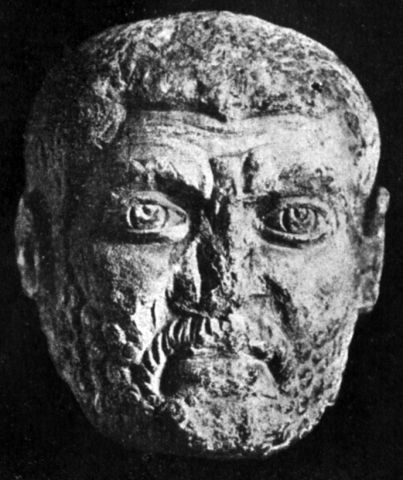
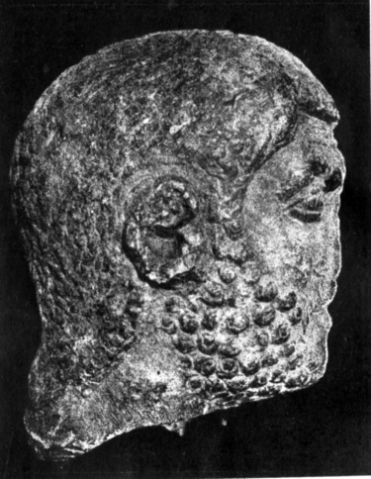
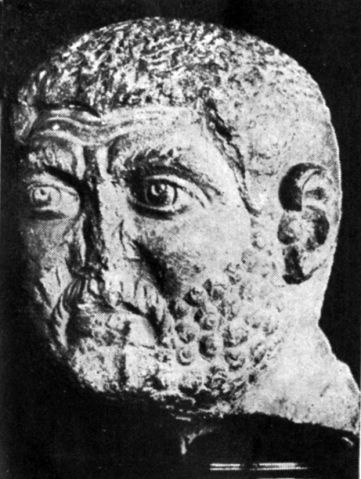
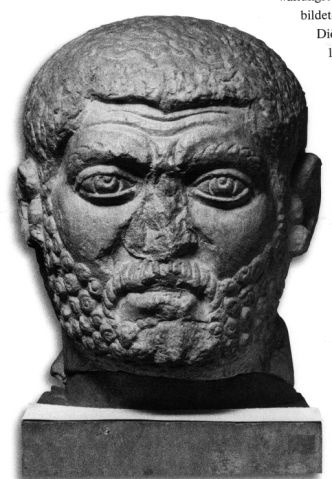
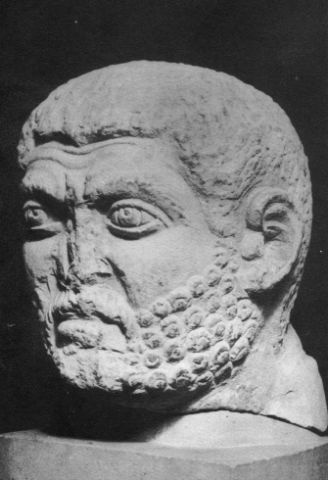
Portrait head of man with short-cropped hair and short beard, probably emperor. From region of Oescus (Dacia Ripensis). 284-305
Record details
Photographs
Bibliography
- L'Orange, H. P., Das spätantike Herrscherbild von Diokletian bis zu den Konstantin-Söhnen, 284-361 n. Chr. Das Römische Herrscherbild. III. Abteilung ; Bd. 4 , Berlin 1984, pp. 26-7. 109 pl. 22 b
Discussion
DESCRIPTION (Object)
Limestone head broken at neck, H 29 cm. The nose is broken; the naso-labial folds, lips, chin and right ear are chipped.
The head is of cubic shape with plump proportions.
The hair surrounds the skull like a tight fitting cap; it is set off the flesh by a clear cut line and is only roughly finished. The beard is arranged into round spiral locks on the cheeks, the moustache is marked by rough vertical chisel strokes.
The eyebrows are marked by vertical chisel strokes; the iris is surrounded by a sharply incised circular line, the horseshoe-shaped pupil is set against the upper lid and likewise marked out by a sharp line.
The brow is furrowed by a system of two deep, short verical folds above the root of the nose and two horizontal lines. Marked naso-labial folds separate the cheeks from the mouth; sharp folds are running down from the corners of the mouth.
The rough finish of the hair is an indicator that this was re-cut from an earlier portrait head.
PROVENANCE AND CURRENT LOCATION
The head was found in 1880 in the village of Peštene in northern Bulgaria, allegedly in a large Tumulus (Dimitrov 1941, 1). This is the region of the antique legionary camp (and city) of Oescus on the Danube from where it was probably looted (http://www.trismegistos.org/place/29839). It is now in the Archaeological Museum in Sofia, inv. no. 693.
DESCRIPTION (Subject)
The portrayed is a man of mature age. He is wearing short hair and a short beard; the hairline forms a point at the centre of the brow. His face is plump, with beefy cheeks. The eyes are staring, the brow is contracted in an attitude of strained alertness to which the folds around the mouth add the expression of morose severity.
HONORAND AND DATE
The typological and stylistic features of the head assign it to the period of the first tetrarchy in the late 3rd century.
Dimitrov 1942, the first publisher of the head, compared the head to the porphyry tetrarchs in the Vatican (LSA-840, LSA-841) and suggested Diocletian (Augustus 284-305) as the honorand. The dating has remained unchallenged since, and most scholars assessed the head as an imperial portrait, slight doubts expressed only by Bianchi Bandinelli 1971 (Bianchi Bandinelli 1971: Galerius; Hoddinott 1975: Diocletian; L'Orange 1984: Galerius).
We think that the similarities with the tetrarchic porphyry group in the Vatican (LSA-840, LSA-841) is striking and that this is probably an imperial portrait of that period. The provenance from a legionary city on the Danube boarder supports this assumption.
Discussion references
- Bianchi Bandinelli, R., Rom. Das Ende der Antike. Die römische Kunst in der Zeit des Septimius Severus bis Theodosius I. , München 1971, p. 321 fig. 301
- Dimitrov, D.P. 'Ein Porträtkopf des Kaisers Diokletian im Nationalmuseum zu Sofia', Studia Serdicensia III, 1942, 1-3
- Hoddinott, R. F., Bulgaria in Antiquity. An Archaeological Introduction, London 1975, pp. 117. 120 pl. 77
Cite: Last Statues of Antiquity, LSA-1050 (Ulrich Gehn).