
LSA-1051
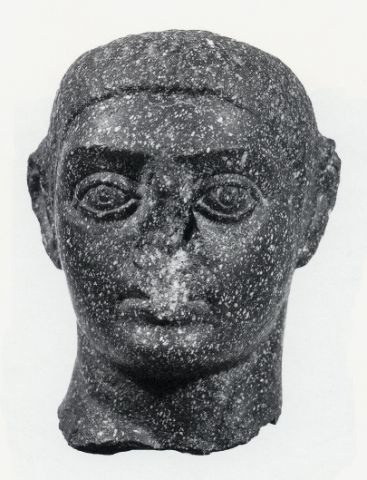
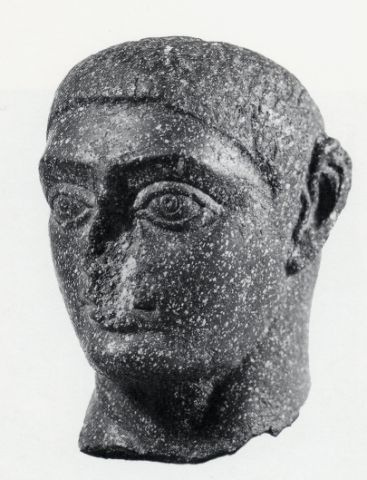
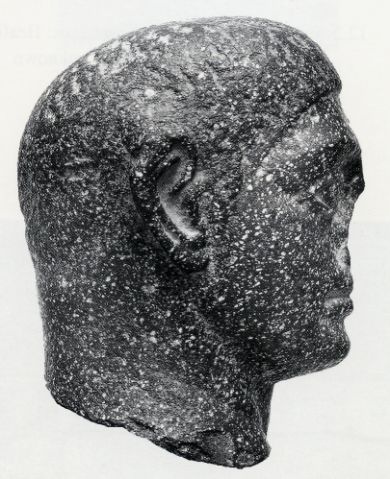
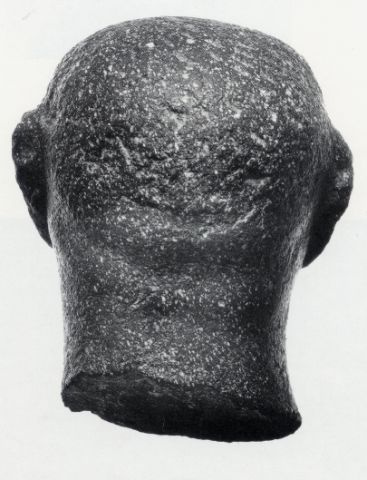
Under life-size porphyry head of clean-shaven man. From Egypt. Early fourth century.
Record details
Photographs
Bibliography
- Calza, R., Iconografia Romana Imperiale. Da Carausio a Giuliano (287-363 d. C.), Rome 1972, 146, no. 57, pl. 38.109-110
- Vikan, G., Catalogue of the Sculpture in the Dumbarton Oaks Collection from the Ptolemaic Period to the Renaissance, Washington D.C. 1995, 19-24, no. 11 (Maximinus Daia?)
Discussion
DESCRIPTION (object)
Under life-size head. H: 16.3, W: 13, D: 12.6 cm. Porphyry.
The neck is broken. The nose and part of the mouth are heavily damaged. The head may be recarved from an earlier portrait. Its neck is too powerful for the head; the top is curiously short; and the ears are too large. They are moreover set on the surface, and there is a flat step between them and the face. These are typical elements of recarving. The surface is polished.
PROVENANCE
From Egypt. Now in the Dumbarton Oaks Collection, Washington DC, inv. no. BZ 1963.5.
DESCRIPTION (subject)
The head is half life-size. It has no indications of age and is devoid of facial expression. The hair is set as a mass against the flesh. Its texture is characterized by scratched lines, not as regular as in the other porphyry portraits. No beard is indicated.
INTERPRETATION
As the texture of the hair is indicated, the missing beard in this case (contrast LSA-845) must be taken literally that the portrayed was beardless, that is, either shaven or young.
The head has been attributed generally to the Tetrarchic period and to Galerius. But the hairstyle and shaven face also suit the Constantinian dynasty which seems more convincing. One might also think of Licinius Iunior (Overbeck 1973, bowl 2 and 3; Smith 1997, 190 pl.7, 2.3 and LSA-334).
Discussion references
- L'Orange, H. P., Studien zur Geschichte des spätantiken Porträts, Oslo 1933, 109 (early Constantinian)
- Overbeck, B., Argentum Romanum. Ein Schatzfund von römischem Prunkgeschirr, Munich 1973
- Smith, R.R.R.,'The public image of Licinius I: Portrait sculpture and imperial ideology in the early fourth century', JRS 87, 1997, 170-202
- Von Sydow, W., Zur Kunstgeschichte des spätantike Porträts im 4. Jahrhundert. n. Chr, Bonn 1969, 139
Cite: Last Statues of Antiquity, LSA-1051 (Marianne Bergmann).