
LSA-1054
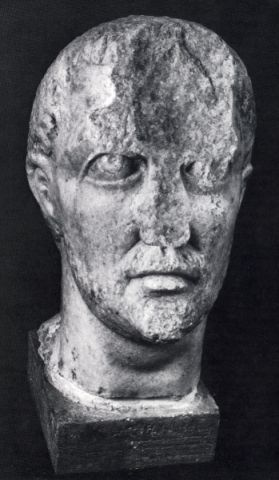
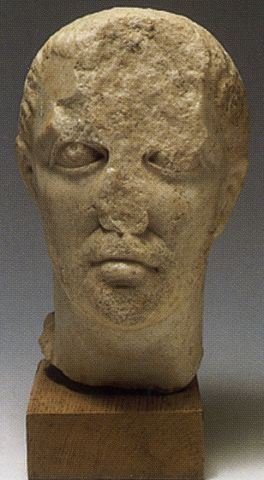
Portrait head of lightly bearded man with drapery around neck. Aquincum (Pannonia Valeria). Fourth century.
Record details
Photographs
Bibliography
- Polenz, H. and H. Polenz, Das Römische Budapest : neue Ausgrabungen und Funde in Aquincum , Münster 1986, 122, fig. 34
Discussion
DESCRIPTION (Object)
Marble portrait head, broken at neck. The brow with the left eyebrow and the nose are broken, the left eye and the chin are chipped. The surface is washed.
The streaks of the hair are singled out by shallow chiselled lines; the beard is marked by short shallow chisel strokes. The hair was set off the flesh by a clear-cut line, as visible at the better preserved portion above the right temple.
The eyes are enlarged, the eyebrows not marked. The iris is circumscribed by an incised line, the pupil is a shallow round hole set against the upper lid.
The lower lip is markedly set off the chin, and two short naso-labial folds accompany the upper lip; the cheeks are flat and without modelings.
PROVENANCE AND MOST RECENTLY RECORDED LOCATION
The head was found in the basilica of Aquincum, in an aedicula which possibly served as a sanctuary (Polenz & Polenz 1986, 122). It is today in the Budapest museum, without published inv. no.
DESCRIPTION (Subject)
The portrayed is a man of mature age, as indicated by the full beard and the receding hair. He has a slender oval face and wears his hair short and his beard trimmed; the hair forms a convex line in the brow. The enlarged eyes are wide open. His right ear sits higher than the left. His lower lip is small and full, almost inflated.
HONORAND AND DATE
The stylistic and typological features of the head, the hairstyle, and notably the enlarged eyes and their marking assign a late antique date to our head. The tetrarchic hairstyle and beard go along with harmonized facial features; the head can therefore hardly be earlier than the late tetrarchic period in the early 4th century. Tetrarchic hair and beard styles remained fashionable with high ranking members of the imperial administration of the Constantinian period (LSA-903).
Polenz & Polenz 1986, 122 saw stylistic features of an imperial portrait of the Constantinian period and suggested Constantius II (ibid. 97 ad fig. 34).
Discussion references
- Póczy, K. , Aquincum. Das römische Budapest, Mainz 2005, 116-117, fig. 122
Cite: Last Statues of Antiquity, LSA-1054 (Ulrich Gehn).