
LSA-1055
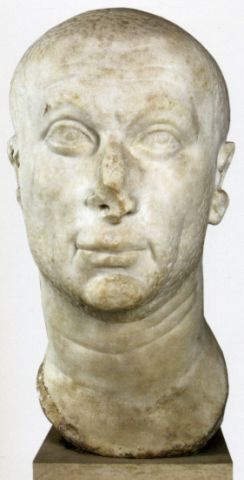
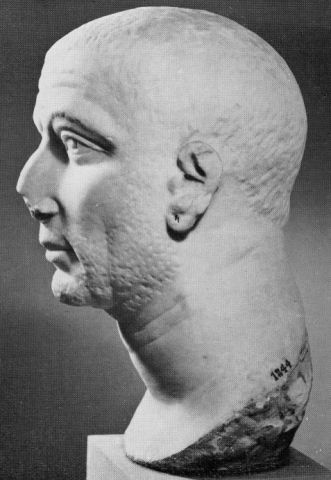
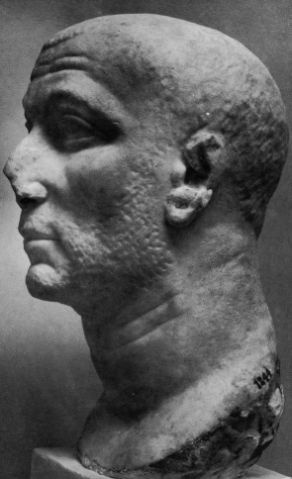
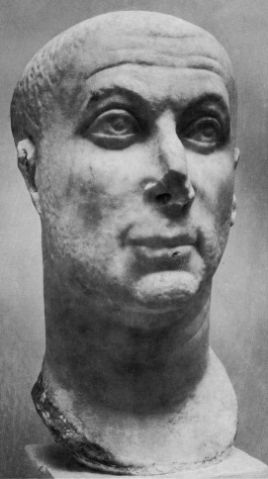
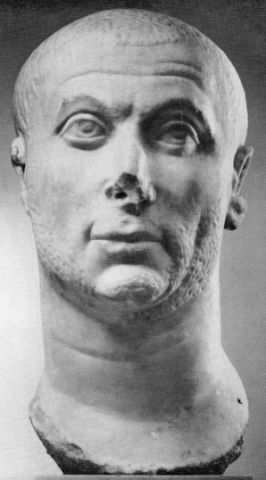
Over life-size head with hooked nose and receding chin, Constantius I? Ostia. Late third to early fourth century.
Record details
Photographs
Bibliography
- Donati, A. and G. Gentili, Costantino il Grande. La civiltà antica al bivio tra Occidente e Oriente, Milan 2005, 208-209, no. 7 (I.Romeo: Constantius I)
Discussion
DESCRIPTION (Object)
Over life-size head, separately worked. H: 38 cm. Fine-grained white marble.
The head was worked separately with its neck and a small area of adjacent chest. The underside of the tenon is roughly picked and convex. The tip of the nose and the rims of the ears are broken.
The hair of the head and the beard is rendered with hits of a chisel. The eyes are marked with large circular hollows.
The portrait has been re-cut from earlier one. The neck is too thick for the head. The hair and top of the head have been taken down. At the base of the neck is a ridge that marks the transition from chest to neck. The left ear, though not clearly illustrated in the published photographs, is extremely awkward and suggests re-working .
PROVENANCE
Piazzale delle Corporazioni. The head was excavated c. 1888. It was once on a togate statue but was deemed not to belong and removed.
DESCRIPTION (Subject)
The head depicts a mature man with short hair and a stubble beard. He has a distinctive physiognomy and turns vigorously to his left.
The hair, which does not rise off the skull, is cut short around the ears and nape of the neck. It comes slightly forward at the centre of the brow. The moustache and beard are also very short. The beard continues on the neck along the junction of the jaw-line and neck.
The brow is short and traversed by two deep creases which terminate in downward curves. The high cheekbones pull the skin taut. The nose has a deeply indented root from which it projects out in a large hook. The nostrils are tucked tightly back into the cheeks. The full-lipped and projecting mouth has upturned corners which create creases. The chin is rounded and juts forward.
The neck is deeply creased. There are more lines on the left side because he turns in that direction. There is a ridge at the base of the neck which is probably an unintended by-product of the re-carving.
IDENTIFICATION AND DATE
The same man is possibly represented by an over life-size head now in Copenhagen, LSA-810, and/or by another portrait from Ostia, LSA-848. All three portraits are stylistically similar and relate to a type that has been identified as Constantius I; see LSA-806and LSA-855.
The head can be dated confidently to the Tetrarchic period. A specific identification however is at the moment impossible. Even the relationship to the ‘Berlin-Copenhagen’ portrait type of Constantius I is unclear. Were these all re-cut and loose versions of one model or are they all simply men with a similar face, the face of the period? The former seems most likely.
Discussion references
- Calza, R., Iconografia Romana Imperiale. Da Carausio a Giuliano (287-363 d. C.), Rome 1972, 94-6, no. 4, pls. 7, 18 and 8, 19 (Diocletian)
- L'Orange, H. P., Das spätantike Herrscherbild von Diokletian bis zu den Konstantin-Söhnen, 284-361 n. Chr. Das Römische Herrscherbild. III. Abteilung ; Bd. 4 , Berlin 1984, 116, pl. 31 (Licinius)
- Sydow, W. von, Zur Kunstgeschichte des spätantike Porträts im 4. Jahrhundert. n. Chr, Bonn 1969, 17 (probably Constantius I)
Cite: Last Statues of Antiquity, LSA-1055 (J. Lenaghan).