
LSA-1056
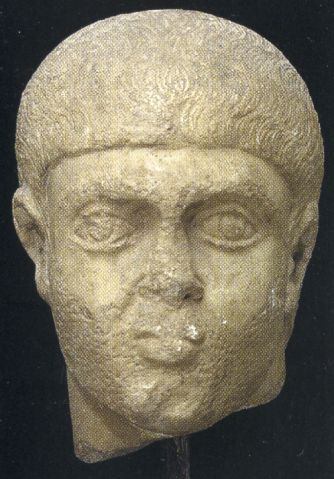
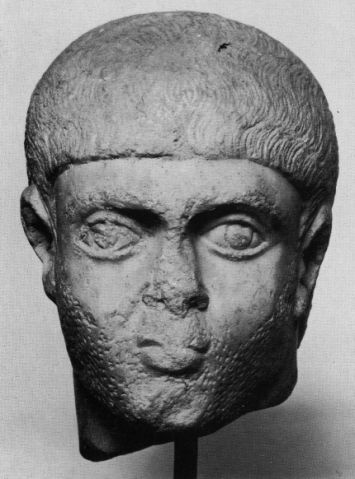
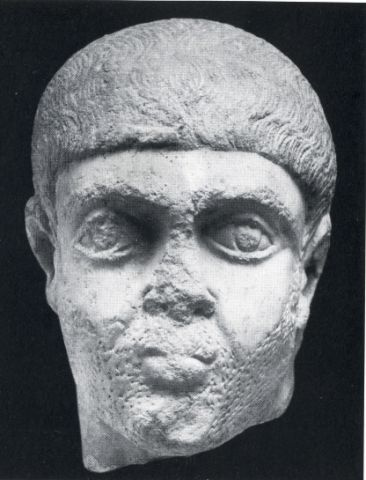
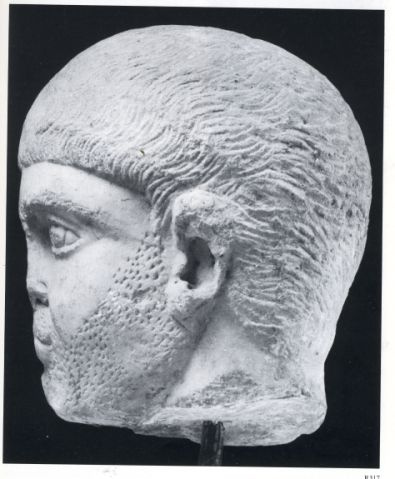
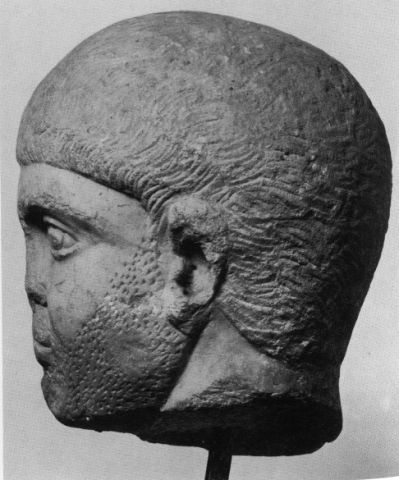
Portrait head of man with stubble beard. From Africa. Late third to early fourth century.
Record details
Photographs
Bibliography
- Giuliano, A. (ed.), Museo Nazionale Romano. Le Sculture I,9. Magazzini. I Ritratti. Parte II, Rome 1988, 415-416, no. R317
Discussion
DESCRIPTION (Object)
Over life-size head. H: 32 cm. White marble.
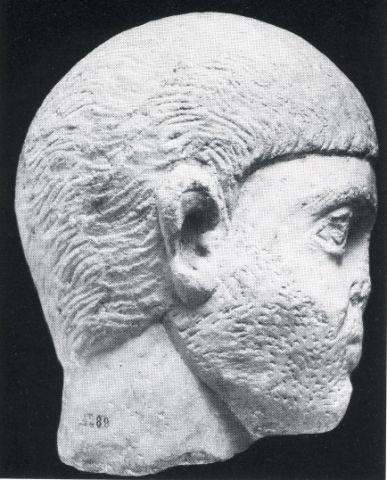
The head is broken unevenly through the neck, more of which is preserved on the proper right side. The nose is missing. The ears, eyes, lips, and chin are chipped.
The head has been re-cut from a portrait which had more copious hair. That hair has been cut down to a uniform volume, and a flat chisel has been used to engrave the locks of hair in a regular fashion. The back is less carefully worked, and the locks over the brow are most carefully rendered in two different tiers. A series of marks of the point chisel create a stubble beard. Large circles made with a broad flat chisel constitute the irises, and small holes denote the pupils.
PROVENANCE
From Africa.
DESCRIPTION (Subject)
The head depicts a man with large eyes, short hair, and a stubble beard. The portrait has been fashioned from a pre-existing one. This is clearly visible in the hair which has been reduced to a uniform volume which falls low on the brow and extends to the nape. The uniform volume has been incised to create the impression of short hair which is brushed forward. Over the brow it falls in two superimposed tiers.
The face is solid and block-like with little modelling. The eyes are large, and large irises have been coarsely engraved into the eyeballs. The pupils are relatively small.
DATE
The large eyes, stubble beard, and block-like form of the head have led scholars to consider it a portrait of a Tetrarch or simply a portrait of that period. It should be noted that the honorand is intended to be young with full hair. Also that this hair is not simply short cropped but rather combed forward and falls across the brow in two layers. This aspect is more Constantinian than Tetrarchic.
IDENTIFICATION
The portrait has been variously identified as Galerius or Licinius. It is possibly also a private portrait, perhaps even of the early Constantinian period. The provenance (Northern Africa) and the re-use make it difficult to exclude any of these possibilities.
Discussion references
- Calza, R., Iconografia Romana Imperiale. Da Carausio a Giuliano (287-363 d. C.), Rome 1972, 203, no. 118
- Donati, A. and G. Gentili, Costantino il Grande. La civiltà antica al bivio tra Occidente e Oriente, Milan 2005, 289, no. 132 (A. Rotondi)
- L'Orange, H. P., Das spätantike Herrscherbild von Diokletian bis zu den Konstantin-Söhnen, 284-361 n. Chr. Das Römische Herrscherbild. III. Abteilung ; Bd. 4 , Berlin 1984, 117, pl. 22c-d (period of Tetrarchy)
Cite: Last Statues of Antiquity, LSA-1056 (J. Lenaghan).