
LSA-1066
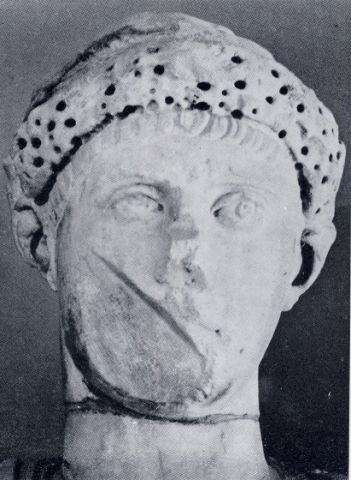
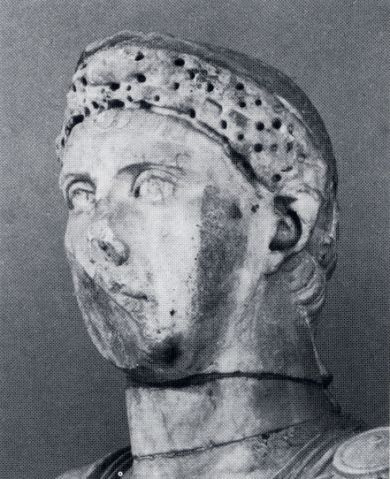
Portrait head of clean-shaven Emperor wearing corona civica. From Rome or its environs. Earlier fourth century.
+
Record details
Photographs
Bibliography
- Calza, R., Iconografia Romana Imperiale. Da Carausio a Giuliano (287-363 d. C.), Rome 1972, 289-90, no. 200, pl. 101,383 (Constantine II)
- Santolini Giordani, R., Antichità Casali. La collezione di Villa Casali a Roma. Studi Miscellanei 27, Rome 1978-79, 114, no. 50, pl. 8
Discussion
DESCRIPTION (Object)
Over life-size head, mounted on cuirassed bust. H (of face to crown): 32 cm. Marble
The head is broken through the neck from under the chin to the lower part of the nape. A cylindrical marble spacer serves to connect the head to the bust on which it is mounted. A large section of the lower right part of the face is missing. The break surface seems to have been evenly worked for a repair. The nose is broken.
The portrait head has been re-worked from an earlier portrait. There are long lock o another portrait visible behind the ears and at the top of the head. Over the brow the crown has been separated from a new shorter hairstyle by a deep drill line. The deep drill holes in the crown itself may also be secondary.
The irises and pupils seem to be defined by concentric, engraved, U-shaped arcs. The inner canthi are marked by drill holes.
PROVENANCE
Rome or its environs.
DESCRIPTION (Subject)
The portrait shows a clean-shaven emperor wearing a corona civica. The hair falls in short gently curving locks on the brow. The locks of the left side of the fringe curve inwards and meet an inward curving lock of the right side over the nose. But apart from this one inward-curving lock on the right side, the others of the right side bend towards the right ear. Thus, there is a small part over the inner corner of the right eye.
The face is oval with regular feature. The brow has one light furrow. The nose may have been hooked. The mouth had full lips
DATE
The head is clean-shaven, has eyes marked in a late style, and features an arrangement of locks over the brow that recalls the main portrait type of Constantine (see, for example, LSA-558, LSA-834, or LSA-899). It was probably intended to represent Constantinian prince (see for example Constantine II, LSA-559, and possibly even LSA-556). Calza in fact suggests Constantine II.
OTHER CLEAN-SHAVEN PORTRAITS WEARING A CORONA CIVICA
There are seven other portraits in LSA that show clean-shaven prince of the early fourth century with a corona civica. These are a portrait, possibly of Licinius II from Cyzicus LSA-334; a re-cut portrait from Constantinople LSA-440; a portrait of a child in the Torlonia collection, LSA-566; a portrait now in Berlin and from Italy, LSA-567; and the three portraits of members of the Constantinian dynasty from the Baths of Constantine on the Quirinal Hill, LSA-555LSA-556,LSA-559.
Discussion references
- L'Orange, H. P., Das spätantike Herrscherbild von Diokletian bis zu den Konstantin-Söhnen, 284-361 n. Chr. Das Römische Herrscherbild. III. Abteilung ; Bd. 4 , Berlin 1984, 138, pl. 45c (connected to 4 Constantinian works from Quirinal)
Cite: Last Statues of Antiquity, LSA-1066 (J. Lenaghan).