
LSA-1069
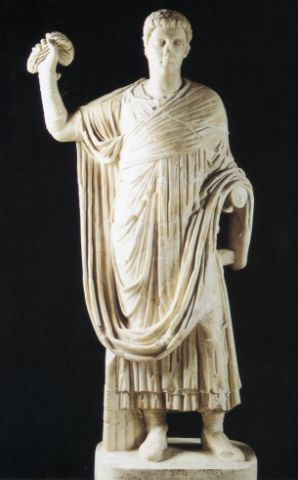
Togate portrait statue of clean-shaven young man with mappa. Rome. Early fifth century.
Record details
Photographs
Bibliography
- Cima, M. (ed.), Restauri nei Musei Capitolini. Le sculture della salla dei Magistrati e gli originali greci della sala dei Monumenti arcaici, 1995, 53-69, 132-5
- Ensoli, S. and E. La Rocca (eds.), Aurea Roma: dalla città pagana alla città cristiana, Roma 2000, 433-4, no. 13
- Gehn, U., Ehrenstatuen in der Spätantike. Chlamydati und Togati, Wiesbaden 2012, 531-5 cat. no. W 10
Discussion
DESCRIPTION (Object)
Life-size statue. H: 188 cm. Medium-grained white marble with grey veins
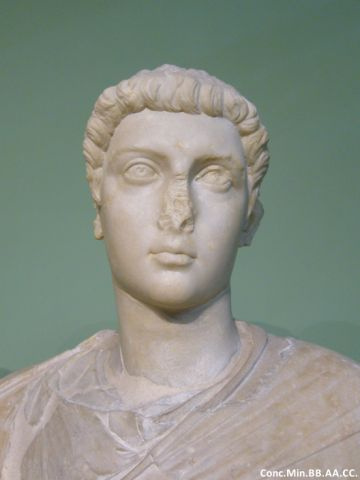
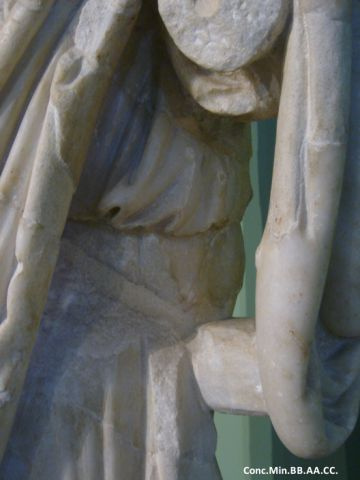
The statue has been recomposed of numerous small fragments. It is missing the left forearm, which was separately worked, the nose, and parts of the ears.
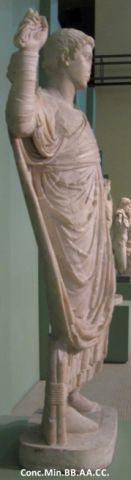
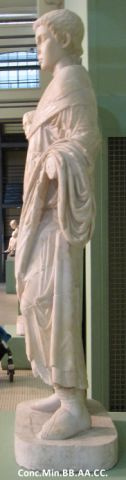
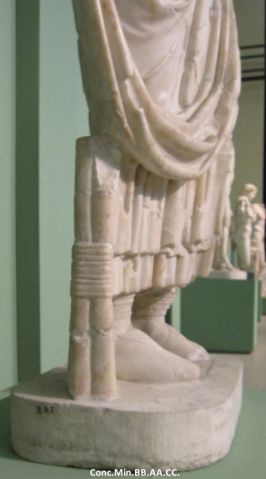
The back of the statue is flatly worked. There is a large strut that connects the drapery on the outside of the left arm to the left thigh. The statue support is located on the outer side of and behind the right leg. It reaches above the area of the knee. The plinth appears originally to have been rounded. The inner eyes are marked by a broad U-shaped drill channel which touches neither the upper nor lower lid and in which three drill points (at beginning, end, and middle) are visible.
PROVENANCE
Recovered on 3 June 1879 , broken in pieces, in a late wall that blocked a niche in the so-called nymphaeum of the Horti Linciani or Temple of Minerva Medica. It was one of 6 virtually complete statues found in this wall: the others were a similar but larger and older figure in the same dress and pose and of the same manufacture, LSA-1068, a draped female wearing a crown, a state of Dionysus with a panther, a statue of a faun, and a seated girl. All of these are now in the collection of the Musei Capitolini.
The ten-sided nymphaeum can be securely located within the Horti Liciniani, an imperial complex of Gallienus. The later history of this building and area is less secure.
DESCRIPTION (Subject)
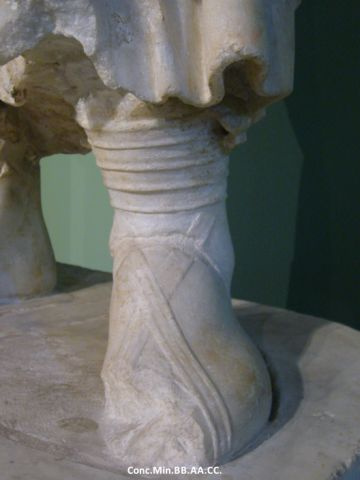
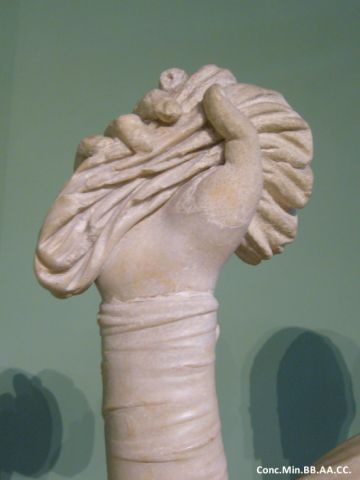
The statue represents a typical late togatus, holding a mappa (see for example, LSA-147 LSA-198,LSA-697, LSA-698). The costume consists of sleeved tunic, the colobium, toga, and the cross-strapped boot-like shoe. He stands on tall plinth and is supported by a set of scrolls.
The portrait head shows a young man or adolescent with a full oval face, full lips, and a full head of hair. The face is softly modelled, giving the impression of youthful softness. The thick hair is wavy and brushed forward; it is cut across the brow in a straight line.
DATE
The statue is dated on the basis of the toga form. The late antique toga was probably a result of Theodosian laws on dress and appears first in the Theodosian period. The earliest, securely datable statues wearing a late antique toga are an imperial group from Aphrodisias dated to 388-392 (LSA-163, LSA-164,LSA-165, LSA-166). The Esquiline statues, however, show a more fully-developed and standardized formula for a figure in a late antique toga. Thus, the Esquiline statues should be dated no earlier than c. AD 400.
COMMENT
This statue and its pendant , LSA-1068, are the only extant examples in the West of statuary in the West which wear this late-antique form of the toga.
Discussion references
- Goette, H.R., Studien zu römischen Togadarstellungen, Mainz 1990, 62, no. E 9, pl. 46.2
- Meischner, J., 'Das Porträt der valentianischen Epoche,', Jahrbuch des Deutschen Archäologischen Instituts, 107 (1992), 217-34, pl. 87-91, 220, pl. 89.4
Cite: Last Statues of Antiquity, LSA-1069 (J. Lenaghan).