
LSA-1072
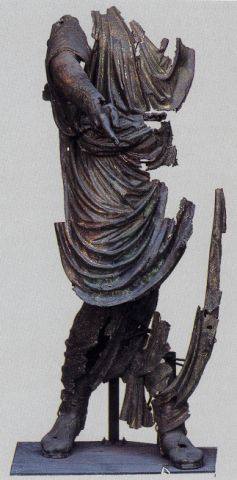
Re-used bronze togate statue, found with LSA-580 and LSA-1820. Rome. Second to fourth century.
Record details
Photographs
Bibliography
- Ensoli, S. & E. La Rocca, Aurea Roma. Dalla città pagana alla città cristiana (Exhibition, Rome 2000), Rome 2000, 461-2, no. 63 (A. Cioffarelli)
- Goette, H.R., Studien zu römischen Togadarstellungen, Mainz 1990, 42 fn. 197, 130 under Bb5 (without comment)
- Kluge, K. - K. Lehmann-Hartleben, Großbronzen der römischen Kaiserzeit, Berlin und Leipzig 1927, II, 57
Discussion
DESCRIPTION (Object)
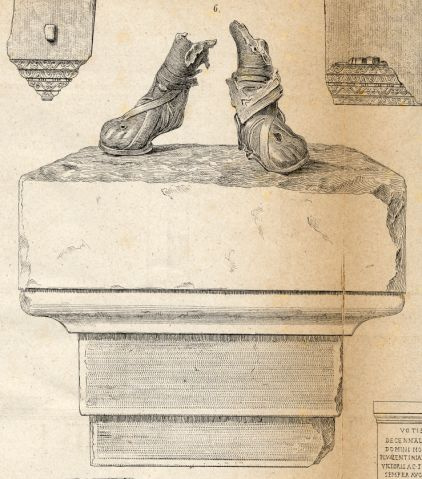
Torso of a bronze statue composed of many fragments, H 190 cm (the statue in its actual statue is composed from 26 out of 33 fragments according to Cioffarelli in Aurea Roma; Lanciani 1878 recorded 30, Fiorelli 1878 only 29 fragments. Note that the photo by Kluge and Lehmann-Hartleben 1927 pl. XXII shows the statue more complete than the recent image in Aurea Roma, including the left leg which is now missing). The left hip, left arm, left shoulder with a portion of the breast, the right arm and the head are missing.
The feet were still mounted on a low plinth when they were found; the plinth is now removed.
The folds of the garment show plastic values and great variety; they follow the underlying body (see below, 'Honorand and Date').
PROVENANCE AND CURRENT LOCATION
The fragments were found in 1878 at the banks of the river Tiber, in the area of ponte Sisto, the ancient pons Valentinianus (pons Antoninus, pons Aurelianus, Aurea Roma). Together with the statue fragments of an inscribed statue base to the emperor Valens (364-78) was found (CIL VI, 31402; LSA-1820). The inscription records restoration work of the emperors Valens and Valentinian I (364-75) in 365/7. Among the other bronze fragments found in the same find spot was the right arm, probably of another toga statue, of about the same size as our statue (Dehn 1911, 246-7 fragment e fig. 3). Moreover, fragments of a diademed head, most probably an imperial portrait of the mid-later 4th century (LSA-580, found in 1910), a bronze portrait head of the early 3rd century, now in the Boston Museum of Fine Arts, and a left knee and a boot from a draped statue (which was not a toga statue) were found (Boston head: Dehn 1911, 253-5 figs. 10 a-b; Kluge and Lehmann-Hartleben 1927, 44 fig. 2; left knee: Dehn l. c. 247-8 fragment f, figs. 4. 11; boot: Dehn l. c. 248-50 figs. 5-7. 11). Dehn 1911, the first coherent publication of the bronze fragments, suggested that the head LSA-580 represented the emperor Valens or his brother Valentinian I (who was Augustus of the West and senior Augustus, and was surely honoured together with his brother), and that our toga statue belonged to the imperial head LSA-580.
The statue is now in Rome, Museo Nazionale Romano, inv. no. 106163.
DESCRIPTION (Subject)
The statue stands over its left leg, the right heel is raised and the right knee slightly bent. The portrayed is clad in a traditional toga with umbo (Goette 1990 type B), a short sleeved tunic, and strapped senatorial boots (calcei). The sinus of the toga is reaching to the right knee.
The footgear identifies the portrayed as a man of senatorial or imperial rank.
HONORAND AND DATE
Although it is probable that the inscriptions and statue fragments found at the ponte Sisto once belonged to its decoration, and although it is an appealing hypothesis that our gilded toga statue and the other one which is testified to by the extant right arm (see above, 'Provenance and Current Location‘) once belonged to a pair of statues of the imperial brothers Valentinian I and Valens, there remain moments of doubt. Neck and shoulders of our statue are lost, and it is therefore impossible to verify Dehn’s suggestion that it belonged with the bronze head LSA-580. Kluge and Lehmann-Hartleben 1927, 67 pointed out that both LSA-580 and the head in Boston from the same findspot (see above, 'Provenance and Location') would fit in size for our statue (note also the critical remarks on Dehn 1911 by Blanck 1969, 122).
The statue body with its variable folds is almost securely a work of the earlier imperial period, most probably of the 1st (the arrangement of the folds in the sinus is comparable e. g. to the 1st-century togate in the Palazzo dei Conservatori, Goette l. c. B a 35 pl. 6, 5; 1st century date for our statue was suggested by Dehn 1911, 244, and by Di Mino 1990; Goette 1990 suggests a date in the early 2nd century, and Kluge and Lehmann-Hartleben 1927 in the 2nd century; Napoli 1959 suggested a fourth century date for the statue, contemporary with the imperial head).
If this statue was combined with the imperial head, so I think, than it was re-used for the imperial statue in the 4th century. If, on the other hand, the statue belongs to an earlier phase of the decoration of the bridge, then the construction of the bridge in the mid-2nd century is the terminus post quem.
Discussion references
- Corpus Inscriptionum Latinarum; , VI, 31402
- Blanck, H., Wiederverwendung alter Statuen als Ehrendenkmäler bei Griechen und Römern, Rome 1969, 122
- Dehn, G. 'Die Bronzefunde bei Ponte Sisto', Mitteilungen des Deutschen Archäologischen Instituts, Römische Abteilung 26, Rome 1911, 238-259, pls.12-13
- Di Mino, M.R. and M. Bertinetti, Archeologia a Roma. La materia e la tecnica nell'arte antica, Rome 1990
- Lanciani, R. 'XII. Monumenti rinvenuti nell'alveo del Tevere sotto il ponte sisto', Bullettino della commissione archeologica comunale di Roma 6, Rome 1878, 248, pl. 20, fig. 6
- Napoli, M. , 'Statua ritratto di Virio Audenzio Emiliano consolare della Campania', Bollettino d'Arte 44, Milan 1959
- Paribeni, R. 'Ancora dei bronzi trovati presso Ponte Sisto', Mitteilungen des Deutschen Archäologischen Instituts, Römische Abteilung 28, Rome 1913, 113-119, figs. 1-2
Cite: Last Statues of Antiquity, LSA-1072 (Ulrich Gehn).