
LSA-1073
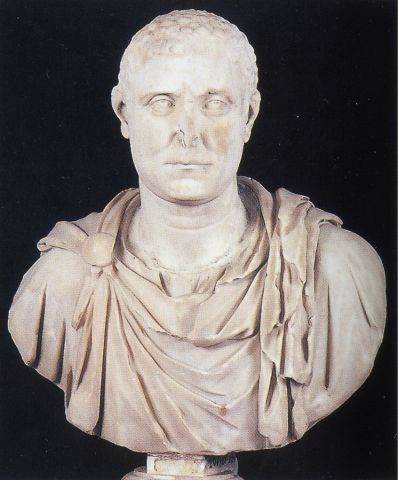
Portrait head of clean-shaven man on alien bust. From Rome. Fourth century.
Record details
Photographs
Bibliography
- Giuliano, A. (ed), Museo Nazionale Romano. Le Sculture I,2. Ali del Chiostro, Rome 1981, 39-40, no. 29
Discussion
DESCRIPTION (Object)
Head for insertion set on alien bust. H: 65 cm. Italian marble.
The head and bust do not belong together. The nose is broken. There are chips on the left eyebrow, right ear, lower lip, and chin.
The hair is rendered in short unruly locks that are articulated with a flat chisel. They sit close to the head but are not flat. The irises are marked by a fine flat chisel line, and the pupils and inner canthi are drilled. A deep drill channel also separates the upper border of the upper eyelid from the brow above it.
PROVENANCE
Found during works on the Tiber embankment. Inventoried after 1900.
DESCRIPTION (Subject)
The portrait head depicts a full-faced man with short copious hair that defines a dome-shaped cranium. The figure is clean-shaven with distinctive physiognomical details.
The eyes have heavy lids and most notably the eyebrows sag over them. The mouth is particularly broad and thin-lipped. The naso-labial folds are pronounced, and a loose skin hangs between the chin and neck, forming a double chin. The forehead has two horizontal creases, and diagonal folds rise from the base of the nose which features also a horizontal furrow.
DATE
The date of this portrait is not clear; both the second and fourth century are possible. The two most significant details are that the figure is clean-shaven and has drilled eyes. The honorand might therefore be one of the minority of men who wore an old fashioned style in the second century AD.
Against this interpretation is the lined face and the lack of drilling in a curly hairstyle. A fourth century would accommodate these details.
Discussion references
- Ensoli, S. and E. La Rocca (eds.), Aurea Roma: dalla città pagana alla città cristiana, Roma 2000, 544-5, no. 193 (M. Bergmann: third-quarter of fourth century)
Cite: Last Statues of Antiquity, LSA-1073 (J. Lenaghan).