
LSA-1074
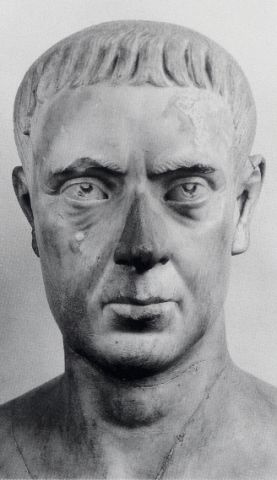
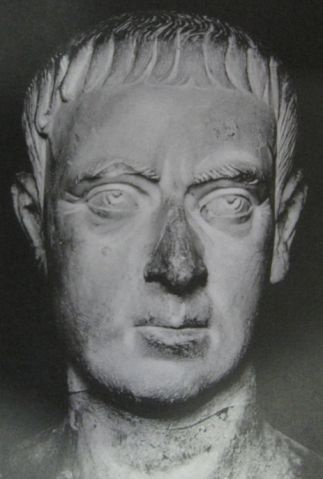
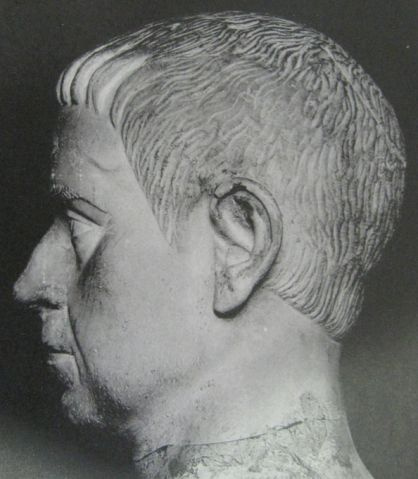
Portrait head of man with engraved beard and lank fringe on tall brow. From Italy. Later fourth century.
Record details
Photographs
Bibliography
- de Kersauson, K., Les portraits romains II; de l’année de la guerre civile (68-69 après J-C) à la fin de l’Empire , Paris 1996, 517, no. 247
Discussion
DESCRIPTION (Object)
Life-size head. H: 27, W: 20, D: 28 cm. Fine-grained greyish marble (Delbrueck; Carrara=.
The head is broken through the middle of the neck but has been reattached. Another break runs from the left side of the neck towards the sternum and then back up to the middle of the right shoulder. The nose, the left half of the upper lip, and most of the ears have been restored in plaster.
The hair is rendered across the brow in large locks with open spaces between them. Around the ears and at the top and back of the head it is delineated by tightly-spaced curving lines of a flat chisel. This technique is also used in the eyebrows. The irises are finely engraved and do not touch the lower lids. The pupils are deeply-drilled U (left eye) and crescent (right eye) shapes. There is no reason to imagine that the eye markings are modern. Light facial hair is engraved into the skin.
PROVENANCE
Catalogued in the Campana collection in Rome in 1857. Acquired by the Louvre in 1863.
DESCRIPTION (Subject)
The head represents a man with light stubble who turns to his left. Both the thinness of the hair across the brow and the treatment of the skin around the eyes suggest that he is of mature age.
The fringe is high on the brow with a part over the inner corner of the left eye. At the right corner of the fringe two non-contiguous large locks curl inwards. At the back and top of the head, the hair is combed forward in long flat locks. At the juncture of the skull and the neck, these locks indent.
The tall brow has two lines of contraction above the nose. There are small creases at the outer corners of the eyes (crow’s feet) and multiple folds under the eyes. The naso-labial folds are marked. The mouth is broad with downturned and creased corners. The chin is rounded.
DATE
The hairstyle, light facial hair, and technique of this head should place it in the second half of the fourth century (see both Fittschen and Bergmann). Earlier scholarship placed it in the Tetrarchic (Delbrueck, De Kersauson) or Constantinian period (Von Sydow).
The fringe and treatment of the eyes finds convincing parallels in the portraits assigned to Valentinian or Valens (see LSA-582 ). LSA-879, which has a good external date of c. 370, provides further comparanda for the general fashion style and technique of the eyes. Bergmann notes that the brow hair is similar to LSA-2116 which is probably also a later fourth-century portrait.
Discussion references
- Delbrueck, R., Spätantike Kaiserporträts. Von Constantinus Magnus bis zum Ende des Westreichs , Leipzig 1933, 122-3, fn. 1, pl. 165 (Tetrarchic era)
- Ensoli, S. and E. La Rocca (eds.), Aurea Roma: dalla città pagana alla città cristiana, Roma 2000, 545, no. 194 (Bergmann: late fourth century)
- Fittschen, K. and P. Zanker, Katalog der Porträts in den Capitolischen Museen und den anderen kommunalen Sammlungen der Stadt Rom, Band I, Mainz 1985, 159, fn. 10 (example of Valentinian facial type)
- Von Sydow, W., Zur Kunstgeschichte des spätantike Porträts im 4. Jahrhundert. n. Chr, Bonn 1969, 36 (Constantinian)
Cite: Last Statues of Antiquity, LSA-1074 (J. Lenaghan).