
LSA-1075
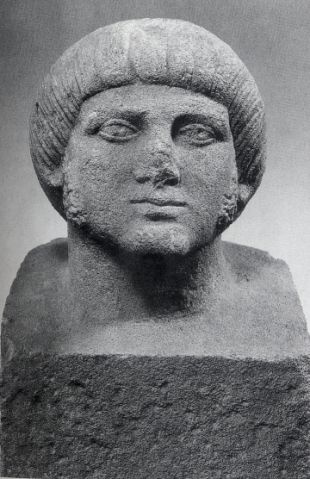
Herm portrait of 'German'. Welschbillig (Belgica II). Later fourth century.
Record details
Photographs
Bibliography
- Wrede, H., Die spätantike Hermengalerie von Welschbillig : Untersuchung zur Kunsttradition im 4. Jahrhundert n. Chr. und zur allgemeinen Bedeutung des antiken Hermenmals , Berlin 1972, 70, 113 Herm 82, pl. 33.1-2
Discussion
DESCRIPTION (Object)
Herm with portrait. H: 1.00, W: 28.5, D: 27.5 cm. Jura limestone.
The shaft is roughly worked on all sides. The block was made originally for architectural use as rebates on the sides and a clamp cutting on the right near the bottom indicate. The nose, right eyebrow, and area over the right ear are damaged.
PROVENANCE
Found in 1891-92 around the pool of the imperial villa at Welschbillig. It is one of 70 extant herms and one of an original total of 108-112 (94-98) herm portraits; see also LSA-2637, LSA-2638, LSA-2639, and LSA-2640. These herm portraits punctuated the balustrade around the pool which has not been completely uncovered (thus, the discrepancy in the total count). This herm was excavated in the first museum excavation in an area of undisturbed collapse. It was located on the short northern side, just east of centre, of the pool. This is one of the herm portraits which has no extant duplicate.
DESCRIPTION (Subject)
The head shows a young, clean-shaven man who turns to his left. He wears a ‘bowl-cut’ hairstyle and full curly sideburns. His hair falls in long straight locks which fall low on the brow and cover all but the lobes of the ears as well as the nape of the neck. The locks part slightly over the inner corner of the right eye, curve downwards at the temples, and bend forward behind the ears. The young man has wide-set eyes, a full and broad mouth, and strong projecting chin.
DATE
The Villa at Welschbillig, to which the pool belonged, was almost certainly imperial and of the fourth-century. The date is confidently placed in the latter part of the fourth-century on the basis of historic, archaeological, and art historic considerations. An imperial presence in Trier is either known or can be assumed (from the numerous laws issued there) for the period between 367-390; the re-use of funerary material in the basin floor post-dates Julian until which point desecration of cemeteries was forbidden; and there is an iconographic similarity between many of the herm portraits and members of the Theodosian court as represented on the Obelisk in Istanbul and in other media..
HONORAND
The portrait has been identified as a 'German'. Portraits identified as members of the Germanic guard on the Obelisk of Theodosius (c. 390) wear similar styles. B. Kiilerich, The Obelisk Base in Constantinople: Court Art and Imperial Ideology (Rome 1998) illustrates a selection of these guards from all sides of the Obelisk on p. 94; see also G. Bruns, Der Obelisk und seine Basis auf dem Hippodrom zu Konstantinopel (Istanbul 1935), figures 66 and 67. Two examples of similarly-styled portraits in the round, both probably from Asia Minor, are LSA-321 and LSA-1081.
It remains unclear whether this portrait at Welschbillig was intended to represent a specific individual or simply to represent generically a kind of individual. Among the 70 extant herms at Welschbillig, there are readily recognizable cultural figures of the past (Socrates LSA-2638, Diogenes, Polydeuces LSA-2639 , Vespasian LSA-2637 ) and divinities (Zeus, Aphrodite, Mars, Hercules, Satyr). Many of these are preserved in duplicate. In addition, there are numerous portraits that represent males of different ages who wear a variety of late fourth-century fashion styles of the, such as the ‘German’ in question. These are today no longer identifiable beyond an ethnic assessment, and it should remain open as to whether they ever were.
Discussion references
- Ensoli, S. and E. La Rocca (eds.), Aurea Roma: dalla città pagana alla città cristiana, Roma 2000, 546-7, no. 197
- Wrede, H., Die spätantike Hermengalerie von Welschbillig : Untersuchung zur Kunsttradition im 4. Jahrhundert n. Chr. und zur allgemeinen Bedeutung des antiken Hermenmals , Berlin 1972
Cite: Last Statues of Antiquity, LSA-1075 (J. Lenaghan).