
LSA-1077
Base for statue of Constans, Constantius I, or Constantius II, emperor. Delphi (Achaea). 293-350
Record details
Photographs
Inscription
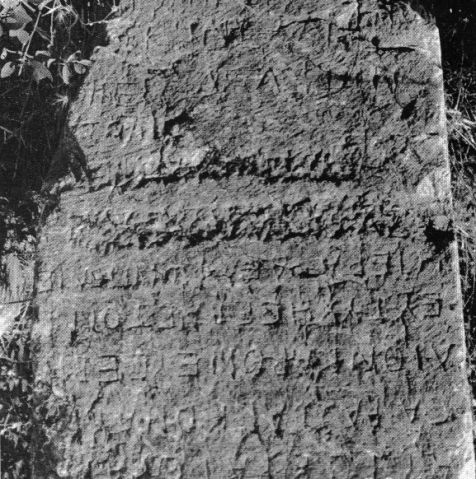
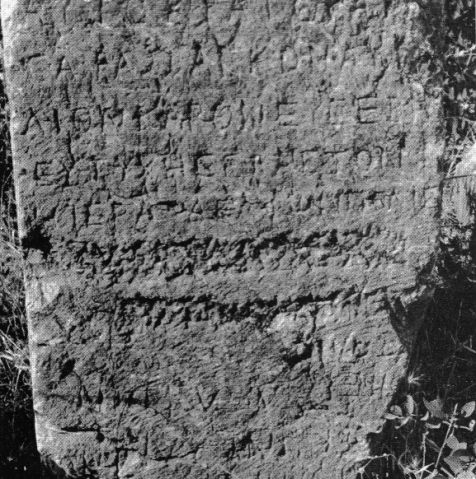
[τὸν ἡμ]ῶν κ̣ύ̣ρ[ιον] / [ἐπ]ιφανέστατο[ν] / Φλ(άβιον) Κώνσταν / ἡ ἱερὰ Δελφῶν /πόλις.
Inscription translation
The holy city of the Delphians (set this up to) our Lord the most noble Flavius Constans.
Bibliography
- Dittenberger, W., Sylloge Inscriptionum Graecarum. 3rd edition., Hildesheim - New York 1982, no. 897
Discussion
INSCRIPTION
In five lines:
[τὸν ἡμ]ῶν κ̣ύ̣ρ[ιον] / [ἐπ]ιφανέστατο[ν] / Φλ(άβιον) Κώνσταν / ἡ ἱερὰ Δελφῶν / πόλις.
'The holy city of the Delphians (set this up to) our Lord the most noble Flavius Constans'.
This is the text as given in the publication by Jannoray 1946. Vatin 1962 proposes an alternative reading of the imperial name in line 3:
[ ] Κωνστάντ̣ιο̣[ν] - 'Constantius'
Letter height 2-5 cm.
DESCRIPTION (from Jannoray 1946 and the published photo)
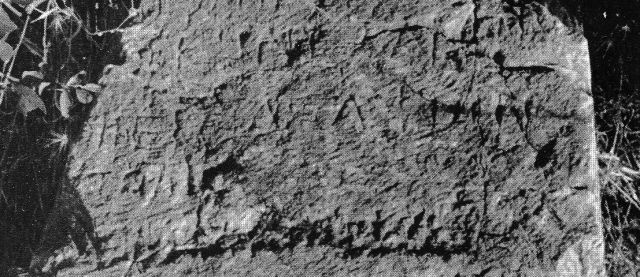
Rectangular block of coarse grained marble. H 102 cm, W 54 cm, D 49 cm. The block, originally inscribed with a dedication to Carus (282-3), has been turned upside down for the present inscription which begins at the original bottom edge. Between the two inscriptions two lines have been erased which probably once belonged to the original inscription (Jannoray 1946, 260). Substantial breaks at the left side have removed the initial letters of lines 1 and 2. The surface is heavily weathered, making the inscription difficult to read.
PROVENANCE NAND CURRENT LOCATION
The block was found in 1935 built into a wall of an olive grove some metres to the right of the entrance to the sanctuary of Apollo. It is today in the Delphi Museum, inv. no. 6074.
HONORAND AND DATE
The inscription's original editor Jannoray identified the honorand as Flavius Iulius Constans, the youngest son of Constantine I. Constans was Caesar 333-7 and Augustus 337-50. The epithet ἐπιφανέστατος (lat. nobilissimus) is usually applied to Caesars, and the inscription is without the title of Augustus; but in Delphi there is another dedication to Constans, as Augustus, which uses the same epithet (LSA-930).
The base was briefly mentioned in a footnote by Vatin 1962 who made the case for reading the imperial name in line 3 as [ ] Κωνστάντ̣ιο̣[ν]] - 'Constantius' rather than 'Constans' and proposed Constantius I as honorand. This would date the base most probably between 293 and 305, the years when Constantius I was Caesar, since in the tetrarchic period the epithet ἐπιφανέστατος - nobilissimus was applied to Caesars, not Augusti.
However, Flavius Iulius Constantius (Constantius II) is a third candidate if Vatin's reading is correct. Constantius II was Caesar 324-37 and Augustus 337-61. If he was the honorand, the base will have been set up while he was still Caesar.
The inscription was set up by the city of Delphi, proudly styled 'the holy' (line 4).
FURTHER DISCUSSION
Four further dedications to emperors of the Constantinian dynasty are known from Delphi, two for Constantine I (LSA-927, LSA-928), one for Dalmatius (LSA-929), and one for Constans (LSA-930). Vatin, who discussed them comprehensively, believed that they did not form a contemporary group, a conclusion with which we concur (Vatin 1962, 235).
Discussion references
- Jannoray, J. Inscriptions Delphiques d'Époque Tardive, Bulletin de Correspondance Hellénique 70, 247-61, Paris 1946, 259-61 no. 9
- Vatin, C., Les Empereurs du IVe siècle a Delphes, Bulletin de Correspondance Hellénique 86, 229-41, Paris 1962, 234 n. 1, 233 fig. 3
Cite: Last Statues of Antiquity, LSA-1077 (Ulrich Gehn).