
LSA-1083
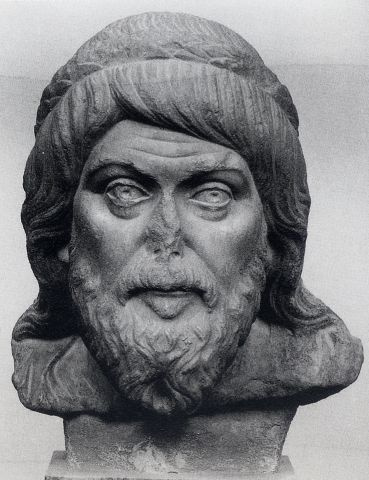
Portrait head of man with long hair and beard and wreath. Athens. Late fourth to early fifth century
Record details
Photographs
Bibliography
- Brouskari, M. S., The Acropolis Museum. A descriptive Catalogue, Athens 1974, 174 no. 1313 fig. 374
Discussion
DESCRIPTION (Object)
Portrait head of a wreathed long-haired, long-bearded male, preserved with a part of the neck and shoulders. Hymettian marble, H 35 cm, W 28.6 cm, D 18.5 cm. According to the first publisher, Dontas 1955, 147, the head once belonged to a bust and a metal dowel on the lower side of the neck is still preserved. The nose is broken off and the lids and pupils are chipped; major chips are moreover on the laurel wreath. There are minor chips on eyebrows, forehead, cheeks, beard and hair. Apart from this, the head is complete and in an excellent state of preservation.
The hair is separated into single strands by long, thin, shallow lines drawn with the chisel.The beard is rendered in the same technique as the hair, without drill work.
The eyebrows are marked with short chisel strokes. The pupil is indicated by an incised circular line; the pupil is a circular drill hole.
Two parallel horizontal furrows are incised into the forehead.
PROVENANCE/ LOCATION
There is no published record of the finding place of the head (according to Brouskari 1974 it is unknown; Dontas 1955 considered its provenance from a late-antique house at the southern slope of the Acropolis, the so-called 'house of Proclus'). The head is today on display in the New Acropolis Museum, inv. no. 1313.
DESCRIPTION (Subject)
The portrayed is a man of mature age, as indicated by marked naso-labial folds. His lank long hair falls onto neck and shoulders, and deeply into the forehead, separating into a 'fork' above the right eye; the earlobes are uncovered. His long beard is conically shaped and densely closed.
The head is decorated with a wreath (laurel(?)); on both shoulders a rest of the garment, probably a himation, is visible. The neatly cultivated long hair and beard identify the honorand as a 'Holy man', 'theios aner', or 'philosopher'. The wreath probably indicates a priestly function (Alföldi-Rosenbaum 1982, 13) or, less likely, posthumous heroisation (Dontas 1955, 151); its bearer was certainly a pagan.
Dontas proposed as honorand Plutarchus, the head of the neo-platonist school of the late 4th/ early 5th century, who died in 431/2 or 433/4 (PLRE I, 708 Plutarchus 5). The name Plutarchus is recorded in three honorific inscriptions in late antique Athens, which possibly refer to the famous philosopher, as honorand (LSA-134, LSA-136), or as awarder (LSA-137). Where Plutarchus is honoured, the texts allude to the pagan piety of the honorand. Alföldi-Rosenbaum 1982, 13 compared the hairstyle and wide-open eyes of our had with contorniate-portraits of Apuleius from Madaura, without, however, explicitly speaking out an identification since the contorniate portraits of Apuleius are without a beard.
DATE
Dontas assessed the head as an example of the 'new agitated-exited style' ('des neuen unruhig erregten Stils', Dontas 1955, 149) which according to him followed the calmer style of the Obelisk base and the years around 400, and dated it to 420 ca. This was supported by v. Sydow 1969, 110, and by Bergmann 1972, 218 (with recourse to the Obelisk-base fom 390/2, and to the Thessaloniki couple LSA-90 and LSA-91) , and by Meischner 2001, 119. H. v. Heintze's approach in contrast, who came to a date around 300 for our head by comparison to a portrait in Bonn which by its asymmetrically adjourned muscles is undoubtedly attributable to the tetrarchic period, is not convincing.
The marking of the eyes assigns a late-antique date to our head; the staring glance indicates a date not earlier than the late 4th century. A date in the late 4th or early 5th century is favourable for the head.
Discussion references
- Alföldi-Rosenbaum, E., Animae sanctiores. Porträt-Galerien berühmter Griechen und Römer aus dem späten vierten Jahrhundert n. Chr., Pro arte antiqua. Festschrift für Hedwig Kenner. Herausgegeben vom Österreichischen Archäologischen Institut in Wien (Sonderschriften Band XVIII), 11-22, Wien 1982, p. 13 pl. II fig. 8
- Bergmann, M. Review of W. v. Sydow, Zur Kunstgeschichte des spätantiken Porträts im 4. Jahrhundert n. Chr., Jahrbuch für Antike und Christentum 15, 1972, 214-25, Münster/ Westfalen 1973
- Dontas, G., Kopf eines Neuplatonikers, Mitteilungen des Deutschen Archäologischen Instituts, Athenische Abteilung 69/70, 1954- 1955, 147-52 pl. XIV Beilagen 54-5, Berlin 1956
- Ensoli, S. and E. La Rocca (eds.), Aurea Roma: dalla città pagana alla città cristiana, Roma 2000, 647, no. 354 (no date possible)
- Von Sydow, W., Zur Kunstgeschichte des spätantike Porträts im 4. Jahrhundert. n. Chr, Bonn 1969, pp.109-11
Cite: Last Statues of Antiquity, LSA-1083 (Ulrich Gehn).