
LSA-1085
Base for statue, with dedication to Constantius II and Constantius Gallus, emperors. Lychnidus (Epirus Nova). 351-354
Record details
Photographs
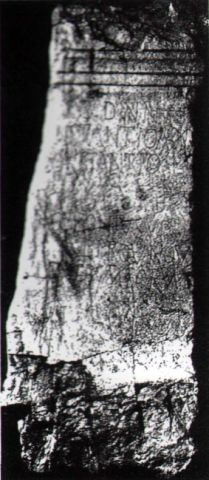
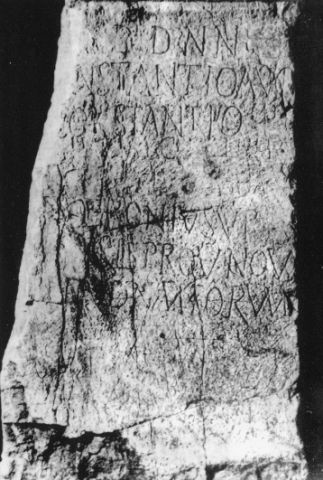
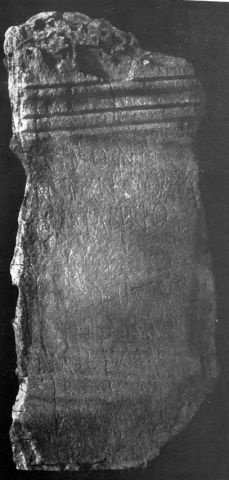
Inscription
DD(ominis) NN(ostris) / [Co]nstantio Aug(usto) / Constantio / [[ [nobi]l(issimo) C[aes(ari)] ]] / [[-------]] / Sof̣ronius v(ir) p(erfectissimus) / [pra]esis (sic) prov(inciae) nova[e] / [E]p̣iri d(evotus) ṇ(umini) m(aiestatique) eorum.
Inscription translation
Sofronius, man of perfectissimus rank and governor (praeses) of the province of Epirus Nova (set this up to) our Lords Constantius Augustus and Constantius the most noble Caesar.
Bibliography
- Inscriptiones Graecae, X, 2(2) 366
Discussion
INSCRIPTION
DD(ominis) NN(ostris) / [Co]nstantio Aug(usto) / Constantio / [[ [nobi]l(issimo) C[aes(ari)] ]] / [[-------]] / Sof̣ronius v(ir) p(erfectissimus) / [pra]esis (sic) prov(inciae) nova[e] / [E]p̣iri d(evotus) ṇ(umini) m(aiestatique) eorum.
'Sofronius, of perfectissimus rank and governor (praeses) of the province of Epirus Nova (set this up to) our Lords Constantius Augustus and Constantius the most noble Caesar'.
Letter height 5.5-6 cm.
The erasure in lines 4 and 5 strangely misses the name of Constantius Gallus (preserved in line 3). In line 4, the C of the imperial title seems to have escaped the erasure. In line 5, Dusanic 1970, 138 proposed that a part of the name of the awarder, the provincial governor was (erroneously) erased.
DESCRIPTION (from IG X and the published photos)
Tall marble block with mouldings at top and bottom; the mouldings surround three sides of the block. H 116, W 47, D 44 cm. (Vulic 1931 and Vulic 1933 give H 140 cm, W 48 cm). The photo given by Vulic 1933, reproduced here as image no. 2, shows the block cut horizontally at the bottom; the epigraphic field and the rectangular break immediately above the upper mouldings nonetheless make it certain that this is the same block as on our thumbnail and image 1. The block is broken and lost on the left, and there are major breaks in the lower mouldings and further breaks in the upper moulding. Above the moulding, a plinth, or other crowning element, is broken on all sides, leaving an unshaped mass of material standing proud. The surface is heavily weathered and cracked rendering part of the inscription illegible. There is no description and no published photograph of the top of the block. CIL describes the block as an altar, following the earlier editions by Vulic 1931, Vulic 1933, and Milin 1997, but the wording of the inscription and the shape of the block both show that it was in fact a statue base.
For the epigraphic field an earlier, Greek, inscription was erased; to the right of the imperial name in line 3 an omega of the earlier inscription is preserved.
PROVENANCE/ LOCATION
The block was found in a house in modern Ohrid, the location of ancient Lychnidus (http://www.trismegistos.org/place/12159) (Milin 1997, 139). It is today in the Ohrid Museum, inv. no. 21.
HONORANDS, AWARDER, AND DATE
The inscription is dedicated to Constantius II, Augustus 337-61, and Constantius Gallus, Caesar 351-4, and is dated by the common reign of these emperors.
The awarder Sofronius is known only from this inscription, hence can not contribute to a closer date (PLRE I, 847 Sofronius 1. PLRE erroneously takes the two publications of this inscription by Vulic, Spomenik 1931 and Vulic Spomenik 1933 as testimony to two identical inscriptions).
FURTHER DISCUSSION
The province of Epirus Nova was cut out of the province of Macedonia in the wake of the tetrarchic reforms, securely after 293 and before 311, possibly before 298 (Milin 1997, 141-3).
Discussion references
- Dusanic, M., Epirus Nova Dalmatorum, Ziva Antika 20, 137-44, Skopje 1970
- Jones, A. H. M. et al., The Prosopography of the Later Roman Empire. Vol. I 260-395, Cambridge et al. 1971 (1975)
- Milin, M., Epirus Nova sine Dalmatorum, Ziva Antika 47, 139-44, Skopje 1997
- Vudic, N., Anticki Spomenicki, Spomenik 71, 3-259, Belgrad 1931, p. 108 no. 260
- Vudic, N., Anticki Spomenicki, Spomenik 75, 3-89, Belgrad 1933, p. 57 no. 174
Cite: Last Statues of Antiquity, LSA-1085 (Ulrich Gehn).