
LSA-1090
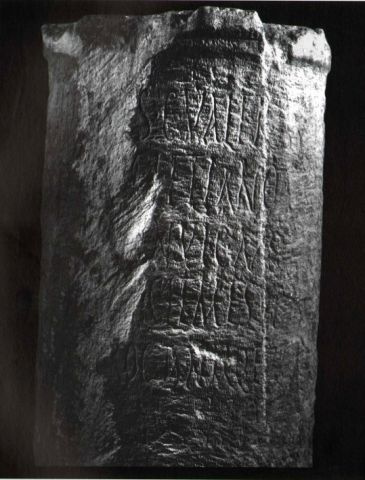
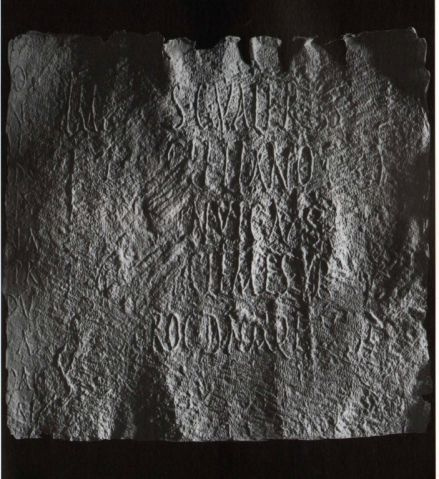
Columnar base for statue of Diocletian, emperor. From Caesarea Maritima (Palaestina I). 284-305
Record details
Photographs
Inscription
Imp(eratori) [Cae]s(ari) C(aio) Valerịọ / D[io]cletiano, / [p(io), f(elici),] invic(to) Aug(usto), / [-] Clemes, v(ir) p(erfectissimus), / proc(urator), d(evotus) n(umini) m(aiestati)q(ue) e(ius).
Inscription translation
To Caesar Caius Valerius Diocletianus, pious, fortunate, unconquered Augustus; Clemens, of perfectissimus rank, governor (procurator), devoted to his divine spirit and majesty, [set this up].
Bibliography
- Lehmann, C. M. and K. G. Holum, The Greek and Latin inscriptions of Caesarea Maritima, Boston 2000, 42-3 no. 6
Discussion
INSCRIPTION
In five lines:
Imp(eratori) [Cae]s(ari) C(aio) Valerịọ / D[io]cletiano, / [p(io), f(elici),] invic(to) Aug(usto), / [-] Clemes, v(ir) p(erfectissimus), / proc(urator), d(evotus) n(umini) m(aiestati)q(ue) e(ius).
'To the emperor Caesar Caius Valerius Diocletianus, pious, fortunate, unconquered Augustus; Clemens, of perfectissimus rank, governor (procurator), devoted to his divine spirit and majesty, [set this up].'
Letter height 3.5 - 9.5 cm.
The inscription, with the honorand in the dative and the name of the awarder in the nominative, displays the crucial features of Latin statue base-inscriptions.
DESCRIPTION (from Lehmann & Holum and the published photos)
Columnar base of grey marble with blue and white streaks, broken at bottom and with a neck ring at the top. H 135, diameter 43-46 cm at the bottom, 48 at the top. The top is roughly finished with a point. Some major breaks at the neck ring. The surface is chipped at the left side of our inscription, rendering it partly illegible.
The column bears traces of three dedications, of which ours is the last. The first, in Latin, is by the centurion Mevius Romanus to his superior Lucius Valerius Valerianus, from the late 2nd century (Lehmann & Holum, 37-41 no. 4); the second, in Greek, by the centurion Alexandrus to Aurelius Maron, acting governor of Syria Palestine, in the 3rd century (Lehmann & Holum, 41-2 no. 5); and our inscription, in Latin again, to Diocletian. The two earlier inscriptions are carved into the original surface; the second inscription left the first intact, using the remaining surface space. For our inscription, the last half of each line of the first inscription was erased with a fine claw chisel to create the new epigraphic field; the second inscription was not affected by this. Because of the erasure, the epigraphic field of our inscription is slighlty inset from the surface.
PROVENANCE AND LOCATION
The base was found in 1961 just south of the Old City. It was not in situ but had evidently been dragged to a lime kiln (Lehmann & Holum 2000, 38). Today in the Israel Museum in Jerusalem, inv. no. 174.
HONORAND, AWARDER AND DATE
Diocletian, the honorand, was Augustus 284-305.
Clemens ('Clemes' in the inscription) was a governor (procurator) of the province of Palestine. He is only known from this inscription (PLRE I, 214, Clemens 1). Clemens is one of the two last known procurators of the Roman empire and therefore must have been in office before the governor of Palaestina became a praeses of equestrian rank in the wake of the tetrarchic provincial reforms of the 290s (cf. Lehmann & Holum, 6 with n. 26). The governor Arbaeus Africanus, who is known from a dedicatory inscription in Caesarea to Maximian (LSA-1100), was already a praeses. This provides some probability for a date before 300 for our inscription.
Diocletian adopted the name Aurelius, omitted in our inscription, when Maximian was elevated to the rank of Augustus in 286, which suggests a date for our inscription before that time (though Diocletian's name does appear without 'Aurelius' on occasion also after 293). The fact that Diocletion alone is mentioned, moreover, could point to the years 284-6 when he held office without a colleague; but, on the other hand, the dedication to Maximian by Arbaeus Africanus (LSA-1100) does not mention any imperial colleague either. Since none of the chronological indicators provide a completely secure closer date, we have kept the full range of Diocletian's reign as our outer dates.
FURTHER DISCUSSION
It is a striking feature of the honorific inscriptions in Caesarea that virually all of them were carved on free standing columns (our inscription, LSA-11, LSA-12, LSA-1100, LSA-1105, LSA-1106, LSA-1107). There is no reason to doubt that these were statue bases, with statues set on top of the columns.
Discussion references
- Jones, A. H. M. et al., The Prosopography of the Later Roman Empire. Vol. I 260-395, Cambridge et al. 1971 (1975)
Cite: Last Statues of Antiquity, LSA-1090 (Ulrich Gehn).