
LSA-1098
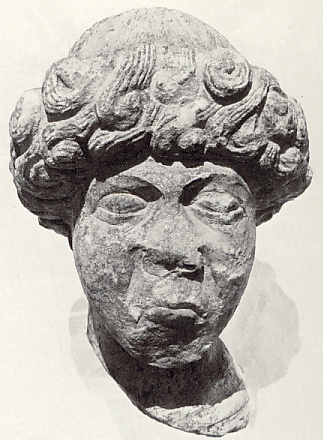
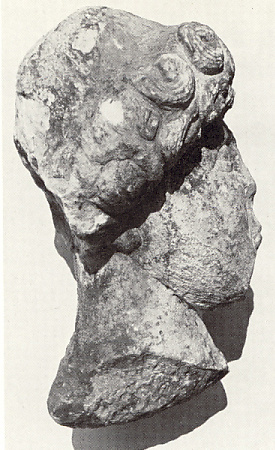
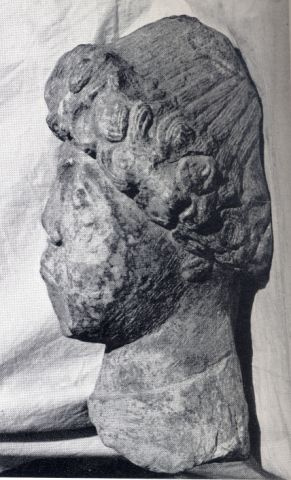
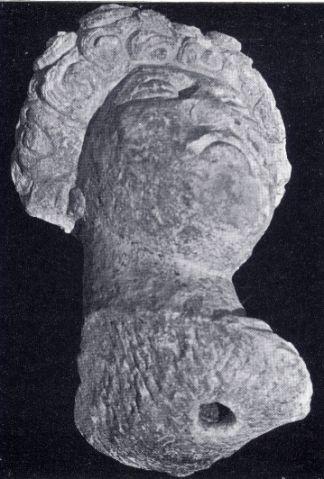
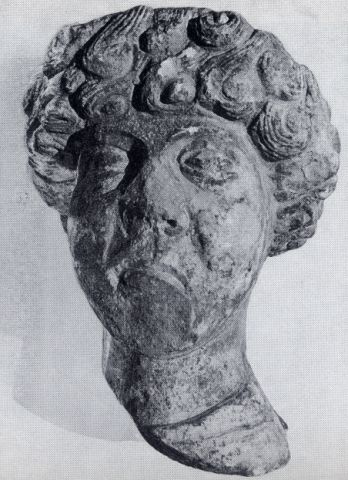
Separately worked head of man with wreath hairstyle. Sardis (Lydia). Earlier sixth century.
Record details
Photographs
Bibliography
- Hanfmann, G.M.A . 'Portraits from Sardis', Hommage à Marcel Rennard III. Collection Latomus 103, Brussels 1969, 291-293, pls. 15-17, figs. 5-10
- Inan, J. & E. Alföldi-Rosenbaum, Römische und frühbyzantinische Porträ̈tplastik aus der Türkei : neue Funde, Mainz 1979, 200-201, no. 171, pls. 270.1-2
- Sande, S., 'Zur Porträtplastik des 6. Jhds n. Chr.,' , Acta ad archaeologiam et artium historiam pertinentia, 6 (1975), 65-166., 81-3, figs. 19-21 (early sixth century)
Discussion
DESCRIPTION (Object)
Over life-size head, separately worked. H: 39, W: 28 cm. H (of face): 17.5. Half-marble.
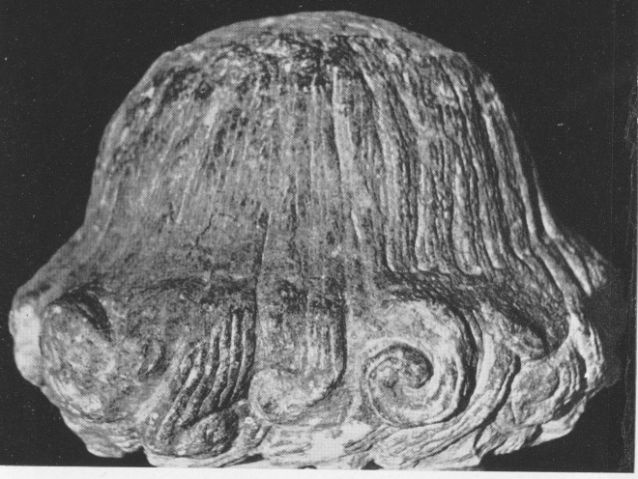
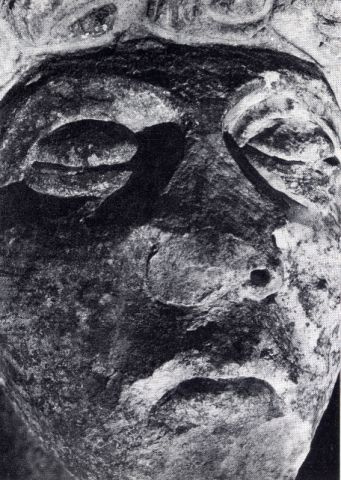
The lower part of the back of the head is missing. The nose and chin are chipped. The head was worked with its neck. The bottom surface of the neck is roughly worked and has a hole for a dowel (Deep 6.2 cm, Diameter 2.5 cm). This dowel fixed the head to a statue. The eyes are unmarked. The drill has not been used in the hair.
PROVENANCE
Excavated in August of 1966 in Hall C which was the major passage between the main building of the gymnasium and the southwest corner of the colonnaded palestra. It was found in the doorway to the main building of the gymnasium. All of these structures were abandoned after the raid by Khosroes II in 616. Lime burning, however, occurred in this Hall C.
DESCRIPTION (Subject)
The head and neck show a man with a thick ‘wreath’ hairstyle, a stubble beard, and some drapery around his neck. The face is oval with a jutting mandible and a down-turned mouth (two characteristics which earned it the nickname ‘sourpuss’ at Sardis). The hair is brushed forward from the top of the head in long thin strands. It develops around the face into wreath of two tiers of thick curly locks. The wreath of hair almost completely covers the ears. The beard has been scratched onto the surface of the stone. The differentiation in the folds around the neck--that is, there are at least two raised folds-- suggest that the head was set on a togate statue.
DATE
The full hairstyle, which almost completely covers the ears, and the stubble beard places this head best at end of the fifth century and, more probably, in the earlier sixth century. Two fine parallels for the general hairstyle, the statue of Pytheas LSA-147 and LSA-148 and the statue of Palmatus LSA-198 and LSA-199, both from Aphrodisias and both identified by their bases, date with high probability to the late fifth and early sixth century; the former wears a hairstyle that does not entirely cover his ears and the latter wears a longer hairstyle which does cover the ears. Sande correctly points out that the consular diptychs of Aerobindus (Constantinople, AD 506) and of Clementinus (Constantinople, AD 513) show the same hairstyle, as does a gold medallion of Theoderic the Great, which is dated to the first quarter of the sixth century.
Some of the awkwardness of the appearance of the head is due to the stone used and its state of preservation.
Discussion references
- Hanfmann, G.M.A. 'The Ninth Campaign at Sardis (1966)', Bulletin of American Oriental Research 187, Ann Arbor (1967), 19-21, fig. 44
Cite: Last Statues of Antiquity, LSA-1098 (J. Lenaghan).