
LSA-11
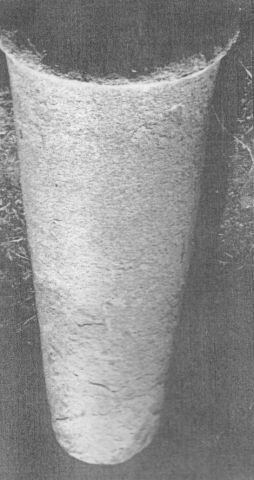
Columnar base for statue of Eusebius, possibly governor of Palaestina. Caesarea Maritima (Palaestina I). Fourth to fifth century
Record details
Photographs
Inscription
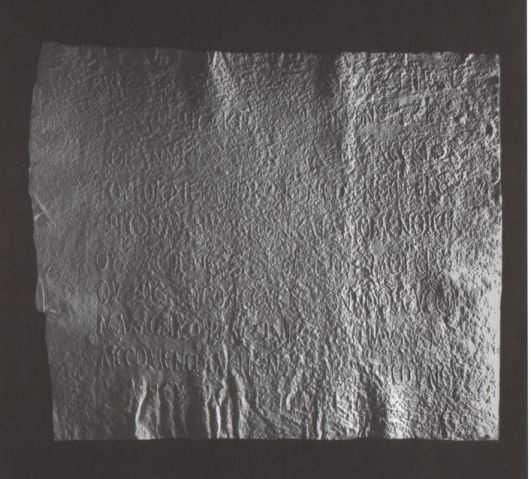
ΕΥ[----------------]ς τύπος [-] / [--ca. 7--]ησα ἱερο[----]μον Εὐσέβι[ον], / κοιρα̣νίη [--ca. 9--] ἔ̣χ̣ει γέρας ἐκ τ̣ῶν [-]. / τοῦτο καὶ ἐβ[--ca. 8--]ν εἶχεν ὀφειλόμ[ενον]. / ἔργων δ’ἀν[--ca. 7--] καὶ δαψομένοισιν [-] / οὐ χρυσὸν [--ca. 10--] προτιμότερον. / οὕτω [ἐς] Θεὸν ἔσχεν [ὅλ]ον νόον, εὐσεβίῃ [τε] / μᾶλλον κοιρανέειν ἤθε̣λ̣εν ἢ δυνάμ[ι]. / λισσομένῳ δ’ ἐπένε[υσε]ν Ἀλυπίῳ ἐν [--] / ἀντ’ εὐεργεσίης πολλάκις ἧς ἔ̣τ̣υ̣χ̣[ε].
Inscription translation
Eu... statue ... sacred ... Eusebius, rule ... he had a statue because of the ...
(line 4) This also ... he had as his due. And of the deeds ... and to those that will consume ... not gold ... more honoured. Thus he kept his whole mind on God,
(line 8) and he wished to rule more by piety than by force. And he permitted Alypius, at the latter’s request, [to honour him] in return for the kindness that he frequently obtained.
(trans. Lehmann-Holum, 58)
Textual evidence
[I leave the greek text until spiritus and accents etc. are fully installed]
Translation
...statue...sacred...Eusebius, rule ... he had a statue because of the ... (4) This also ... he had as his due. And of the deeds ... and to those that will consume ... not gold ... more honoured. Thus he kept his whole mind on God, (8) and he wished to rule more by piety than by force. And he permitted Alypius, at the latter's request, (to honour him) in return for the kindness that he frequently obtained
Bibliography
- Lehmann, C. M. and K. G. Holum, The Greek and Latin inscriptions of Caesarea Maritima, Boston 2000, no. 26 pl. XXVI, XXVII
Discussion
INSCRIPTION
In ten lines:
ΕΥ[----------------]ς τύπος [-] / [--ca. 7--]ησα ἱερο[----]μον Εὐσέβι[ον], / κοιρα̣νίη [--ca. 9--] ἔ̣χ̣ει γέρας ἐκ τ̣ῶν [-]. / τοῦτο καὶ ἐβ[--ca. 8--]ν εἶχεν ὀφειλόμ[ενον]. / (5) ἔργων δ’ἀν[--ca. 7--] καὶ δαψομένοισιν [-] / οὐ χρυσὸν [--ca. 10--] προτιμότερον. / οὕτω [ἐς] Θεὸν ἔσχεν [ὅλ]ον νόον, εὐσεβίῃ [τε] / μᾶλλον κοιρανέειν ἤθε̣λ̣εν ἢ δυνάμ[ι]. / λισσομένῳ δ’ ἐπένε[υσε]ν Ἀλυπίῳ ἐν [--] / (10) ἀντ’ εὐεργεσίης πολλάκις ἧς ἔ̣τ̣υ̣χ̣[ε].
'Eu... image ... sacred ... Eusebius, rule ... he had this reward because of the ... .(line 4) This also ... he had as his due. And of the deeds ... and to those that will consume ... not gold ... more honoured. Thus he kept his whole mind on God, (line 8) and he wished to rule more by piety than by force. And he permitted Alypius, at the latter’s request, (to honour him) in return for the kindness that he frequently obtained' (trans. Lehmann-Holum 58, slightly adapted).
Letter height: 4 - 5.5 cm (lines 1-9); 4.5 - 6 cm (line 10).
Familiar features of this kind of honorific inscription are: the good rule of the commemorated man (koiran-, line 3); the statue as a reward (geras, line 4); his hard work (ergon, line 5); the apology that he is being honoured only with a marble or bronze statue, though he had deserved gold (line 6, for which see Bauer 2007). Unusual is the focus on piety (seemingly Christian piety) instead of justice as his prime virtue (lines 7 & 8), though the motif fits well with praise of the mildness and affability of governors. Last, but not least, 'euergesia, kindness' (line 10) is a reoccuring term in this kind of inscription, though it is very unusual that these benefits are received by an individual (here Alypius, the awarder), rather than a community.
DESCRIPTION (from Lehmann-Holum)
Large section of a grey granite column with upper ring-moulding. The bottom and a large part of one side are broken off. H 238 cm, diameter 67 cm at bottom, 75 at upper moulding. Cut into the top towards the inscribed side are five holes, two large ones (5 - 6 cm in diameter, and 3.5 - 4.5 cm deep), and two small ones (2.4 by 4 cm, and 1.7 - 2.5 cm deep). A fifth hole is almost entirely broken away. The surface was originally highly polished but is now for the most part worn. The inscribed area is 75 cm high and 80 cm wide, and starts 15 cm below the neck.
Originally published (by Germer-Durand) as a funerary inscription, this was re-read by Lehmann-Holum as a statue base. Freestanding granite columnar statue bases are a striking feature of the honorific dedications in Caesarea (Lehmann-Holum 7; LSA-12). The wording of the inscription as read by Lehmann-Holum certainly suits a statue-base - see 'Inscription' above.
PROVENANCE AND CURRENT LOCATION
Discovered in 1974 'in Field B just south of the Byzantine Esplanade' (Lehmann - Holum 2000). Now in the Caesarea Museum.
HONORAND, AWARDER AND DATE
As often on eastern bases with verse inscriptions, there is no explicit record of the office held by the honorand Eusebius, but the virtues attributed to him are typical of those found in inscriptions to late antique imperial officials. Since Caesarea was the provincial capital, he may well have been a governor of Palaestina Prima.
The awarder Alypius was probably a member of the local aristocracy, but could have been a member of Eusebius' staff.
Neither individual are readily identifiable with known and datable late antique persons (both names being common).
Lehmann - Holum suggest a date between 300 and 650, in other words the entire period of poetic late antique honorific inscriptions. We have dated it before 500, because after that date non-imperial statues are extraordinarily rare. The apparent reference to Christianity in line 7 perhaps favours a date in the 5th century.
FURTHER DISCUSSION
It is a striking feature of the honorific inscriptions in Caesarea that virually all of them were carved on free standing columns (our inscription, LSA-12, LSA-1090,LSA-1100, LSA-1105, LSA-1106, LSA-1107). There is no reason to doubt that these were statue bases, with statues set on top of the columns.
Discussion references
- Bauer, F. A., "Virtuelle Statuensammlungen", Bauer, F. A. and Witschel, C., Statuen in der Spätantike, Wiesbaden 2007, p. 89
- Germer-Durand, E., Echos d’Orient : revue d’histoire, de géographie et de liturgie orientales 7, Bucarest 1904, 260-1
- Merkelbach, R. and J. Stauber (eds.), Steinepigramme aus dem griechischen Osten. Bd. 4. Die Südküste Kleinasiens, Syrien und Palaestina, Munich 2002, p. 317 no. 21/ 03/ 03
Cite: Last Statues of Antiquity, LSA-11 (Ulrich Gehn).