
LSA-110
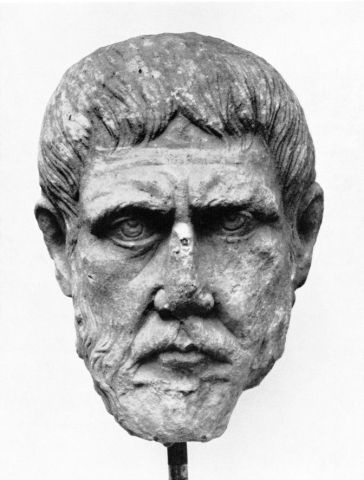
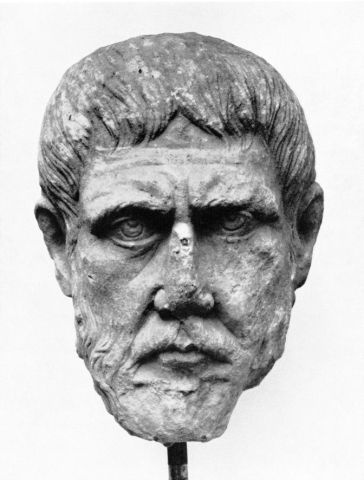
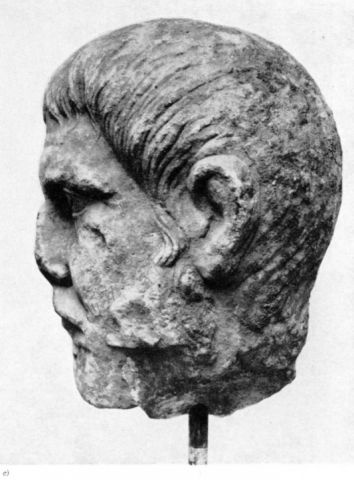
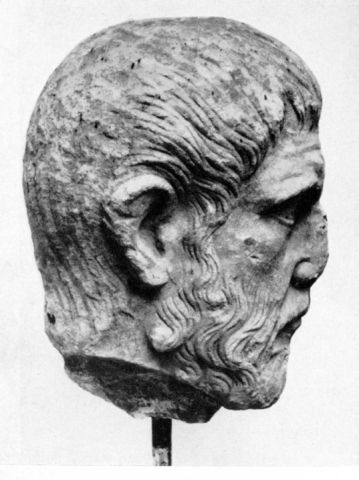
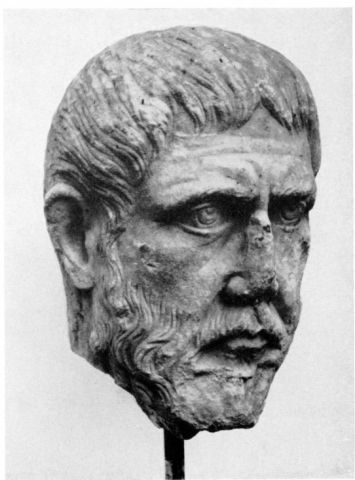
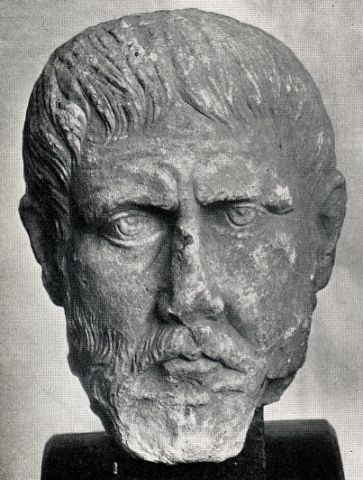
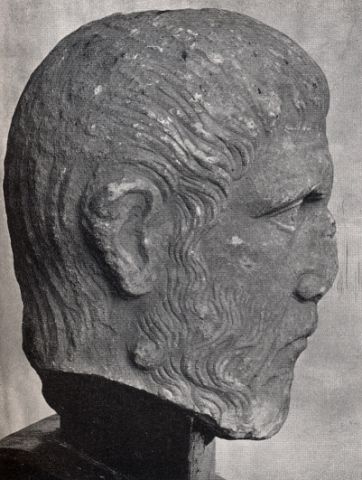
Portrait head of bearded man in 'Iamblichus-type'. From Delphi (Achaea). Later third century.
Record details
Photographs
Bibliography
- L'Orange, H. P., Studien zur Geschichte des spätantiken Porträts, Oslo 1933, 40-42, 124 nr. 59 fig. 110, 112
Discussion
DESCRIPTION (Subject)
The marble head, H 28 cm, is cut under the chin. In the centre of the cut face the first editor Pomtow 1889 noted a small cone, possibly to connect the head with a statue body or herm. The left jawbone and beard are broken, the chin, tip of the nose, and the earlobes are chipped.
The hair is arranged into lank strands by long parallel chisel lines around the face. The skull is only roughly finished; at the neck in the back long lank strands are roughly indicated. The beard is arranged into wavy compartments by the same chisel technique as the hair around the face; hair and beard merge in front of the ears.
The pupil is set against the upper lid and is marked by a deep semicircular incision. The iris is sketched out by an incised circular line. The right eye is larger than the left and its bulging lower lid is set markedly off the cheek bone. The eyebrows are contracted and almost horizontal; they are marked by short beveled chisel strokes. Short wrinkles are incised at the corners of the eyes.
The brow is marked by two horizontal folds. The contraction of the eyebrows causes a system of short vertical and beveled folds at the root of the nose. The cheeks and the area around the mouth are forcefully modeled; deep naso-labial folds extend from the nostrils to the corners of the mouth and separate the cheeks from the mouth.
PROVENANCE AND CURRENT LOCATION
The head was found in Delphi. It is now in Athens, National Museum inv. no. 390.
DESCRIPTION (Subject)
The portrayed is a man of mature age; this is indicated by the full beard, the flabby cheeks, and the wrinkles on the brow and around eyes and mouth. His lank hair is still dense; it is brushed into the brow where it is divided at the centre and at the right temple. From the centre three large lunular strands are brushed to the right.The ears are uncovered.
The somewhat fuller beard and hair of our portrait head have lead scholars to the assumption that the portrayed was a homo spiritualis, a poet, philosopher or sage (Rodenwaldt 1919; L’Orange 1933, L’Orange 1975; see also below, ‘Further Discussion’). The label 'Iamblichus-type', also applied by us, is due to this assumption; it goes back to a proposal of identification made by L'Orange 1933 (repeated in L'Orange 1975). I keep this labelling because of its popularity, although I do not support the identification suggested by it.
In my view, our head most probably represents a local notable. Similar hairstyles and longer beards are not uncommon in late 3rd and 4th century Greek portraiture; such a habit was possibly fashionable particularly among local notables of the period (Harrison 1953, 104; see also LSA-116).
DATE
Rodenwaldt 1919 dated this head (and the others in the group: see below, 'Further Discussion') to the late 4th century. L’Orange 1933 grouped this head together with a similar one likewise from Delphi (LSA-111) and another one in Eleusis (LSA-116) to form the earlier subset of his ‘Iamblichus-type’. L’Orange pointed out the resemblance of our head with the portraiture of the Gallienic period, however claimed that it was stylistically beyond that. The 'uneasiness and asymmetries' in its proportions, so he argued, were dating it to the late 3rd century; this date was repeated in L’Orange 1975.
The asymmetries in the face, notably the different eyes, and the heavily moved facial features one would usually associate with the portraiture of the early tetrarchic period in the late 3rd century. However, similar stylistic features reoccur on a head from the Athenian Agora (Harrison 1953 no. 49 pl. 31>; not in our database); from the burned condition of this head Harrison reasonably concluded that it was made before the Herulian incursion. The stylistic features fit the 'realism' of the mid 3rd century Athenian portraiture with its deliberate asymmetries (Harrison 1953, 95-6). While a date in the mid/later 3rd century seems secured, an earlier date within this frame appears more likely.
FURTHER DISCUSSION
Our head was first grouped by Rodenwaldt with LSA-111, LSA-112, LSA-113, LSA-114, LSA-115, LSA-116. Rodenwaldt suggested that these heads represented ‘spiritual men’, neo-platonist philosophers from the late 4th century.
L’Orange 1933 considered that date far too late; however, he acknowledged the grouping and the general identification. L’Orange added a head in the Vatican to the group (LSA-894); he argued that all these represented the same individual and suggested the neo platonic philosopher Iamblichus from Apamea, active in the late-3rd/ early 4th century (PLRE I, 450-1 Iamblichus 1). L’Orange suggested that the heads were not all contemporary but were produced over a period of nearly 50 years, from the early tetrarchic into the Constantinian period of around 320/5; our head, so L’Orange argued, was among the earlier items of the group (see above, ‘Date’).
This group of similar heads was again enlarged by Harrison 1953 who added the Corinthian head LSA-79 and a head from the Athenian Agora (Harrison 1953 no. 49, not in our database). Harrison divided the heads into an ‘Eleusis-group’ (LSA-116 and the head from the Athenian Agora Harrison no. 49) and an ‘Epidaurus-group’ (all other heads). The Agora head is burnt and was found in a mixed deposit on the Agora; both its state and its find spot suggest that it was destroyed in the Herulian sack of 267. Harrison concluded that the heads of the ‘Eleusis-group’ had to be dated to the mid-3rd century. The other heads (her ‘Epidaurus-group’), so Harrison argued, were typologically and stylistically connected; five of them represented the same person (LSA-79, LSA-112, LSA-113, LSA-115, LSA-894). Harrison dated these heads somewhat later than the ‘Eleusis-group’, but still in the pre-tetrarchic 3rd century. Moreover, Harrison argued that the iconography of the heads was appropriate for local notables (see above, 'Description (Subject)'; see also LSA-116); for an identification she tentatively suggested the Athenian historian Publius Herennius Dexippus, active in the 260s and 270s (PLRE I, 250-1 P. Herennius Dexippus 2).
L’Orange 1975 insisted on the identification as ‘spiritual men’ but claimed identity only for LSA-112, LSA-113, LSA-114, LSA-115 and the Vatican head LSA-894, which, as he maintained, represented the older Iamblichus.
Based on stylistic analysis, Voutiras 1982 suggested a pre-tetrarchic date for all heads in question, the Eleusis-group and the ‘Epidaurus-group’. Voutiras supported Harrison’s idea that the heads were appropriate for local notables and took up her proposal to recognize Publius Herennius Dexippus for LSA-114. However, he argued that the differences in details visible on the heads indicated that they portrayed different persons; only the Athenian head LSA-112 and the Corinthian head LSA-79 did he recognize as replicas (Voutiras 1981, 204). The ‘Epidaurus group’ was further subdivided by Voutiras according to stylistic and typological criteria. Two heads in Athens, LSA-112, LSA-113, and the Vatican head LSA-894 share the a-penna-like hair which is made in a different technique than the long strands of the beard. On the other hand, LSA-114, LSA-115 and the Corinthian head LSA-79 form a group because they all articulate hair and beard in the same technique. The Delphi heads (our head and LSA-111), so Voutiras argued, were typologically dependent on the heads of the ‘Epidaurus-group’.
Discussion references
- Harrison, E. B., Portrait Sculpture: The Athenian Agora I, Princeton, N. J. 1953, 101-105
- Pomtow, H., Beiräge zur Topographie von Delphi, Berlin 1889, 110-11 pl. XIII
- Rodenwaldt, G., Griechische Porträts aus dem Ausgang der Antike, 76. Programm zum Winckelmannsfeste der Archaeologischen Gesellschaft zu Berlin, Berlin 1919, 5 no. 6 pl. V
- Voutiras, E., Ein wiedergewonnenes attisches Porträt der Spätantike, Mitteilungen des Deutschen Archäologischen Instituts, Athenische Abteilung, 96, 1981, 201-208
Cite: Last Statues of Antiquity, LSA-110 (Ulrich Gehn).