
LSA-1100
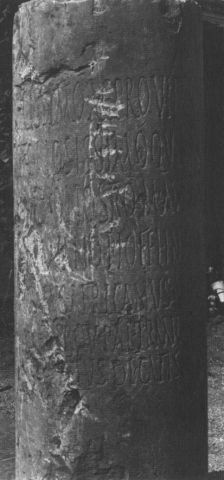
Columnar base for statue of Maximian, emperor. Caesarea Maritima (Palaestina I). 286-305
Record details
Photographs
Inscription
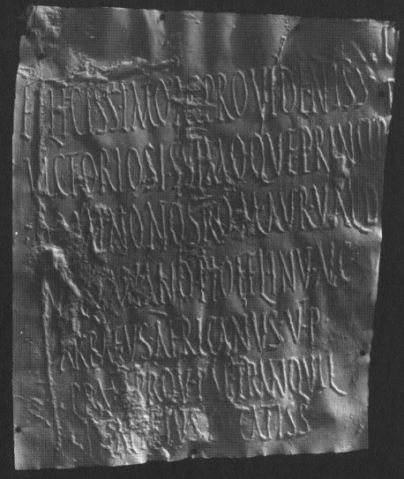
Felicissimo ac providentissimo, / victoriosissimoque princip(i), / domino nostro M(arco) Aur(elio) Val(eriano) / Maximiano, pio, fel(ici), invicto Aug(usto), / (5) Arbaeus Africanus, v(ir) p(erfectissimus), / praes(es) prov(inciae) Pal(aestinae), tranquil/litati eius dicatiss(imus).
Inscription translation
To the most fortunate and most prudent and most victorious emperor, our lord Marcus Aurelius Valerianus Maximianus, pious, fortunate and unconquered Augustus; Arbaeus Africanus, of perfectissimus rank, governor (praeses) of the province of Palestina, most devoted to his serenity, [set this up].
Bibliography
- Lehmann, C. M. and K. G. Holum, The Greek and Latin inscriptions of Caesarea Maritima, Boston 2000, 44-5 no. 9
Discussion
INSCRIPTION
In seven lines:
Felicissimo ac providentissimo, / victoriosissimoque princip(i), / domino nostro M(arco) Aur(elio) Val(eriano) / Maximiano, pio, fel(ici), invicto Aug(usto), / (5) Arbaeus Africanus, v(ir) p(erfectissimus), / praes(es) prov(inciae) Pal(aestinae), tranquil/litati eius dicatiss(imus).
'To the most fortunate and most prudent and most victorious emperor, our lord Marcus Aurelius Valerianus Maximianus, pious, fortunate and unconquered Augustus; Arbaeus Africanus, of perfectissimus rank, governor (praeses) of the province of Palestina, most devoted to his serenity, [set this up].'
Letter height 5 - 8 cm.
The inscription, with the honorand in the dative and the name of the awarder, displays the crucial features of Latin statue base inscriptions.
DESCRIPTION (from Lehmann & Holum and the published photo)
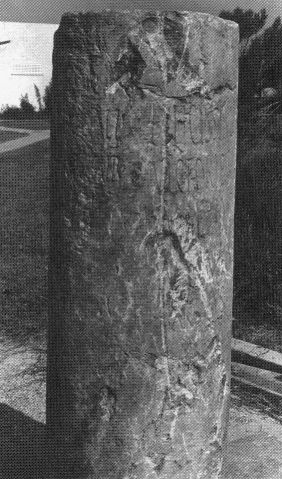
Column of purple and yellow limestone, without neck rings. H 118 cm, diameter 40 cm. The surface is smoothly finished; some cracks and chips slightly affect the inscription.
The column carries two inscriptions: the first by the city to a provincial governor of Syria (legatus Augusti pro praetore provinciae Syriae) of the 2nd century (cf. Lehmann & Holum pp. 6-7), and our inscription to Maximian.
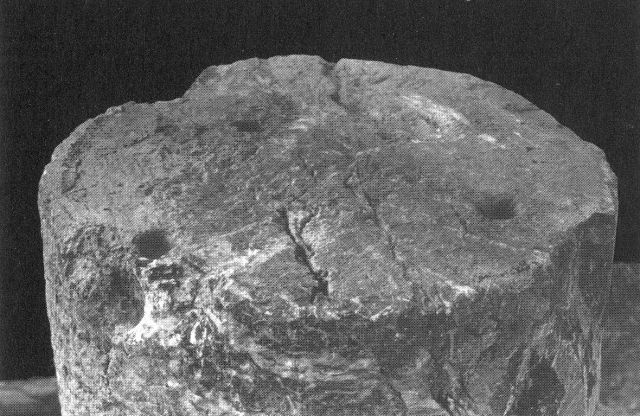
Three circular holes are cut into the top surface, which correspond to three circular holes cut into the shaft at the upper edge of the column. The cuttings on the shaft intrude into the first line of the earlier of the two inscriptions, and therefore must be associated with our (later) inscription. They may have served to connect a crowning element to the column, on which the statue of Maximian was set.
PROVENANCE AND CURRENT LOCATION
The column was discoverd in 1982 during agricultural work in the fields between the Byzantine Esplanade and the hippodrome in Caesarea (cf. map in Lehmann & Holum 2000, p. 5 fig. 4). Today in the courtyard of the Caesarea Museum (no published inv. no.).
HONORAND, AWARDER AND DATE
Maximian was Augustus 286-305.
Arbaeus Africanus, governor (praeses) of the province of Palaestina, is known only from this inscription (and has no entry in PLRE). He held office after the rank of the governor of Palaestina was changed, in the wake of provincial reforms, from that of a procurator to that of a praeses. An earlier governor, Clemens, who dedicated an inscription to Diocletian, is still a procurator (LSA-1090). Most of the provincial reforms were carried out some time in the 290s, but the exact date of each change is unknown. We have therefore kept the years of Maximian's reign as the outer dates for our inscription.
FURTHER DISCUSSION
It is a striking feature of the honorific inscriptions in Caesarea that many of them were carved on free standing columns (our inscription, LSA-11, LSA-12, LSA-1090, LSA-1105, LSA-1106, LSA-1107). There is no reason to doubt that these were statue bases, with statues set on top of the columns.
Cite: Last Statues of Antiquity, LSA-1100 (Ulrich Gehn).