
LSA-1102
Base for statue, possibly imperial. Novae (Moesia Secunda). 430
Record details
Photographs
Inscription
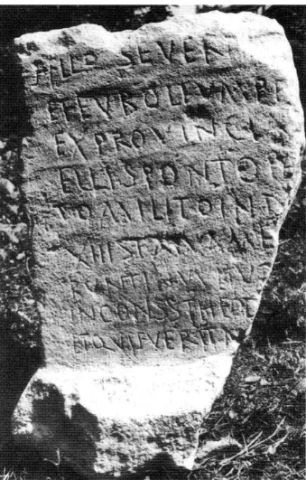
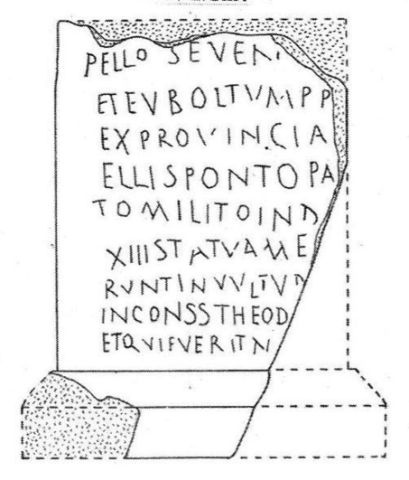
Pello Severi[inus ?] / et Eubolium, p(rimi)p(ilarii) / ex provincia / (4) Ellisponto, pa[s]/to milito, ind(ictione) / XIII, statuam e[rexe-]/runt in vultu D (or: P)[---], / (8) in conss(ulatibus) Theod[osi] / et qui fuerit n[unt(iatus)].
Inscription translation
Pello Severi(nus ?) and Eubolium, the primipilarii from the province of Hellespontus, after having finished their service (pasto milito), in the 13th indiction set up this statue in front of D (or: P).... during the consulship of Theodosius and whoever will have been named [for the West].
Bibliography
- Sarnowski, T., Drei spätkaiserzeitliche Statuenbasen aus Novae in Niedermösien, Mirkovic, M. (ed), Römische Städte und Festungen an der Donau, Belgrade 2005, no. 1
Discussion
INSCRIPTION
In nine lines:
Pello Severi[inus ?] / et Eubolium, p(rimi)p(ilarii) / ex provincia / (4) Ellisponto, pa[s]/to milito, ind(ictione) / XIII, statuam e[rexe-]/runt in vultu D (or: P)[---], / (8) in conss(ulatibus) Theod[osi] / et qui fuerit n[unt(iatus)].
‘Pello Severi(nus ?) and Eubolium, the primipilarii from the province of Hellespontus, after having finished their service (pasto milito), in the 13th indiction set up this statue in front of D (or: P).... during the consulship of Theodosius and whoever will have been named [for the West].’
Letter height 2-4 cm.
For a discussion of what 'in vultu D...' might mean, see LSA-1103.
DESCRIPTION (from Sarnowski 2005 and the published images)
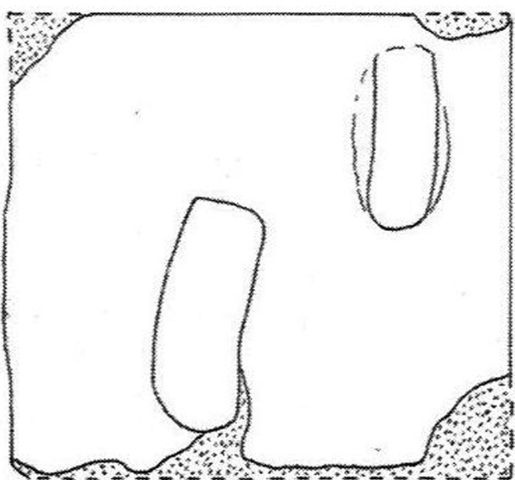
Rectangular limestone base, re-used from an altar or an earlier base, with mouldings at bottom around three sides. The lower right corner is broken off; the margins are chipped, and the moulding has several breaks. On the top face, the traces of the feet of a bronze statue are visible (L 18.5, W 6.5, D 2.1 - 3.1 cm).
PROVENANCE AND LOCATION
The block was found in 1996 re-used as a building block in a later building (of the late 5th to earlier 6th century) on the site of the former basilica principiorum in Novae (for a map of Novae see Sarnowski 1999, 56; for a ground plan of the principia ibidem p. 59 fig. 1; http://www.trismegistos.org/place/29656). It is today in the lapidarium of Novae, inv. no. 472/96 w.
HONORAND, AWARDER, AND DATE
The inscription is securely dated to the year 430, by the combination of a consulship of Theodosius II and a 13th indiction. The western colleague of Theodosius II of this year, Valentinian III, was obviously still unknown in Novae at the time the inscription was set up.
The awarders, Pello Severi(nus) and Eubolium (Eubolion? Eubolius?), were primipilarii. In Late Antiquity this is no longer the highest-ranking centurion of a legion, but a civilian office-holder whose duty was the organization of the food supply (pastus militus, lines 4-5) for the border-troops (limitanei). Pello Severi(nus) and Eubolium set up their dedication after they had finished their time in office.
The inscription does not tell us who was honoured by this inscription. Sarnowski 2005, 228, suggests an imperial person of the time, like Theodosius II, his wife Eudocia, or his sister Pulcheria. It is however strange that they are not named.
FURTHER DISCUSSION
From Novae two further statue dedications by primipilarii from the same period, and with similar inscriptions, have been published. This group of three bases (our base, LSA-1103, and LSA-2445), all for bronze statues, and all of the same late period, are quite exceptional for a military setting right on the frontier in the 430s.
These dedications and others by primipilarii of the 4th century in nearby Oescus (LSA-2596, LSA-2597, and LSA-2598) and also in Novae (LSA-2594) form a remarkable group. They obviously continue an older tradition fostered by the primi pili of the 2nd and 3rd centuries (Kolendo 1980; Kolendo 1988). There is no way of knowing at present whether this was a very localised phenomenon, or a more widespread practice along the Danube frontier.
Discussion references
- Kolendo, J., Le role du primus pilus dans la vie religieuse de la légion en rapport avec quelques inscriptions des principia de Novae, Archeologia. Rocznik Instytutu Historii Kultury Materialnej Polskiej Akademii Nauk 31, 1980, 49-60
- Kolendo, J., Les nouvelles inscriptions des primi pili de Novae, Archeologia. Rocznik Instytutu Historii Kultury Materialnej Polskiej Akademii Nauk 39, 1988, 91-103
- Sarnowski, T., Die Principia von Novae im späten 4. und frühen 5. Jh., v. Bülow, G. &- Milceva, A. (eds.), Der Limes an der unteren Donau von Diokletian bis Heraklios. Vorträge der Internationalen Konferenz Svistov, Bulgarien (1.-5. September 1998) , 1999, pp. 61-3
Cite: Last Statues of Antiquity, LSA-1102 (Ulrich Gehn).